
by Roseanna White | Oct 14, 2013 | Word of the Week
Nearly forgot it was Monday! LOL But lucky for you, I remembered. 😉 And so, I’m hear to talk about acute.
This will be a quick one, but I found it kinda interesting primarily because of my own weird thought-processes. See, when I was learning about angles back in middle school, I taught myself to remember that acute = under 90 degrees, because small = cute. So acute angles were small angles.
Worked well enough in math class…but not so well in vocabulary, LOL, when I began reading books that used acute in a non-math sense. When I first came across it, I naturally thought that “an acute case of the flu” meant a SMALL case of the flu.
Um, er…brilliant, Roseanna. Just brilliant. 😉
I quickly learned I was wrong, but I never bothered looking up why. As it turns out, it’s pretty simple. Acute in its math sense doesn’t mean “small.” It means “sharp.” Makes total sense, right? The Latin acutus is “sharp, pointed.” Interestingly, though, the original meaning in terms of a disease or whatnot was “coming and going quickly” more than “intense,” which didn’t come about until 1727. Between those two, though, was the expected “sharp, irritating” meaning that evolved by the 15th century.
Makes much more sense with the angle meaning than my “small.” 😉
_Detail.jpg)
by Roseanna White | Oct 7, 2013 | Word of the Week
Last week in the course of our homeschool day, somehow or another we got talking about what our different fingers are called, and my clever little Xoe asked me why the pointer finger is also called the index finger.
|
| Closeup from Michelangelo’s Creation of Adam |
Insert Mommy going, “Um…because…maybe…it’s the one you trail down the page of an index when you’re looking for something?” LOL. At which point I added, “Don’t believe that, I’m making it up. Let’s look and see.” And so we did. =)
Index has meant “the pointer finger” since the 14th century. It comes directly from Latin, and the literal meaning is “that which points out.” So of course, it makes sense for the finger…and it also makes sense for the index in a book, a meaning which came along by the 1570s. Old in its own right, to be sure! So while the two are very directly related, coming from the same meaning of the same word, one didn’t derive from the other, but rather from the root. So I quickly corrected my guess, LOL.
More derivative meanings (like “cost-of-living index” or “heat index”) come from the sense of “indicator” that the word carries and started popping up in the 1800s.
Hope everyone has a great week!

by Roseanna White | Sep 30, 2013 | Word of the Week
I’m back! All settled in (mostly) at the new house, with internet up and running–if you heard the “Hallelujah Chorus” ringing through the air last night, that was just me when my angel of a husband got it all set up. 😉
My search for a word of the week started with the last one I posted, “cool.” I kept scrolling down through the listings at www.etymonline.com, and soon I learned something!
Cucumber is from the Latin cucumerem, and may even predate Latin, believe it or not–this is one ancient veggie! 😉 In the 17th and 18th centuries, English speakers often spelled it cowcumber, and that pronunciation apparently lingered well into the 19th century, though the spelling had, by then, changed.
But of course, what convinced me that this vegetable is worthy of a Word of the Week is the phrase “cool as a cucumber.” That idiom came about around 1732. Ever wonder why? Well apparently folk knowledge said that cucumber fields were cooler than the air around them. Which would earn nothing but an “interesting…okay” except that in the 1970s scientists thought to question this old phrase. And what did they learn? That, indeed, the temperature in a cucumber patch is 20 degrees below the surrounding areas!
I had no idea. Honestly, I didn’t even know where the phrase came from. Pretty neat, eh?
Oh, and ATTENTION WRITERS!
For an upcoming article in the ACFW Journal, a friend of mine is running a survey at The Character Therapist on whether writers feel supported or unsupported by their spouses. The survey will be live at 6 a.m. CST today and will remain up for a month. If you’re a writer (with a spouse, I suppose, LOL), do go take the survey, and pass along the link to your writing friends!
https://www.roseannamwhite.com/2013/09/writers-quiz-is-your-partner-supportive.html

by Roseanna White | Sep 16, 2013 | Word of the Week
Thank you, Rachel Koppendrayer, for the inspiration for this week’s word in your comment last week. 😉
So cool has quite a fun history! Its primary meaning of “not warm” has been around since Old English days. No surprise there. And has also been applied to people who are unperturbed or not given to emotional demonstration for just as long.
But of course, we’re more interested in the slang uses. 😉 I had no idea that it’s been around since 1728 in its application to large sums of money to give emphasis–i.e. “a cool million.” And it’s also meant “calmly audacious” since 1825–had no clue about that one!
It’s modern meaning of “fashionable” is older than you might think, too, from 1933. It originated in black jazz circles but was in the common vernacular by 1940. Pretty cool, eh? 😉
But not as cool as this–check it out! Whispers from the Shadows was apparently one of the freebies given away at lunch yesterday at ACFW! Big thanks to all my friends who sent me texts and pictures of its appearances at conference, from the placard on the Harvest House table to this:
Makes me feel like I was there!

by Roseanna White | Sep 9, 2013 | Word of the Week
One of my historical writer friends asked about canteens a little while ago (namely, what they would have called them before they were canteens), which inspired me to look up the word.
Canteen is from the French cantine, which means “sutler’s shop.” Which I had to look up, LOL. Turns out a sutler is a person who maintains a store for the army, either by following them with provisions or having a shop within a camp. In this sense, the word entered English in 1710. There’s speculation that it’s a sense of the Latin canto, which means “corner”–that it’s a corner for storage.
The familiar sense of “container to carry water” evolved by 1744, also from a sense in the French, and used mainly by the military still, or campers. People on the move. The extended-from-the-first-definition sense of it being a “refreshment room on a campus or base” is from 1870.
Somewhat appropriate word choice today, as we’ll be traveling to Johns Hopkins for the last (hopefully) follow-up appointment for the elbow my little girl broke back in May. Prayers appreciated!
by Roseanna White | Sep 2, 2013 | Word of the Week
Leave it to Roseanna to browse through the dictionary for fun on the weekend. 😉 Sunday as I was beginning to think about the Word of the Week, I popped over to
www.etymonline.com and accidentally bumped the O section. Then thought, “Sure, go with it” and browsed through a few pages. Randomly clicked on page 11 and soon was learning something. =)
Operative as an adjective is from the 15th century, meaning “producing the intended effect.” The weakened sense of “important” (i.e., “challenge being the operative word in the speech”) is very new, from 1955. But it’s the noun version that intrigued me. =)
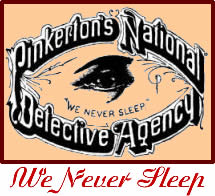
Since 1809 operative has meant “worker; one who operates.” Sure. No problem. But obviously the more interesting is its meaning of “spy.” I’d never looked up this one before, but it’s so right up my alley that I’m kinda surprised I hadn’t, LOL. This meaning came about around 1930, directly from the Pinkerton Agency. They would refer to their detectives as “operatives,” and since much of their work was undercover–spying–it was soon applied to any secret agent. Fun, eh?

_Detail.jpg)


 Roseanna M. White is a bestselling, Christy Award winning author who has long claimed that words are the air she breathes. Having successfully launched two homeschool grads, she now spends her time writing fiction, designing book covers, and pretending her house will clean itself. Roseanna is the author of a slew of historical novels that span several continents and thousands of years, as well as a fantasy series and contemporary mysteries and romances. Spies and war and mayhem always seem to find their way into her books…to offset her real life, which is blessedly ordinary.