
by Roseanna White | Dec 2, 2013 | Word of the Week
Hello, all! I hope everyone had a wonderful Thanksgiving week (for all you Americans out there. For all you internationals, I hope you had a lovely week too, even if it wasn’t a holiday for ya). 😉 You may think I was just relaxing and taking the week off from the blog, but really I was hard at work on the galleys for Circle of Spies, the final installment to the Culper Ring Series.
Today said manuscript is ready to go back into the hands of FedEx though, and so here I am back to blogging. =) And today I bring to you…
Swell. We think of it as a tiny bit old-fashioned these days (as in, more of The Greatest Generation than mine. Whatever my generation is. I think I shall dub it Generation Sarcastic), but not old. Right? It’s a swell party sounds decided ’40s or ’50s. But as a matter of fact, the meaning of “elegant or fashionable” dates back to 1810! And by 1897, it could mean generally “excellent.” American slang made it an exclamation that could stand alone in the 1930s.
 |
| These ladies look to be having a swell time at a South African beach in 1944 |
The adjective comes from a noun applied to a person with a distinguished style–so a swell could make or break a gathering, I suppose. Said noun dates to 1786.
And all of these come from the more literal meaning of “puffed up,” i.e. “arrogant.”
So there we go. Hope everyone has a swell day. =)
~*~
And while I have your attention–the next FREE novella/short story (not sure which it technically is at 11,000 words, LOL) in the Culper Ring Series, A Hero’s Promise, is up for pre-order! Click now and it’ll be delivered to your device on January 1. (It will also be on iTunes and B&N, but those links aren’t live yet.)
by Roseanna White | Nov 18, 2013 | Word of the Week
First of all, I did do the drawing last week for the winner of the digital of one of the Ellie Sweet books, and the lucky duck was
Kirstin Whitener!
Congrats, Kirstin! I know you’ll love them!!
This week I’ll be starting a giveaway for a signed paperback of The Unlikely Debut of Ellie Sweet, so if you were holding out for the hard copy, stop back by later!
And now on to our word of the week. =)
Any historical writer knows that a big challenge in writing authentic dialogue is trying to find era-appropriate exclamations…especially when writing for the Christian market and wanting to avoid any that venture toward cursing. And one can only use “blast it” so many times, LOL. I’ve looked up a lot of these over the years, and figuring out their etymology is always fun.
|
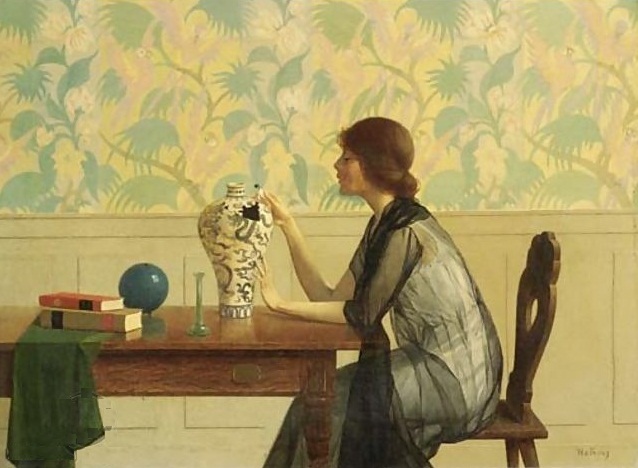
| The Broken Vase by Harry Watrous, circa 1900 |
Today, we’re taking a look at dash, which I have used a time or two. The verb dash dates from about 1300 and comes from a Danish word that means “to beat, to strike.” And so, the oldest English sense is of something getting “dashed to pieces”…including the metaphorical “dashed hopes.” Around the same time, it also took on the transitive sense of “to move quickly,” which lead to the noun by the late 1300s.
Round about 1726, it began being applied to hurried writing (to dash a letter to someone…), but it took until 1881 for it to be applied to a race, originally one run in one heat.
And now back I go to dash a few more words into A Soft Breath of Wind before it’s time to start school. 😉

by Roseanna White | Nov 11, 2013 | Word of the Week
Last night my poor little Rowyn had a toenail come off (ouch!), and his papa said that that surely deserved as much consideration as losing a tooth. So Rowyn got to pick dinner. Hence how the White family ended up eating waffles, macaroni and cheese, and grapes, LOL.
And hence why I thought to look up waffle this week. 😉 It’s pretty interesting!
The waffle we know, love, and eat comes directly from the Dutch wafel, which comes in turn from a very, very old German word, wabila, which means “web, honeycomb.” It made it into English by 1744–and waffle iron in 1790! I had no idea they were that old.
But then there’s the verb, the one that means “to vacillate.” I’ve always wondered what in the world that had to do with a tasty breakfast food. Turns out, NOTHING. They’re from completely different roots. Waffle, the verb, came around in the 1690s as an imitation of a bark or yelp (like “woof”). By 1701, it meant “to talk foolishly.” That’s the meaning that led, a hundred years later, to the one we use today. It was first used in Scotland and northern England…while the Dutch deliciousness was making
its way to us from a different direction. 😉
~*~
Now onto some business! The Veterans Day Sale on
Ring of Secrets and
Whispers from the Shadows will be over on Tuesday, November 12, at 11:59 p.m., so if you’re looking for that perfect time to buy a digital, it’s here!
And don’t forget that I’m running a giveaway for a few more days of one of my favoritest books, The Unlikely Debut of Ellie Sweet (or the first book, The Revised Life of Ellie Sweet, if you haven’t read that one yet). These books are amazing! Check out the giveaway here.

by Roseanna White | Nov 4, 2013 | Word of the Week
I called Xoe chum last week, and she gave me such a look! LOL–she only knew the word as “fish food,” apparently. (Thanks, Spongebob. Really.) I had to tell her that it meant “friend” too. And then, of course, had to look it up to see where these two very-different meanings came from.
Chum has meant “friend” since the 1680s, by far the first of these two meanings. It originated among university students, used with their roommates–an alternate spelling of cham, which was short for “chamber-mate.” (Who knew?) Apparently in the late 17th century, clipping words like that was a big fad. (Again, who knew??)
The “fish bait” meaning didn’t come along until the 1850s, and the best guess is that it’s from the Scottish chum that just means “food.” So no correlation at all between these two, which are from different languages entirely.
The things we learn when our kids look at us funny… 😉
Happy Monday, all! I get to start on edits for
Circle of Spies today with my editor, so I’m pretty excited. =) After, of course, taking my kids to science club this morning. And then this evening, hubby and I are going to see
Ender’s Game, which is also exciting! It’s been his favorite book since he was 12, so this is a Big Deal in our house, LOL. Hope everyone has a great one!
by Roseanna White | Oct 28, 2013 | Word of the Week
This classifies as another word that I knew was new, but didn’t know was that new.
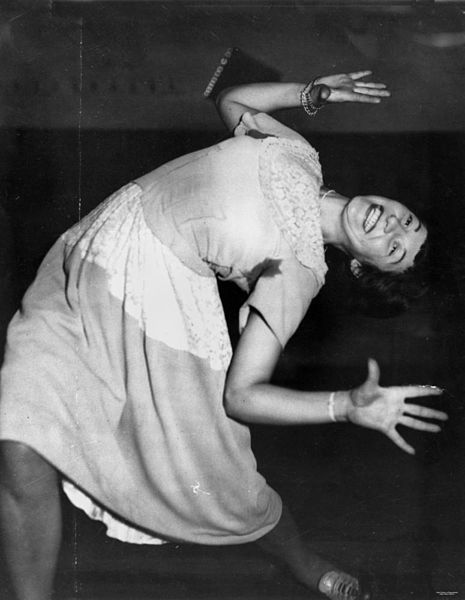
Jitters entered English round about 1925–and it’s not entirely clear where it came from. The best guess is that it’s a variation of chitter, which had been a dialectical word for “tremble, shiver,” since Middle English.
|
| The jitterbug, 1947 |
It took it another 6 years for the ‘s’ to get dropped and the noun to become a verb–to jitter. And another 7 for the jitterbug dance to join the scene. Still, that’s a lot of evolution for just over a decade!
And as cold as it is here this morning, there could easily be some jittering going on. 😉

by Roseanna White | Oct 21, 2013 | Word of the Week
Saw this one when I was looking up acute from last week. 😉 If you recall, acute technically means “sharp.” And so it’s not great stretch for it to be applied to mental acumen as well as angles or illnesses.
What I didn’t realize is that cute is a direct shortening of acute, and its first meaning, in 1731, was “clever.” I’ve heard it used this way, but I had no idea it was the first and primary meaning.
Around 1834, American college students began taking the word and applying it to physical attributes, not just mental ones. And so cute moved from “clever” to “pretty.”
So there we are at the meaning we use most today, which leads us to clever little things our kids say, like Rowyn (5) claiming, “I’m not handsome yet, Mommy. I’m still cute.” 😉
Happy Monday!



 Roseanna M. White is a bestselling, Christy Award winning author who has long claimed that words are the air she breathes. Having successfully launched two homeschool grads, she now spends her time writing fiction, designing book covers, and pretending her house will clean itself. Roseanna is the author of a slew of historical novels that span several continents and thousands of years, as well as a fantasy series and contemporary mysteries and romances. Spies and war and mayhem always seem to find their way into her books…to offset her real life, which is blessedly ordinary.