
by Roseanna White | Jan 31, 2018 | 17th-19th Centuries, 20th Century, Remember When Wednesdays
I thought it would be fun to take a quick look today at Willa’s violin…or, rather, violins in general, and some info that appears in A Song Unheard about this beautiful stringed instrument.
Violins and other stringed instruments like them began appearing in the 1500s. They were invented in Italy, and some of the first evidence we have of their existence is from paintings by Gaudenzio Ferrari.
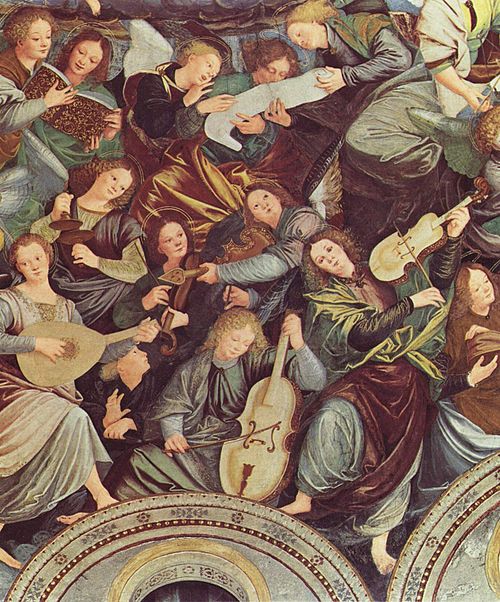 |
Glory of Angels by Gaudenzio Ferrari.
Not to be confused with Enzo Ferrari.
Or, you know, other painters with the same surname.
|
There also exists a treatise written in 1556 that details the string family as we know it now.
Willa, of course, didn’t know all this history. What she did know was that Stradivari was always heralded as THE luthier whose instruments everyone wanted to own. That’s certainly true today just as it was a hundred years ago.
It’s only been recently, however, that scientists have discovered
why Strads sound better than other violins. I happened to catch a documentary on this just before I began writing
A Song Unheard (thank you for that, Lord! LOL), which obviously proved useful. 😉
So the secret to the amazing sound of these instruments? The Little Ice Age.
Yep. See, these drastically colder temps resulted in trees’ growth drastically slowing. If you recall your middle school botany, you know that each year trees add a ring of growth, hence how we can count a tree’s age with a cross-section. Well if you’ve ever seen the stump of a really, really old tree, you’ll have noticed that some rings are very wide and others very narrow. The wide rings are the years that were perfect growing years–nice temps, good rain, lots of sun–and the narrow rings are harsher years.
During the Little Ice Age, trees couldn’t grow very much. So the rings were narrow, and the wood, therefore, was very dense. The forest from which Stradivari sourced his wood was full of Little Ice Age trees, whose wood was heavy and dense. Meaning the instruments, while the same size as others made from different wood, would be a bit heavier and denser, and that of course effected the sound.
Now, this is a relatively new discovery–certainly not something they knew in 1914. But I wanted to hint at it, so I had Willa observe several times that Lukas’s Strad felt heavier and more substantial than the battered, cheap instrument she’d rescued from a rubbish bin.
She got up again and strode to the
wardrobe. Not set on grabbing a hat for the trek she had to make, but to pull
out that battered violin case. She set it on the bed and extracted the
equally-battered violin.
Poor thing. It looked like a rag
next to the memory of the Stradivarius she’d held last night. Dull and scarred
and . . . lighter, even, as if the wood were too thin. Perhaps it was. Still,
it was one of her oldest friends, and her fingers caressed the familiar curves
and corners, ran along the strings.
~ A Song Unheard, Chapter 6
Do you play an instrument? Or is there one you particularly enjoy listening to? One you’ve always dreamed of owning?
I’m a piano player, so I may occasionally drool over baby grands…though not the newfangled electronic ones. Those are just WRONG. 😉

by Roseanna White | Jan 29, 2018 | Word of the Week
Today’s Word of the Week is a special request from Lynne F. (and as a reminder, if ever you have a word you’d like me to look into, please feel free to let me know and I’ll add it to my list!).
Nurse is rather interesting, in that the noun and verb forms evolved a bit differently. The oldest form of this word is nurrice, which dates from the 1100s, meaning a “wet-nurse or foster mother to a young child.” This word was borrowed directly from the French, which came in turn from the Latin nutricia (wet nurse) which in turn is a variation of the Latin word for “suckle.” Look familiar? This is the same root from which we get nourish and nutrician.
The extended meaning of “one who cares for a sick person” evolved rather naturally from the idea of “one who cares for a child,” but it took quite a long while to do so! That noun didn’t enter English until 1580. And the verb form, “to care for the sick” is from 1736! (I had no idea that was so late!!)
As for the verb meaning “to suckle an infant,” that’s surprisingly late to the game as well, though not as much as the one mentioned above. This dates from the 1530s and is a Middle English alteration of a similar word, nurshen, which is taken from the same root but had previously been pronounced differently.
So there we have it. Our modern member of the medical community derives its name from women caring for children. =)

by Roseanna White | Jan 25, 2018 | Thoughtful Thursdays
I totally stole the title inspiration for this blog…from the other person embarking on this adventure with me. 😉 I think she’ll forgive me. (
Check out her post here)
So, a few weeks ago my husband said, as he has said many a time before, “You need an assistant. You should really consider hiring someone.” In the past, I always just waved off that suggestion because…well…I don’t know. Because figuring out how to delegate work is work in and of itself, I guess.

But I’m staring down the barrel of quite a lot of deadlines, and this time the advice really hit home. I
do need an assistant. Someone to handle some of the minutia of book releases and promotions, to help keep me on schedule and do some of my scheduling. Someone who can handle the non-creative parts of my job, so that I can focus on the creative parts.
The next morning, I shocked my husband by putting together a list of things I could have an assistant do, and posting to my launch team that I was looking for someone. To my mind, who better to go to first than the readers who are already my cheerleaders and promoters?? I was shocked to get a big response from my post. I thought I might get one or two interested people, who may or may not be serious. Instead, I was flooded with emails from a collection of wonderful, gracious people with experience and a passion for helping authors.

After a whole lot of prayer and quite a lot of emails, I’ve hired Rachel Dixon as my virtual assistant, and I’m so excited to begin this new chapter with her! Maybe most people wouldn’t feel the need to post about hiring someone, LOL, but I do. Because the way I view it (and the way Rachel views it, hence why she was a good match for me) is that what we’re doing is building a team. We’re working together toward a common goal. Serving authors as an assistant is Rachel’s calling, and serving readers as a writer is
my calling. So the fact that we can work side by side for the Lord…well, that’s pretty awesome.
So to Rachel, welcome to the team–your heart for this work really touched me, and I’m super excited to be working with you!
To my readers, I know this move is going to help me get more, better stories to you, and also allow me to be more interactive.
I can’t wait to see where the adventure takes us. Here’s hoping and praying it’s to new heights in faith, friendship, and productivity. ?

by Roseanna White | Jan 24, 2018 | Books, Cover Designs
Time for another peek behind the cover design process! This time, I’m featuring one that won’t be all that involved. As designs go, it was pretty simple. Which is why I’m featuring it today, as I’m short on time. 😉
Rachel McMillan is best known for her historicals, but she occasionally puts on a contemporary novella, and I’m always thrilled when she comes to me for the cover. =) Last year I designed a cover for a Christmas novella duo in which she and Allison Pittman each wrote a story.
This year, Rachel has Love in Three Quarter Time releasing on Valentine’s Day.
Her wants were pretty simple. The heroine, face not visible, and Vienna in the background. She gave me some great photos for inspiration and even the name of a few buildings she’d like to see on the cover. And as a comparable cover, she recommended this (and other covers for Carla Laureano):
Armed with nice, decisive information like this, I hit Shutterstock with confidence. It’s always so much easier to design a cover when the author knows exactly what they want!
My first hunt was for a model that fit the description of Rachel’s main character. Rachel described her as having shoulder length dark hair, cut in a curly bob. She tends to wear turtleneck sweaters, knee high boots, tweed, cardigans…”classic librarian.” I went searching for such lovely ladies with their faces averted and happened pretty quickly upon this one.
Not bad! Happy with that as a starting place for Evelyn, I next turned to images of Vienna. Anything from historical Vienna would do, but I began by looking for images of the Staatsoper (opera house), upon Rachel’s recommendation. And there were some GORGEOUS photos of this building at sunset. This is the one that caught my eye.
Putting the two together was pretty simple. The only real tweaks I had to make were to delete a few flyaway hairs and add some lighting to the model, which gave me this.
I wanted to punch the lighting up a little bit though, so I added the Hudson filter…
Satisfied that this was a good base, I added some faded color layers to give me a good place for the words…
And then added the title and author. Now, I’d just purchased this super-gorgeous font called Monstera that I was dying to use…especially since I’d FINALLY figured out how to access all the pretty alternates (I’m embarrassed by how long it took me to actually read the how-to included with all these fonts I’ve downloaded. For reference, on a PC, hit the Start button and type “Character Map.” Click on that, and up will pop a screen like this…
Just click on the version of the letter you like, click Select, and then Copy, and paste directly into where you want to use it–in my case, the text layer in Photoshop. Ridiculously simple.)
So as you can see in the image above, I played around with the various forms of each letter until I landed on this.
This was almost, almost there. But I wanted a little something more. A flourish. Something to pull the music theme of the title (Vienna is where the waltz originated) into the cover. So I found this pretty little musical flourish…
I put my choice of this set behind the title, and it added just the touch I was looking for! I showed it to Rachel, and she declared it exactly what she was looking for. Yay! So here’s the final:
So here’s some more about the story.
A romantic waltz through a city filled with music, passion and coffee.
Evelyn
Watt fell in love with Austrian marketing director Rudy Moser the
moment he stepped into their Boston firm. With his ice blue eyes and
chocolate-melting accent, he is as refined as she imagines his home
country to be. When Evelyn finds herself unexpectedly unemployed right
before Christmas, she is left with an unknown future until Rudy steps in
with a job appraising, assessing and cataloging heirlooms, lending her
American vernacular to the translated descriptions to give each item
international appeal. Evelyn will live in Vienna for the months leading
up to a grand auction at a party held in conjunction with the Opera
Ball—on Valentine’s Day.
Vienna is a magical blend of waltzing,
antiques, and bottomless cups of Einspanner coffee at the Café Mozart.
When a secret from Rudy’s family’s past blows in with the winter chill,
Evelyn is forced to confront how well she knows the object of her
affection. Her café tablemate, the gruff and enigmatic Klaus Bauner
might be the only person who holds the key to Rudy’s past. But could
that key also unlock her future? In the days leading up to the Opera
Ball, Evelyn finds herself in the middle of the greatest romance of her
life…as long as she doesn’t trip over her two left feet.
You can pre-order this from Amazon now, and it’ll download to your Kindle on 2/14!
What do you think of the cover? Do you like the feel? The setting, the face-averted heroine?

by Roseanna White | Jan 22, 2018 | Word of the Week
I’d noticed when reading historical work–either original or fiction–that recipe and receipt were often used in ways that we today would deem, well, flipped. But I’d never really paused to look it up.
I’m glad I just did, because I learned something!
We’ll start with recipe. Coming from the Latin word of the same spelling, which means “Take!” (a command), it came into English in 1580 as the word for “a medical prescription.” Literally, what the doctor was ordering you to take. (Who knew?!) This is (what I learned today) where the abbreviation Rx comes from. It took on a figurative sense (“recipe for disaster” etc) round about 1640. So when, you may be asking, did it come to mean “instructions for preparing food”? Not until 1743! I had no idea our primary meaning of the word is so relatively new!
So what did people call those instructions for food prep before they called it a recipe? Receipt. This word, borrowed from Old North French, has been in use in this way since the 1300s. It’s literally “a statement of ingredients in a potion or medicine.” As “a written acknowledgment of goods received,” it dates from 1600ish.
Any recipes you’ve been dying to try, or a favorite you’d like to share? I’m going to be hunting up the ingredients to make this chili con carne one of these days… And if you’re in the mood for some utterly scrumptious, light and fluffy and a-mazing homemade dinner rolls, this is the only recipe you’ll ever need…



 Roseanna M. White is a bestselling, Christy Award winning author who has long claimed that words are the air she breathes. Having successfully launched two homeschool grads, she now spends her time writing fiction, designing book covers, and pretending her house will clean itself. Roseanna is the author of a slew of historical novels that span several continents and thousands of years, as well as a fantasy series and contemporary mysteries and romances. Spies and war and mayhem always seem to find their way into her books…to offset her real life, which is blessedly ordinary.