
by Roseanna White | Mar 3, 2014 | Word of the Week
 |
Practice Makes Perfect
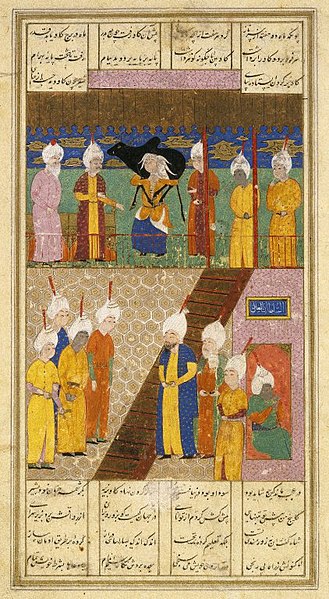
from a “Haft Paikar” of Nizamic. 1530 |
I’m surprised I haven’t thought to look up the history of this word before, given that I come from a family of perfectionists. 😉 I personally display such tendencies with some of my work, but not all…certainly not my housework, LOL.
But it’s a pretty interesting word!
Perfectionist has been around since the 1650s, but it had only a moral connotation. It was very much a theological stance, proclaiming that one believed that moral perfection is attainable in this life. So this isn’t something that anyone would use for anything other than this theological question. It was rather one that would be applied to certain preachers or theologians.
So this is really another one for the trivialization file. In the 1930s–so very recently!–it took on the meaning we know of one satisfied only by the highest standards. And that’s when perfectionism came around too.
And for anyone looking forward to Circle of Spies, you’re going to want to make sure you stop by on Wednesday–I’ll be posting the first chapter!!
by Roseanna White | Feb 24, 2014 | Word of the Week
|
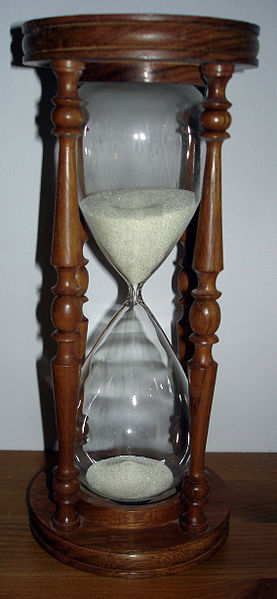
| Image by Martin Olsson |
For some reason, I had this image of an hourglass being really, truly ancient. Like Ancient Egyptian kind of ancient. I’m not sure where that idea came from…probably some movie, LOL. Or maybe just the idea of the sands of time obviously being linked to those desert places…
As it turns out, hourglasses are pretty darn old, but nowhere near ancient. The word–and the device–originated round about 1510. And so, you’d think that an hourglass shape would have come not long after, right? It’s pretty distinctive. And applies so well to the female form, that surely someone made the connection early on. Right?
Wrong. According to etymonline.com, no one thought to call a woman’s figure hourglass until 1897, after corsets had been exaggerating those shapes for half a century. Here’s one of the first written mentions of it:
Men condemn corsets in the abstract, and are sometimes brave enough to
insist that the women of their households shall be emancipated from
them; and yet their eyes have been so generally educated to the approval
of the small waist, and the hourglass figure, that they often hinder
women who seek a hygienic style of dress. [Mary Ashton Rice Livermore,
“The Story of My Life,” 1898]
And since the sands are flowing and I have a book to finish writing today (woot!), I say farewell!

by Roseanna White | Feb 17, 2014 | Word of the Week
|
Now this is fantastic!
C&E Dragon by David Revoy |
One thing I often flag when I’m editing and have to think about when I’m writing are those words that we use today in a rather un-amazing sense. Words that have come to mean an ambivalent “okay” or “nice.” Words that used to mean a whole lot more.
The first one is fantastic. This is a word we commandeered to mean anything
great or amazing. But it began with a very specific sense of “that
belonging to the world of fantasy; imaginary.” It wasn’t until 1938 that it was trivialized to mean “wonderful, marvelous.”
Next is fine. Fine has become a meaningless answer to the question “How are you?” We all reply “Fine.” It’s therefore taken on a “Meh” connotation. Sure, we still use it in a more pointed sense when talking about a fine point on the tip of our marker, but in general? I think if you ask most kids what the word means, they’d say it’s a synonym with “okay.” So-so. All right.
But of course, when we think about it, we realize that fine actually means “unblemished, of superior quality.” Hence why in England it became an expression of unmitigated approval. Which we then took and overused until it ceased to mean much of anything, LOL. So next time someone asks you how you are, only say “fine” if you mean it. 😉

by Roseanna White | Feb 10, 2014 | Word of the Week
We have so many beautiful color names, that all describe beautiful shades–which surely existed forever, right? Maybe…but the words sure didn’t! So today, a few quick lessons on when some of those shade names joined the English language. =)
|
| Indian Pigments (image by Dan Brady) |
Cerulean is for the blue-green family, and dates from the 1660s. So we historical writers will want to use that one instead of…
Teal – not used for a color until 1923! Before that, “teal” just meant a small duck, whose head is said color. We took the color name from the duck name, not the other way around.
Fuchsia, which I can NEVER spell without the help of a dictionary, was the name of a plant in the 1700s, but didn’t get applied to the reddish-purple color in general until 1923.
And don’t think you can instead use magenta! Magenta was so-called in honor of a battle in a town called Magenta in Italy in 1860, where a rich dye was discovered soon after the fighting ended.
Turquoise – again, the stone has been known and named a goodly while–since the 1560s. But it wasn’t used to describe the color until 1853.
Lavender has the same story. The plant has been a word since the 1300s, but apparently people didn’t use it for the color until 1840.
Aubergine is an eggplant–the original word for it. The deep purple color we associate with eggplant was also first called aubergine (the first veggie called “eggplant” was apparently a white variety, oddly…). But keeping in this pattern, it wasn’t actually applied to the word until 1895.
Okay, that should do us for today. 😉 Have a colorful one!

by Roseanna White | Feb 3, 2014 | Word of the Week
First of all, my apologies to anyone who missed my Thoughtful Thursday last week–I was taking a sick day. Just a cold, which I’m happy to say didn’t get as bad for me as it did for my hubby. Not that I’m happy it involved a fever for the hubby–you know what I mean. 😉
Anyway! A new week, and on we go to our feature word. So go ahead. Ask “Why in the world are we talking about doorknobs??”
Well, I’ll tell you. Because until 1847, we wouldn’t have been. That’s right–doorknob is only 167 years old! Which is darn new, considering how old doors are. 😉 But up until the 19th century, most doors used latches or handles rather than knobs. In fact, the knob we know and love wasn’t patented until 1878.
Who knew, right? 😉 So we historical writers better be sure to never have our medieval heroine carefully turning the knob and sneaking into a room. Just sayin’.
Happy February, all!
.jpg/425px-Illustration_of_revolving_stairs_(U.S._Patent_25,076_issued_to_Nathan_Ames,_9_August_1859).jpg)
by Roseanna White | Jan 27, 2014 | Word of the Week
|
| Patent diagram of the first escalator (“revolving stairs”) – 1859 |
This one got me. I admit it. I looked it up during edits on a WhiteFire book because I wasn’t sure it was quite early enough in the sense used. And what do I find? A surprise!
Escalate is new. Darn new. As in, from 1922–and that’s in the literal sense. It’s actually a back-formation of escalator (from 1900). Before that, the verb had been escalade. Not so different a word, right? Except that escalade has exactly one meaning: “to use ladders to scale a fortified wall.” Yeah, um…not how I use escalate!
So what of that meaning? The “to raise,” or “to intensify” meaning? Well…that didn’t come around until the Cold War! 1959 to be exact. I had no idea it was so new!



.jpg/425px-Illustration_of_revolving_stairs_(U.S._Patent_25,076_issued_to_Nathan_Ames,_9_August_1859).jpg)
 Roseanna M. White is a bestselling, Christy Award winning author who has long claimed that words are the air she breathes. Having successfully launched two homeschool grads, she now spends her time writing fiction, designing book covers, and pretending her house will clean itself. Roseanna is the author of a slew of historical novels that span several continents and thousands of years, as well as a fantasy series and contemporary mysteries and romances. Spies and war and mayhem always seem to find their way into her books…to offset her real life, which is blessedly ordinary.