
by Roseanna White | May 5, 2014 | Word of the Week
Short but sweet one today. =)
I grew up with a perfectionist for a father, so it’s a word I’ve known for, oh, ever. I too can be a perfectionist in a lot of things (housekeeping not among them, ha ha). Never had I thought to look up its etymology, though, until I came across it in a manuscript set in biblical days. I’d already learned that most of those “isms” we know so well came out of the psychological revolution.
Perfectionist has a different but similar story. The original meaning of the word, dating from the 1650s, is actually “one who believes that moral perfection is attainable in this life through faith.” A button topic for millennia, LOL. If you believed that, you were a perfectionist. If you didn’t, then you weren’t.
It wasn’t until 1934 that the modern meaning came around–“one who is satisfied with only the highest standards.” Pretty different! No longer is a word that has to do with theological debates, but now it’s about measurable standards.
Who knew?

by Roseanna White | Apr 21, 2014 | Word of the Week
I’ve watched a lot of historical shows and movies (shocker, right?). And I’ve also studied enough historical dialect that I can tell when they get something wrong (well, a lot of the time). And in so, so many, I’ve heard one character demand of another, “Shut up!”
Perfectly reasonable, right? I mean, why wouldn’t it be? Is there any better way to interrupt somebody mid-argument? LOL.
Last night I was watching Turn with my hubby, and there was an intense showdown between Tallmadge and a few would-be deserters. And in the midst of their arguing, one of said deserters shouts, “Shut up!”
I held my tongue until the commercial. Then had to say, grin in place, “That wasn’t actually in use until the 1840s.” I knew. I’d looked it up at least once for every book I’ve written, LOL, just
waiting for it to be usable! It certainly wasn’t in
Ring of Secrets, which shares that setting with
Turn.
Insert my hubby laughing at me. 😉
But it’s true. While shut one’s mouth has been around as an expression that refers to the cessation of speaking since the 14th century, shut up has, er, NOT. In face, it didn’t even start to trickle its way into English until 1814. And even then, it wasn’t a command, but rather a reference. As in, “The loud noise shut up the speaker.” The sense in which we use it didn’t come around until 1840.
So unfortunately, Tallmadge probably wouldn’t have had a clue what that command meant. 😉 But that’s okay–it was a fun episode, and I love knowing random trivia like that, LOL.

by Roseanna White | Apr 14, 2014 | Word of the Week
On our writing retreat, Stephanie and I were working on books that took place within 15 years of each other. This is pretty new for us, LOL, and we had some fun conversations on what words were around back then. Our motto–“Surprisingly modern.”
 |
The Snark Banker, illustration by Henry Holliday
from Carroll’s “The Snark Hunter” |
One of our favorite discoveries was snarky. This is a word writers use All. The. Time. Because, let’s face it, so many of us are “irritable, short-tempered” artists, LOL. And it can be so much fun to write characters who are the same. Apparently it’s not so widely-used a word in larger circles, but come on. It totally should be. 😉
Snarky has been around since 1906 (which means I can totally use it in my 1910-1911 book! Woot!) with the above meaning. The verb snark actually dates from 1882, meaning “to nag or find fault with.” Which in turn comes from the noun (1866) that means “snort.” (From the same root as snarl.)
Interestingly, Lewis Carroll actually coined the word as an imaginary creature in 1876. His snark is unrelated to snarky, though there has sense been a back-formation that gives snark the meaning of “caustic, opinionated rhetoric” that we writers so love. 😉
On a completely unrelated note, in remembrance of Holy Week, I’m offering the Kindle version of A Stray Drop of Blood, which pivots around the crucifixion, on sale for only $0.99 cents! So if you’ve been waiting for the perfect excuse to buy my debut novel, you won’t find a better one. 😉 Through this Sunday, 4/20/14, only.
And pleas share the link!
by Roseanna White | Mar 24, 2014 | Word of the Week
Last night I ate an orange. (I know–groundbreaking news, right? LOL) At which point Xoe came in and exclaimed over how lovely my hands smelled. Which prompted her cheeky question of, “Mommy, did you get new cologne?”
I, naturally, said, “Now, now. These days cologne is reserved for what men wear, and women wear perfume.” And thought, Mostly. Although it used to be…
While I was thinking thus (ahem, LOL), my hubby thought it would be funny to say I was wearing “eau de toilette.“
Need it even be mentioned that our darling daughter dissolved into laughter and, upon getting the translation of “toilet water,” asked why in the world perfume was ever called that?
I then had the pleasure of educating husband and daughter both. 😉 Granted, I was halfway making it up. But I was right. So there.
|
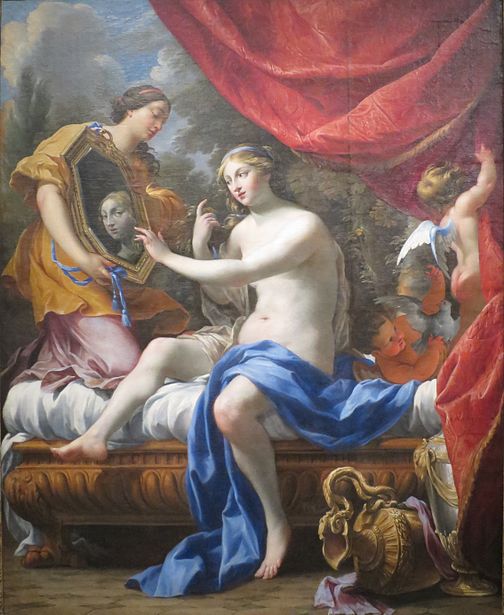
Toilet of Venus (no, not THAT kind!) by Simon Vouet
circa 1628-1639 |
The English toilet has pretty much followed the evolution of the French toilette through the ages. First, it meant “cover or bag for clothes.” So, a garment bag. This first meaning, which made its way to English in the 1530s, was from the French toil–cloth. In the late 1600s, it took on the meaning of “the act or process of dressing.” Another 120 years passed, and it became the word for the room in which you do that dressing, especially one with a lavatory attached. Then, and only then–70 some years later, in 1895–did it get attached to the lavatory and its fixtures instead of the dressing room. And yes, that euphemism is also an Americanism.
So really, it’s a very lovely word that we first used to pretty-up a not-so-lovely room…and by which we managed to make into an ugly word. Sigh. Sorry, toilette!

by Roseanna White | Mar 17, 2014 | Word of the Week
 |
| A Cool Retreat by John William Godward, 1910 |
I have a writing retreat quickly approaching, and I am getting a little giddier at the thought with each passing day. =) But of course, I then have to pause and consider the word, because I’m just that kind of nerd, LOL.
I wasn’t surprised to learn that the typical definition of retreat is very old. The noun, meaning “act or retiring from action,” dates to the 13th century. The verb, oddly, took another 200 years to join English. But what I found really interesting is that my kind–“a place of seclusion”–dates from the 15th century! I had no idea it was that old. It had gained religious connotation by the 1750s.
To change the subject, I spent my weekend in VA Beach, celebrating with my critique partner, Dina Sleiman, her 3-book deal with Bethany House. And when hubby and I got home (after driving through a blizzard), I found these waiting for me!
The Dutch version of Ring of Secrets! This is my first Dutch-translated book, though many, many of my friends’ books have been translated, so it’s pretty cool. =) The title in Dutch translates as Mask of Innocence. I was hoping for a “mask” title in the series, so that’s awesome!!
by Roseanna White | Mar 10, 2014 | Word of the Week
It’s always fun to trace these words that have become names kids call one another…and eventually a banner of pride, LOL.
|
| Photo by Tommy Hancher |
Geek traces its origins back to 1510, surprisingly–and was even used by Shakespeare! The meaning has changed over time, though. Originally it meant “a fool, a simpleton.” Within twenty years, it was applied to contemptible people in general. In the early 1900s the circus folk adopted it to mean “a sideshow freak.” Still, it took quite a while longer to be applied to that particular brand of person awkward in the social graces but up on computers–our geek didn’t gain the name until 1983. So this is a word both very old and very new!
Nerd is even funnier. It’s thought to be a variation of nert, which was 1940s slang for “stupid or crazy person,” but it didn’t really gain in popular use until Dr. Seuss used it in “If I Ran the Zoo.” Seuss’s nerd was a small, unkempt animal, and that, interestingly, is where the modern take comes from.
And now they both have such particular definitions that each will proudly claim his own title but be very offended if you call him the wrong one. 😉



 Roseanna M. White is a bestselling, Christy Award winning author who has long claimed that words are the air she breathes. Having successfully launched two homeschool grads, she now spends her time writing fiction, designing book covers, and pretending her house will clean itself. Roseanna is the author of a slew of historical novels that span several continents and thousands of years, as well as a fantasy series and contemporary mysteries and romances. Spies and war and mayhem always seem to find their way into her books…to offset her real life, which is blessedly ordinary.