
by Roseanna White | Jul 15, 2013 | Giveaways and Contests, Word of the Week
Wow, halfway through our month of giveaways already!! How did that happen? LOL. We’ve had lots of winners already (most recently Kelsey Shade Perkins and bn100!), and just as many still to come! Remember, every day I’m doing a drawing for Ring of Secrets, book 1 in the Culper Ring Series, to celebrate the release on August 1 of book 2, Whispers from the Shadows.
And if you’re new to my books, you can get a free taste! Fairchild’s Lady is a free novella that comes chronologically between books 1 and 2, but which is a stand-alone. So download it today to see if you like my style!
Available from:
Amazon, CBD, B&N, iTunes, and GooglePlay
And our bonus prize this week is this beautiful Tea Light Garden by Elements. The drawing for that will be on Friday.
And now for your regularly scheduled program. 😉
Word of the Week – Roughshod
Ever wonder where the phrase “to run roughshod over” something came from? Apparently it’s a pretty literal expression.
Back in the 17th century, “roughshod” was what they called a horse’s (ahem) snow tires. LOL. When weather was bad, they would leave nail heads protruding from a horseshoe to it could dig into and break up the snow and ice. So a horse was literally shod with a rough shoe. Makes all the sense in the world, doesn’t it?
And yet, I don’t think I’d ever really paused to wonder where it came from…
So in honor of our equestrian friends, your question of the day is:
Have you ever ridden a horse? Did you like it?
a Rafflecopter giveaway

by Roseanna White | Jul 8, 2013 | Giveaways and Contests, Word of the Week
The winner of day 7’s drawing is:
Amy WV!
As a reminder, every entry this week keeps you in each day’s drawing for a book, and also for winner’s choice of one of two necklaces from Inspired Novelties–so keep those entries coming, and please do share! Last week we ended up with over 1,000 entries, which was pretty awesome! =) Let’s see if we can get it even higher this week. =)
Now for today!
Word of the Week . . . Sleight
I admit it–this is one I’d never paid attention to before. I’m sure I’ve seen “sleight of hand” written out correctly like so, but I never paused to realize it was spelled with an ‘e’.
And I’m not the only one who has written this as “slight of hand.” Slight makes sense there, implying light, nimble fingers. There’s even a phrase from French that means “light of hand” literally, used the same way.
Sleight, however, comes from a whole different word. An Old Norse one that made its way to English waaaaay back in the 13th century. It means “cunning.” Which makes even more sense in “sleight of hand,” doesn’t it?
That phrase, by the way, has been around since 1400. Whodathunk it was so old?
My question for you today:
Have you seen any sleight of hand tricks lately that really got ya?
We just saw a magic show last weekend–favorite trick was one where the guy turned $1 bills into $100 bills. Don’t we all wish we knew THAT one? LOL
a Rafflecopter giveaway

by Roseanna White | Jul 1, 2013 | Giveaways and Contests, Word of the Week
 Much as I can’t believe it, there is only ONE MONTH before the release of Whispers from the Shadows, book 2 in the Culper Ring Series!
Man, the last six months have flown by!!
And you know what? I still have boxes and boxes of Ring of Secrets sitting here, just waiting to find happy homes. So…how better to get them into eager hands than with a massive giveaway??
Excellent question. Answer: there is no better way. 😉
So [insert trumpet blare here], allow me to introduce the great, the magnificent
30 Days of Giveaways!!
Each and every day for the month of July, I’ll be giving away 1 copy of Ring of Secrets (if you already own RoS, you can have another of my books. If you have them all, then someone else’s). PLUS, once a week (drawn on Friday), I’ll be giving away a bonus gift. First up:
A $15 gift card to Bath & Body Works
Now…confession. This giveaway has an ulterior motive *gasp*. No, not that I want to suck you into my series with book 1 and thereby cajole you into ordering book 2. Well, I man, obviously that, but it’s not what I mean. 😉 I’d also love to get y’all talking more on the blog. So. If you think I’m discontinuing my normal blogging…think again.
Did you know that Mondays are Word of the Week days around here? Seriously! And this is the sort of fun we have on Mondays.
Today–nickname. Ever wonder where that word came from? No, not from all the Nicholases that came to be called Nick. 😉 Nope. It’s from eke.
Wouldn’t have guessed, would you? But it is. Eke, which means “to lengthen or supplement” (usually laboriously), was added to “name” back centuries ago as an “additional” name. But over time, “eke-name” got shifted and mispronounced and became “nickname.”
Fun, eh?
So my question to you today is:
What’s the funniest/strangest/sweetest nickname you’ve ever been called?
My answer: Boat. Wanna figure out how I got that one?
Now–get entering! And don’t forget to come back tomorrow for Day 2, and more fun stuff. =)
a Rafflecopter giveaway
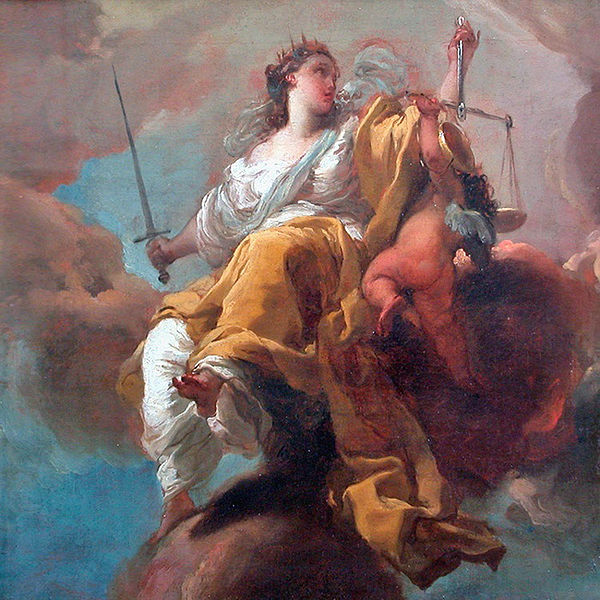
by Roseanna White | Jun 24, 2013 | Word of the Week
|
| Allegory of Justice by Gaetano Gandolfi |
“You’ll get your just deserts!”
Okay, confession. Because that phrase pronounces the final word as one pronounced the word for the delightful confections that make life worth living, I never once realized it’s spelled with one ‘s’ like an arid area. Hadn’t a clue. But it is. One ‘s’ but pronounced like desserts. And…why?
Well, that’s the interesting bit. =) Apparently it’s from a whole different word that either a sandy desert or a sweet dessert–it’s from deserve.
Ah!
Okay. So the word deserve is from French, and back in the day when it was entering English (as in, the 13th century), desert was used to mean “that which is deserved.” So you deserve your deserts. Which makes total sense, right? And yet it’s fallen completely out of use except for in that one phrase about just deserts. (Probably because of the confusion with sandy ground and chocolate, LOL.)
Pretty fun, eh? Happy Monday!

by Roseanna White | Jun 17, 2013 | Word of the Week
|
| Sir Sumbras at the Ford by JE Millais, 1857 |
Hello, m’lovelies! I’m back from the beach and back to business. =) And while I was gone, a friend sent me a link to some awesome word etymologies, so I thought I’d share one with you today.
So. We all know the word “wend,” right? We wend our way through crowds and other things that make us take twisty paths and whatnot. But apparently back in the day wend and go were synonyms. Used interchangeably. You could wend anywhere you could go and vice versa.
In those days (of Middle English), the past tense of wend was went and the past tense of go was gaed. Then round about the 15th century, people started to like go better for whatever reason. Only, the past tenses of the synonyms got mixed up. Hence one of our most crazily irregular verbs–it’s actually a mix-up of another verb! Pretty fun, huh?
I’ll be bringing you more of the words from this list over the next couple weeks. =)

by Roseanna White | Jun 3, 2013 | Word of the Week
First, have you grabbed your free copy Fairchild’s Lady yet? If not, check out Saturday’s post for all the links to your choice of retailers!
Now onto the Word of the Week. =) This will be short but sweet. Carnival. I confess that when I see the word, I mostly think of a fair. But carnival in fact has its roots far more firmly in the famous Brazilian celebration–meaning literally “goodbye, meat!” in Latin, it has been a time of merrymaking before Lent since the 1540s.
Color me surprised. I really had no idea the pre-Lent festival was so old! The more generic “fair” meaning didn’t actually come around until the 1930s.
Have a lovely Monday, all! We’re heading back to Johns Hopkins today for Xoe’s follow-up. Prayers appreciated that her arm is healing up perfectly! =)



 Roseanna M. White is a bestselling, Christy Award winning author who has long claimed that words are the air she breathes. Having successfully launched two homeschool grads, she now spends her time writing fiction, designing book covers, and pretending her house will clean itself. Roseanna is the author of a slew of historical novels that span several continents and thousands of years, as well as a fantasy series and contemporary mysteries and romances. Spies and war and mayhem always seem to find their way into her books…to offset her real life, which is blessedly ordinary.