
by Roseanna White | Sep 27, 2011 | Uncategorized
Every so often, I find one of those books that just takes my breath away as I’m reading. Every so often, I find one whose characters stay close to my side even when I’m not reading it, going through my days hovering in the corner of my mind. Every so often I find a book where the not-kisses are intense as the kisses, where the emotion is so high I feel taut as a bow while reading, where I savor each page.
The Colonel’s Lady by Laura Frantz is one of those books. I’ve never done a rating system, but I’m tempted to come up with one for this just so I can give it maximum stars.
Roxanna Rowan has lost everything she knew in Virginia. Her mother has died, her betrothed has broken their engagement. The only promise left in her life is her beloved father, who is serving as a scrivener to the fearsome Colonel Cassius McLinn on the frontier in Ketucke. Not knowing what else to do, Roxanna packs up everything she owns and heads into the unknown–only to arrive at Fort Endeavor and discover her father is dead. Trapped at the outpost, surrounded by natives that are working for the British, Roxanna has little choice but to stay in this terrible place, where her father’s memory haunts her home and the towering Irish commander haunts her mind . . . and soon her heart.
Cassius McLinn has been given charge of the western frontier, but it is punishment rather than honor. He ought to be in the east, serving General Washington. Fighting the British outright, just as he had given up his inheritance in Ireland to do. But he is instead in this godforsaken wilderness, with too few supplies, too few men, and now a passel of women to care for–including the too-alluring, too-generous daughter of the man he accidentally shot in the shadowy twilight on their last campaign. He cannot explain why Roxie Rowan burrows so quickly into his heart. What he does know is that when she discovers her father’s death came at his hands, she will hate him. His Irish premonition tells him he will die out here, perhaps even at the hands of the spy Roxie’s father had discovered before his death . . . but is there a chance he will know happiness before he does?
The Colonel’s Lady is . . . just WOW. It’s heart-wrenching. It’s beyond beautiful. It’s complicated and engaging and memorable. It’s absolutely everything a book needs to be, and I can honestly think of nothing I would change about it. As I read it, I could feel the danger lurking in the forests just beyond the fort’s walls. I could feel the tension stretching the characters to their breaking points. I could sense the resignation of Cass, the desperation of Roxanna. Which made the love story all the more poignant.
This book can boast the most intense not-a-kiss scene I think I’ve ever read. The actual kissing scene is awesome too, but I have to note the first because it’s far harder to find. 😉 Buy boy howdy! The book would be worth reading for that alone.
I’ve given up wasting time on books I’m not enjoying, so pretty much anything I review on here is going to be one I like and fully approve. But I have to say that The Colonel’s Lady holds a spot on my favorites list. It is truly a masterful combination of wordsmithing and storytelling, of real, torn characters and a high-stakes plot.
Go get your hands on this book. Now. Seriously. GO. You’ll thank me for it. =)
by Roseanna White | Sep 26, 2011 | Word of the Week
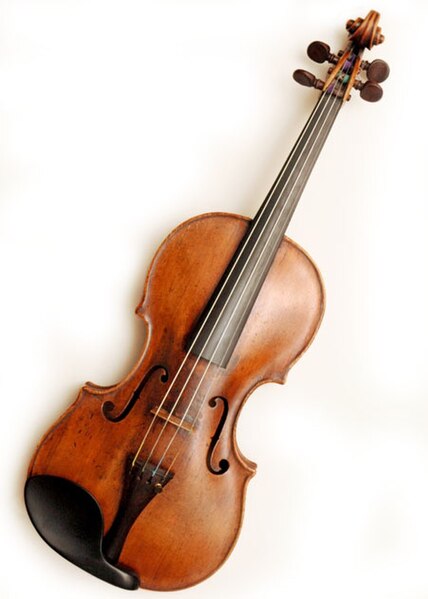
Everyone knows what a fiddle is, right? Or what it means
to fiddle. It’s a violin. More, it’s a colloquial use (that usually denotes the rural or country or south) at this point. Why? The word has been used since the late 14th century, it’s perfectly legitimate. Why the connotation? (Let’s keep in mind that I LOVE what has become termed “fiddling.” I like the more formal
Violin too, but the fiddle is so much fun!)
Interestingly, it’s been relegated to such use largely because of the other words containing “fiddle” that mean “nonsense.” Funny, huh? We’ve got fiddle-faddle used since 1610 for “nonsense.” Fiddlesticks has meant the same since 1620. Fiddlededee combines the nonsensical with contempt, and has since 1784. From what I can tell, there’s no particular reason why “fiddle” got used in all these words, but it’s certainly had an effect on the root word. Fiddle now has associations with nonsense.
Maybe that’s why I like it so well. 😉
Forgive me if this post isn’t quite coherent–we spent 12 hours in the car yesterday coming home from St. Louis. The conference was great, fun, etc. Appointments went well, classes were great, but the absolute best part was getting to talk to all my friends face to face!
I’m guessing it may take a few days to recover though, LOL.
by Roseanna White | Sep 21, 2011 | Uncategorized
It’s conference time!! I’m currently en route to St. Louis for the ACFW conference (or there, depending on when you see this), so not blogging. Nope, instead I’m looking forward to a few days of immersion into the industry I love. Some awesome classes, the chance to chat with some professionals, and best of all, the fellowship of my like-minded colleagues. Yay!!
I’ll be back to my normal schedule next week. Hope everyone has a great one–and if you’ll be in St. Louis, I hope you see you there!

by Roseanna White | Sep 20, 2011 | Uncategorized
I was chatting with my 14-year-old niece over the weekend about classics. She’s reading Great Expectations in class right now, and while she finds some parts of it good, overall she’s come to the conclusion that it’s boring. She said, “Modern books are just better. By which I mean books written recently, not necessarily set recently.”
In a lot of ways, I think she’s right. Fiction writing has evolved a lot over the centuries. We have a craft, and we study on ways to improve it, to fully engage our readers. And the readers have changed! A TV generation isn’t prepared to wade through all those descriptive paragraphs. Or backstory. Or info dumps. Overall, I think this is an improvement, certainly for the world we’re writing for.
But of course, I had to tell her that not all classics are as difficult as Dickens. =) Now, I’ve read some Dickens I like. But I must confess–I sat down one summer during college with my Complete Works and said, “I’m going to read Dickens this summer!”
I got about three chapters in and went, “I’m not going to read Dickens this summer!” LOL.
But I could read Pride and Prejudice over and over again. The wit is just amazing. And as I told my niece, Jane Eyre is shockingly modern. When I read that right after college, I couldn’t believe how similar it was in style to modern books. L. M. Montgomery (who wrote around turn-of-the-century, so is borderline modern in my opinion) will always remain one of my favorite authors.
I’m glad fiction writing has come as far as it has, but I definitely still love–and have immense respect for–classics. What are you favorite pieces of classic literature? Authors, titles? Why do you love them? And which ones do you think translate best to today’s teens?

by Roseanna White | Sep 19, 2011 | Word of the Week
How do you describe a pearl? It doesn’t shine like other gems. Doesn’t shimmer, has no fire. It gleams, yes. But it’s the rainbow of color that really sets it apart. That . . . you know, the pearlized effect. 😉 Its iridescence.
I can never think of a more accurate word for it, so I was a little frustrated when I looked up “iridescent” and realized it entered English just a wee bit too late for my 1780 book. As in, 16 years later, in 1796. After grumbling for a minute over not being able to justify using it (I’m nit-picky about my word choices like that), I put it aside to wonder about the word.
“Iridescent” comes from the word “iris.” Now, we all know “iris,” right? The colored part of our eyes. A flower. Yep. But apparently “iris” means rainbow in Greek–hence why the colored part of our eyes are called that. The Greeks would also use it to describe any colored circle, like the round “eyes” on a peacock feather. Pretty neat, huh?
So it makes perfect sense that we would have created a word like “iridescent” to describe that rainbow effect. If only we had created it two decades earlier . . . 😉
(Photo credited to Georg Oleschinski/Inst. f. Paläont., Uni Bonn via Wikipedia Commons)



 Roseanna M. White is a bestselling, Christy Award winning author who has long claimed that words are the air she breathes. Having successfully launched two homeschool grads, she now spends her time writing fiction, designing book covers, and pretending her house will clean itself. Roseanna is the author of a slew of historical novels that span several continents and thousands of years, as well as a fantasy series and contemporary mysteries and romances. Spies and war and mayhem always seem to find their way into her books…to offset her real life, which is blessedly ordinary.