by Roseanna White | Jun 2, 2014 | Word of the Week
|
A place at which I love to hang out…
Seascape by William Trost Richards, 1901 |
I looked this word up the other day to make sure “get the hang of it” would be an appropriate phrase to use in a book set in 1911–and discovered that there are a plethora of hang uses with surprising elements!
The one in question dates from 1834–and was a primarily American use of the word for a great many years.
But it was the verb usages that surprised me. The “teen slang” sense of hang that means “spend time” dates from 1951–which is about what I’d expect. But did you know that hang out is from 1811?? I had no idea it was so old! And hang around, meaning “idle, loiter,” is from 1830. Another one that was way older than I thought!

by Roseanna White | May 29, 2014 | Thoughtful Thursdays, Uncategorized
Last fall, we moved. But we moved in a rush, to a smaller house that was given to us by my hubby’s grandfather. We had a lot of work to do on the old one, so were in no rush to sell. We took what we needed right away…and then the bad weather closed in. It was not a good winter to move, and every weekend when it might have been possible, it was either snowing, raining, icing, our help was out of town, or there were more pressing repairs to be made to, say, automobiles.
So 9 months later, we’re finally getting to work–and on a tight schedule.
 |
A few boxes of books. Just a few.
Many more to come… |
As the one who will not be patching walls and rewiring, hanging new doors or plumbing, I’m on clean-out detail. And oh. My. Gracious.
When we moved back to Cumberland from Annapolis, Xoe was only 3 months old–she’s now 8.5. I was only a year and a half out of college. Now we’re planning our 10 year reunion. When we moved, I’d shoved a lot of clothes into a portion of a closet that’s hard to reach and unseen, and totally forgot about them. I just went through them last week and had to laugh. The wedding dress, okay. But seriously? That dress from high school? And that one from middle school? I still had that?? Why in the world did I still have that???
I discovered the amazing mess of items that the kids managed to lose under the bunk bed and behind the dresser in their room. I re-learned how few books you can really fit in a box. I found an insurance policy from our first apartment back in 2001. I scrubbed out a pretty-darn-gross fridge with nothing but elbow grease, cold water, and Windex. And I marveled at how much junk we’d accumulated–things that seemed so important at some point, but which I now threw out with no compunction.
And I wonder…what else in my life–in my emotional, spiritual, unseen life–is like that? How much do I cling to when I need to let it go? How much is begging for a good spring cleaning, a purging, a blank slate, but is still gunked up because I don’t have the time or energy or strength to let it go?
Then there are the things we’re looking for. For months, Xoe has been wondering where her little Ty hippo was. We verified it wasn’t among the toys brought over. So every time we went to the other house, Xoe looked for Humba. We checked all the likely places. The toy box. Under the bed. Under the couch. Downstairs.
Nothing.
She was starting to get upset about it. When I went on my own to do some cleaning on Tuesday, the first words from her mouth afterward were, “Did you find my hippo?”
Nope.
 |
My hutch, now filled with
all my china. =) |
Yesterday, we checked more places. Xoe sighed. We gave up and worked on other things–like moving my cabinet that would hold all my china, which had already been boxed and brought to the new house and now sat in the kitchen, taking up a quarter of my floor space. David and I (both sick) hefted the thing–and we hear Xoe call out, “There she is!”
She’d fallen, inexplicably, behind the cabinet. The last place we ever would have looked for her, there she was.
I was struck by the life lesson there too. That so many times we search and search for something. We work so hard for what we want, in the ways that seem logical. And we fail. Or at least falter. We never seem to attain that thing we’re reaching for.
So eventually we move on to other tasks. The ones that aren’t exactly what we want, but which are more important. And it’s there, in doing what we need to do, that we find that Thing. The one we’d been looking for. God knew all along what we needed to do to get us there, and once we gave up on following our own way–our so-called logic–we get where we need to go.
I’ve got a lot of packing and sorting, tossing out and selling ahead of me yet. No doubt I’ll have a lot more moments of “Why in the world did we keep this??” But maybe I’ll have some more realizations too. Some more opportunities to learn.
 |
| Humba the Hippo – home at last |
And maybe we’ll find some more treasures along the way.

by Roseanna White | May 28, 2014 | 17th-19th Centuries, Remember When Wednesdays
This post (written by me) first appeared on Colonial Quills
One thing I really love about the early American era is that so many gentlemen with time on their hands went about interesting pursuits–like invention. I’ve previously talked about some of the inventions of Benjamin Franklin. Today I wanted to take a look at Thomas Jefferson’s.
The Jefferson Polygraph
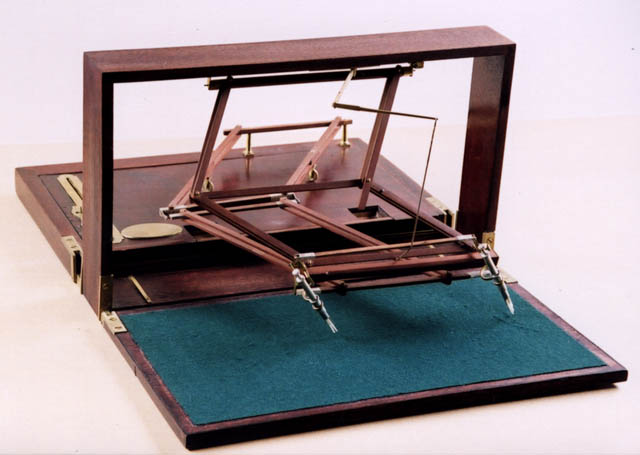
One of the most interesting of the inventions to be found at Monticello is the polygraph. In an age well before copiers or computers, Jefferson still wanted multiple copies of his letters–so came up with a way to copy them as he wrote them.
The Wheel Cipher
Though the image above is actually a Confederate era wheel cipher, Jefferson described one of his own creation in a letter. These could be used to encode correspondence, so long as both parties had one.
The Revolving Items
Looking through the page at Monticello.org featuring Jefferson’s inventions, there are quite a few that utilize the idea of revolving or spiraling objects to maximize the use for a space. The first is a “turning machine” for hanging clothes–much like many of the closet-organizing items to be found today! The “hanger” was a spiral with arms coming out in all directions, over which you would drape the clothing. It seems that only a drawing of it remains, and many mentions of it in the correspondence of those who had visited Monticello.
He also invented a revolving bookstand that could hold up to five books at once, displaying them all. This would also be quite handy for anyone who is comparing various texts. The stand displayed one book on the top and one on each side, and then the reader could spin the devise to show him whichever text he needed. Certainly beats spreading them all out on a table or stacking them one on top of the other!
But Jefferson didn’t stop there. He also created a revolving service door between the dining room and the passageway so that servants didn’t have to physically open a door to bring the food in–always difficult when hands are full. Instead, they slid the food onto the shelves on one side of the door and spun it.
~*~
I just love how all these early-American inventions are so very practical–and some are so very surprising. And especially how “gentlemen of leisure” put that leisure to such good use.
by Roseanna White | May 22, 2014 | Thoughtful Thursdays, Uncategorized
|
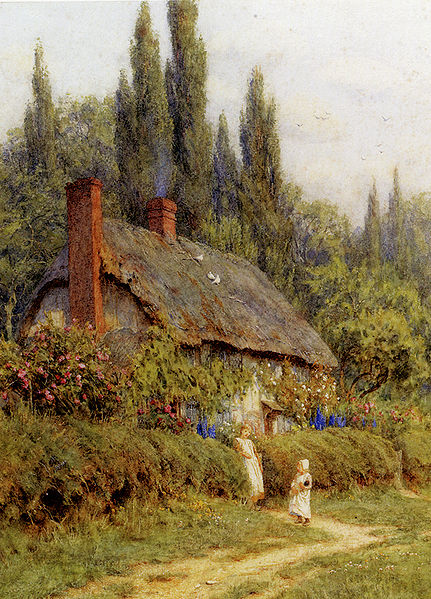
| Children on a Path Outside a Thatched Cottageby Helen Allingham, late 19th century |
With the first round of edits wrapped up on A Soft Breath of Wind, I moved on this week to my first round of edits on The Lost Heiress. (Lots of editing going on around here!) There are some changes I know I’m going to make, some inconsistencies I’m finding. An old (for me) story taking on new life.
But one of the major themes in this book has been there since I was 12, when I first started writing it–the one that involves Brook, this noblewoman raised in a country not her own, finding her rightful place. Finding her home. Finding her family.
When I was writing this in seventh and eighth grades, it was easy for her. She lifted her chin, screwed her stubbornness and faith into place, and took England by storm. Her family all adored her, London adored her, life adored her. The only people who didn’t were the bad guys, because they were evil and therefore couldn’t love.
When I was writing this in seventh and eighth grades, I was trying to find my place. Trying to adjust to friends who were suddenly interested in boys instead of Barbies, in being popular instead of being genuine. I was trying to figure out how to be who I knew I was in a world that demanded I be who they wanted to make me.
I was an outspoken 13-year-old. The kind that refused to be led by other kids my age because, frankly, I found them obnoxious. I was the one who thought about consequences. About right and wrong. I was the one who told the other girls at the sleepover that if they were serious about trying a seance, I was going to call my mom and go home. The one who said if they were seriously going to try to sneak out, I would lock the windows and stand guard. The kind who greeted gossip with, “Are your lives so boring that you have nothing better to talk about than me? Seriously? Sorry to hear it.”
Yes, I was an outspoken 13-year-old. But I also wanted those I liked to like me back. I didn’t want arguments for no reason. I wanted to please people, when I deemed them worth pleasing.
I remember one time in the cafeteria, talking about spaghetti, of all things. I proclaimed my mom’s homemade sauce the best (which it is. Just sayin’.). A friend asked, “Does it have chunks of tomatoes?” in a voice that I interpreted as meaning “because if it’s the best, it will.”
Now, my mom’s sauce is ground totally smooth. But I hedged and said something along the lines of, “I don’t know, maybe a few.”
My friend then said, “I hate chunks of tomatoes.”
And there I had a conundrum that brought me to an epiphany. My desire to make this friend agree with me made me lie–and now the truth, which would have been pleasing, couldn’t be spoken. That was the day when I realized that my yes must be yes and my no be no. That was the day when I realized that having someone’s good opinion didn’t mean squat if it wasn’t right opinion.
That was the day when I realized that my place in life couldn’t always be easy–but that it was only worth having if it was really mine.
I’ve never been one of those people to be found in a gaggle. I have some awesome friends, but the best ones are few. I have an amazing family, but I’m not the one always throwing parties, or going to them. I’m not the popular one. Sometimes I wish I were, sometimes I wish people showed up to things when I host them, that I knew how to draw a crowd. Sometimes I wish my place was what Brook’s used to be in my story–beloved by all, effortlessly.
But it’s not who I am. And it’s not my place. It’s never been my place, not when I was a kid penning her first novel in class, and not now, when I’m rewriting it.
Brook’s place has changed now too. Because though 13-year-old-me wanted to believe someone could have it all, 31-year-old-me knows better. Because while there may have been, in some point in history, one young woman who was beautiful and rich and popular and of strong faith and different from everyone else…that’s not the story most of us know.
And it’s not the story I needed to write this time around. This time around, I needed a story of someone who had to fight for her home. Someone who had to decide whether she was going to be molded or if she would do the molding. Someone who had to choose what path she would tread and then face the consequences.
Someone who is less who I wished I were back then…and more who I grew to be.
Someone whose place wasn’t just waiting for her–someone who had to find it. And when she does, she finds there are those in it who oppose her. And those who would do anything for her.
Because that is life. We can never have it all.
But we can have what matters most.

by Roseanna White | May 21, 2014 | Remember When Wednesdays
Last week, WhiteFire’s latest historical released. And oh, is it a fun one.
Some of our books are haunting. Some of our books are plumb-to-the-depths deep. Some of our books are as serious as they come. Sweet Mountain Music…it’s an adventure. And one you don’t want to miss.
Now, I’ve never been a believer in Big Foot. I admit it. And all those shows about Squatchy popping up on TV lately usually make me giggle. And start planning for the A-squatch-alypse, just to be cheeky. (Anybody watch Top Gear, the American version? Anybody see the end-of-the-world vehicle episode, where one of the guys said they thought it would be Apocalypse by Sasquatch? LOL)
BUT–that said. This book, all about the hunt for the legendary creature, made me cheer for Big Foot hunters. It was fun, it was engaging, and it made me ask what if…? Can you ask for more in good fiction?
Here’s why, as an editor, I loved Suzie J’s approach to the Big Foot question. First of all, it’s a historical. And in the age where gorillas had just been discovered not long before in Africa, of course naturalists thought there was a North American variety lurking in the un-explored forests of the Pacific Northwest! Why wouldn’t there be?? The world was shrinking by the 1890s, yes, but it was still filled with people out to discover the unknown (as opposed to today, when it’s filled with people who think they know all there is to know, and if they don’t know it, it must not be real. Ahem.).
Added to that, you have a cast of amazing characters. A heroine who just wants to follow her dreams and be a reporter, even though neither family nor the hero supports her. A hero who just wants to prove that he can make a world-changing discovery, without hurting anyone in the process…unlike last time. And a supporting cast that goes the full spectrum from bad guy to one with an unlikely heart of gold.
Sweet Mountain Music has laughter, tears, some sizzling romance, and an adventure that will have you hoping that maybe, somehow, some way these characters will find what you know very well has never been found. That maybe, somehow, some way they’ll redefine history.
And you know…maybe they do. 😉



,_captured_at_the_surrender_of_Mobile,_Alabama,_in_May_1865_-_National_Cryptologic_Museum_-_DSC07710.JPG/800px-Confederate_cipher_wheel_(Vigenere),_captured_at_the_surrender_of_Mobile,_Alabama,_in_May_1865_-_National_Cryptologic_Museum_-_DSC07710.JPG)


 Roseanna M. White is a bestselling, Christy Award winning author who has long claimed that words are the air she breathes. Having successfully launched two homeschool grads, she now spends her time writing fiction, designing book covers, and pretending her house will clean itself. Roseanna is the author of a slew of historical novels that span several continents and thousands of years, as well as a fantasy series and contemporary mysteries and romances. Spies and war and mayhem always seem to find their way into her books…to offset her real life, which is blessedly ordinary.