by Roseanna White | Apr 13, 2016 | Remember When Wednesdays
Since The Reluctant Duchess is barely a week old, I thought I’d chat a little today about the heroine in it, Rowena Kinnaird–or more specifically, about her name.
Sometimes, you name a character once, and that’s it. Such was the case with Brice Myerston. Sure, I needed to find a reason for Brice to have as a first name something that wasn’t common to English men at the time, but that was easy enough.
This heroine, however . . .
In a previous draft, her name was Constance Augusta Grant. But she had an Aunt Constance, so she went by Augusta. Only, not Augusta–Gusty.
No one but me liked this. As in, no one. (Pout, pout)
I could ignore that when it was only (ahem) all my critique partners and family who didn’t like “Gusty” as a nickname (come on, y’all–I came up with that when I was 13! Obviously that means it’s SUPER COOL!). I had it all figured out. Wind was going to be a subtle theme in the story. Even Brice’s family home bore the Gaelic word for “Wind.” (Gaoth–which, by the way, you pronounce “Gway.” I know, right?) But then, when I turned in my synopsis before I started writing, my editors asked for a new name, so . . . guess who got a new name, LOL. (The wind theme is still here and there through the book. Better read it to see if you can find it, wink, wink. I even just gave you the first one!)
If one were to scroll back through the chats I exchanged with my best friend/crit parnter during the renaming process, one would have seen that I soon found all the most ridiculous and difficult to pronounce Scottish names in the world. Not that I intended to use them, but they were certainly entertaining. =) Really though, I knew what her name would be if it weren’t Gusty.
Rowena.
I’d always loved the name. Loved it so much, in fact, that I’d already planned to use it later in the series for another, minor, character. In the previous version in which I’d already used it, there was a very important rowan tree; so someone was named after this rowan tree. But I knew I intended to name my son Rowyn if I had a boy (I was in fact pregnant with him when writing this previous version of the book), and I didn’t want a character with my son’s name. So the character was instead a girl, and had a similar sounding name. Rowena.
Did I want to “steal” the name for my heroine? It took me a few hours to decide. But yes, yes I did.
And so, Gusty became Rowena.
But her previous last name wouldn’t work either–Grant is a real Scottish clan, which means that the Grants had a real chief and a real estate at this point in history. And I didn’t want to risk maligning them with my not-so-nice chief, Rowena’s father. Plus I wanted the freedom to place this clan, their home, etc. wherever I pleased. So rather than choose a real clan, I talked with my historical writers group, who advised I choose a real Scottish name that isn’t actually a clan on its own. One of the ladies even offered up hers. 😉 She told me Kinnaird was a sept (branch) of an existing clan, but didn’t have its own chief or anything. So Kinnaird (you say it kin-AIRD — and roll that R, baby!) it was, with my hats off to Deb.
Overall, I love this new name much better than my old one. But yeah, I’ll admit it . . . my editor caught a Gusty that had slipped into the first draft, LOL.
Evolution of other character names in the series, from first draft when I was a kid through final:
Brook Eden — started life as Brook Moon
Justin Wildon — has always been Justin Wildon, though his titles have changed
Regan — used to be Megan
Melissa — was always Melissa
Aunt Mary — used to be two characters, actually. Aunts Lisa (nothing screams Victorian England like the name “Lisa” right?) and Marie. (I may have had a good friend in middle school named Lisa Marie…)
Deirdre — used to be Lyddie
Douglas Kinnaird — used to be Douglas Grant
Lord Cayton — used to be Kent
Lady Catherine — her name hasn’t changed, but she wasn’t Brook’s cousin in earlier versions
Just FYI, I’m about to turn in the second round of edits on Book 3, A Lady Unrivaled. And I would just like to say that Ella has always been Ella. And she is so very Ella. 😉

by Roseanna White | Apr 11, 2016 | Word of the Week
I always find it interesting to see how very common words have changed over time–and mean is certainly one that has shifted around quite a bit!
I’m going to focus solely on the adjective version of the word today, though it’s worth noting that through the years, some of the changes to mean‘s meaning (ha…ha…ha) is because of it’s noun definition (“that which is in the middle or between extremes”–a definition mostly retained these days in math).
When mean first entered the English language back in 1200 (you know…when the English language first entered the English language), it meant “of low quality; common to all.” Within a hundred years there was a subtle shift to “inferior, second-rate.” This was of things–think of the second verse of “What Child Is This?”: “why lies he in such mean estate…?”–but it came from an application to people that had arisen earlier in the 1300s, that of a low or inferior rank.
The word carried these meanings of “common” or “inferior” for quite a while. In the 1660s, it took a bit of a turn and started to mean “stingy, nasty.”
So when did our main meaning today (“not obliging, pettily offensive”) come into play? Interestingly, not until 1839, and it was American slang. The inverted meaning of “remarkable good” (think, “She plays a mean piano”) is from about 1900, probably a shortened form of “no mean _____”)
~*~
Don’t forget about all the giveaways going on!
(17 hours left as of when I’m publishing this)
COMING SOON

by Roseanna White | Apr 7, 2016 | Thoughtful Thursdays, Uncategorized
Yesterday, I was talking to my husband about loss. His grandfather recently passed away; and this was a man we saw nearly every day. We’re currently living in the house he’d had built on the family property, just a short walk from the apartment we’d helped build for him at my mother-in-law’s house. Her last couple years have been dedicated almost exclusively to caring for him. To say he’s missed is an understatement.
My husband said something that really resonated with me. He said, “I’ve heard this analogy for sin–that every sin is a nail through us. And that when we’re forgiven, the nail is removed–but the hole is still there. I keep thinking that’s how grief is. When we lose someone, we’re left with a hole. That doesn’t just . . . go away in a few days or weeks or months.”
Brains being quick as they are, my first thought was the one you’d expect a girl raised in the church to come up with–that God fills those holes. That’s His job.
Then another thought quickly followed. Do we ever stop missing those we love? The pain fades, yes. God gives us new purpose, yes. God fills us, yes. But no. We never stop missing those we love. And we’re not supposed to. So in that respect, we always carry those holes with us. Like Swiss cheese, maybe?
Then an image filled my mind. You see, I’ve been knitting for about 7 months now, and some of my favorite pieces are lacework. Lace . . . such beautiful stuff, right? But when you’re making lace, it isn’t just about the yarn. It isn’t about the knits and the purls.
It’s about the holes.
One of the things I love about knitting is realizing how long people have been doing it. How this is something that has been passed down for literally thousands of years. Some things I wonder how anyone ever figured them out. But lace . . . I get lace. Lace is made by purposefully adding in holes that are pretty easily added by accident. Lace is taking a process that could have been a mistake and turning it into a work of art.
Maybe that’s what our lives are meant to be. We’re not supposed to just fill in those holes. We’re supposed to turn them into something beautiful.
Because there will always, always be loss. People die–it’s inevitable. And we’re supposed to feel it. We’re supposed to miss them. We can’t just push past it. We can’t just rush to fill in the hole their passing leaves with stuff, with activity, with new things. But each event like this in our lives is supposed to change us. Maybe . . . just maybe it’s up to us whether we’re left with a hole-ridden garment of our lives…
Or lace.

by Roseanna White | Apr 5, 2016 | Giveaways and Contests
To celebrate the release of The Reluctant Duchess, I’m giving away some things that would make Rowena smile.
~ Brookside chocolates.
Because . . . chocolate. Need I say more?
~ Pepperidge Farm cookies
A nice biscuit to go with her tea on a blustery day always hits the spot
~ Rooibos Red Tea
A little tea to go with those biscuits . . . 😉
(Try adding a dash of cherry juice and almond extract to this. Seriously good stuff.)
~ Traditional Music of Scotland CD
Rowena’s father says he has “a man McCloud who can pipe the faeries from their hills.”
This best-selling CD might be able to do the same. (Well you never know!)
~ Signed copies of both Ladies of the Manor books
(If you already have them, think gifts! Or substitute any of my other books)
~ The story of George Muller
(whose faith inspired the characters . . . and me. Oh so much.)
~ Vintage style red necklace
Loosely inspired by the Nottingham rubies. (I don’t have Nottingham ruby money to spend on giveaways. My apologies, LOL)
and a special something hand-crafted by me
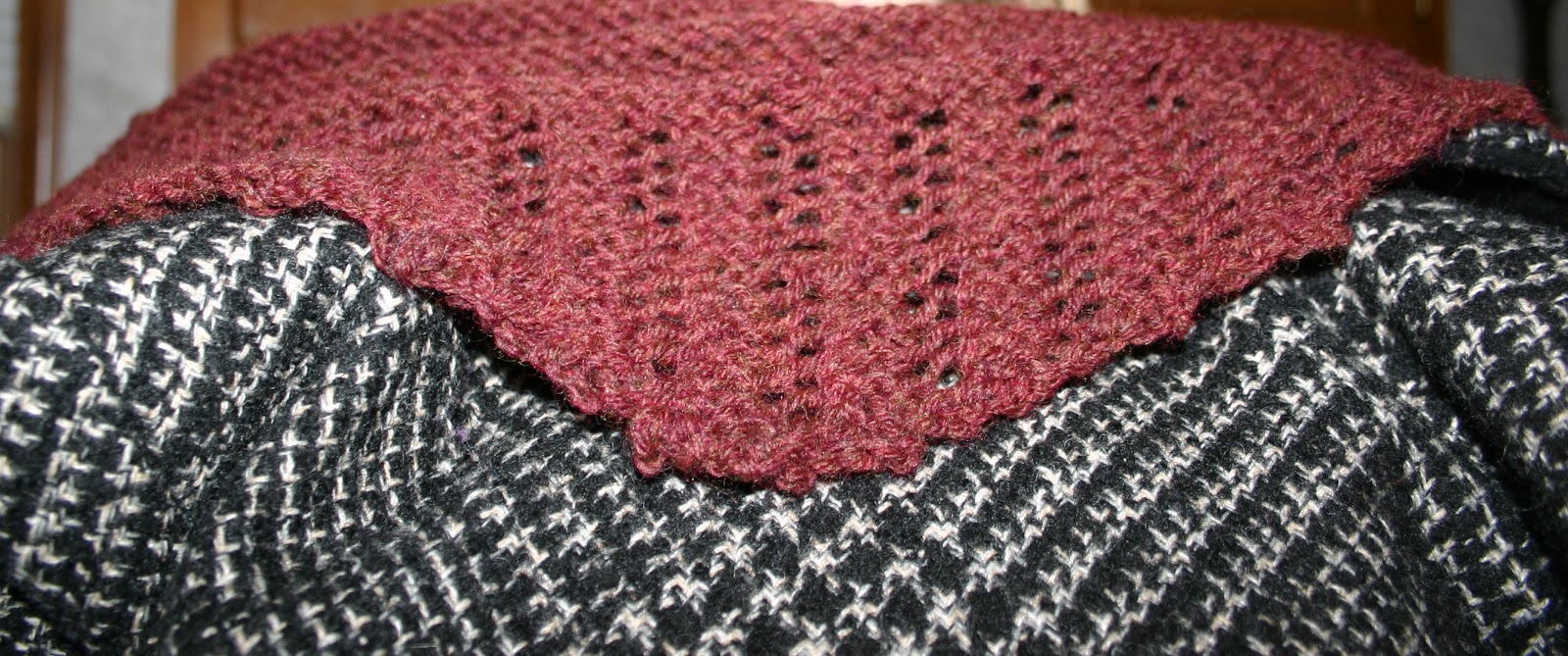
~ Rowena’s favorite scarf
This beauty, in a deep red reminiscent of the cover and rubies, would give Rowena comfort on those blustery days. It could drape her shoulders when she has just a bit of a chill
or wrap around her neck to add a bit of style to her warmth.
Made from a wool/acrylic blend that is super-soft. Machine washable and dryable.
Can’t wait for the chance to win and need to read the book NOW? (Of course you do. Ahem.) Get it from your favorite site!
Contest will run from April 5 – 26.
Void where prohibited. Chance of winning depends on number of entries.
Winner will have 1 week to claim prizes before another winner is drawn.
Due to shipping costs, only US addresses are eligible.
a Rafflecopter giveaway

by Roseanna White | Apr 4, 2016 | Word of the Week
This is a simple one, but likely to be apt today, after I stayed up way too late last night watching the season finale of The Walking Dead. 😉 But I took a nap first. And when my husband came in from working outside right after I got up, I said, “I’m still groggy.”
To which he replied, “You were drinking grog?”
I knew right then that this is where that word came from. And indeed, it does. Grog, in the 18th century, first meant “any alcoholic drink diluted with water.” British General Edward Vernon, you see, ordered his men’s rum to be diluted with water; he was also known for the grogram cloak he wore (grogram is a stiff, coarse cloth), so his men started calling this drink grog, after his trademark cloak. The term, coined in 1749, caught on so quickly that by 1790, taverns were often called grog shops, though the “diluted” part got lost, and grog meant any strong alcoholic drink.
Groggy, then, by 1770 meant “drunk with grog until one staggers or stumbles.” It took on the figurative sense of someone just who is staggering or stumbling without necessarily being drunk by 1838. I’m not quite sure when it shifted toward the modern meaning, but today’s dictionary entries say, “staggering from exhaustion or blows; dazed or weakened from lack of sleep.”
Now, announcement. The Reluctant Duchess releases tomorrow!!!!!!! My big giveaway will go live at some point during the day tomorrow. Not sure what time, because I still need to take a picture of the giveaway items, and one of said items needs just a bit more work. 😉 But it will definitely be up at some point, and then you’ll have two weeks to enter!



 Roseanna M. White is a bestselling, Christy Award winning author who has long claimed that words are the air she breathes. Having successfully launched two homeschool grads, she now spends her time writing fiction, designing book covers, and pretending her house will clean itself. Roseanna is the author of a slew of historical novels that span several continents and thousands of years, as well as a fantasy series and contemporary mysteries and romances. Spies and war and mayhem always seem to find their way into her books…to offset her real life, which is blessedly ordinary.