by Roseanna White | Apr 28, 2016 | Thoughtful Thursdays
I got up this morning and realized it was Thursday. Time to get thoughtful. I opened my blog. Drew up a clean post. And sat. Staring. Waiting for inspiration to strike. Sometimes I know days or weeks in advance what I want to write about on Thursdays. Sometimes I even have my posts written on Sundays.
Today . . . not so much. =)
So I opened up my next project–editing Giver of Wonders, which will release November 1. And I started to read.
In chapter 2, a single line jumped out at me.
“Forgive me, my love.” But his tone asked for
indulgence, not forgiveness.
I know I wrote those words, but I frankly didn’t remember them. As I read them, though . . . it’s a commentary, isn’t it, on our culture today? It’s a commentary, too often, on our churches. On our very lives.
I decided to hop over to the dictionary to see what the technical differences are.
INDULGENCE:
1. the act or practice of indulging;
gratification of desire.
4. a catering to someone’s mood or whim; humoring:
6.
Roman Catholic Church. a partial remission of the temporal punishment, especially purgatorial atonement, that is still due for a sin or sins after absolution.
FORGIVENESS:
the state or act of:
1. to grant pardon for or remission of (an offense, debt, etc.); absolve.
2. to give up all claim on account of; remit (a debt, obligation, etc.).
3. to grant pardon to (a person).
4. to cease to feel resentment against:
5.
to cancel an indebtedness or liability of
Some of the same words are used in those definitions, it’s true. But there are some vital differences, aren’t there? Indulgence is giving in to a person; forgiveness is giving up the account of their wrong.
Indulgence is saying “It’s okay that you sin.” or “It’s not a sin.”
Forgiveness is saying, “You sinned. But the account has been paid.”
We live in a very “tolerant” society, which means one that makes an art of indulgence. Funny, isn’t it, how that renders forgiveness, too often, powerless? Because if people have been told all their lives that it’s okay, that it’s not wrong, that we’re entitled to live our lives as we see fit so long as we don’t hurt anyone else . . . then how can they value the forgiveness of those sins they’ve been taught aren’t sins?
One of the greatest gifts ever given to man–cheapened. Our society has filled up on the junk food of indulgence, and now we don’t have the stomach for the real feast: forgiveness. We’ve embraced the look of a shirt with stains rather than taking the time and putting out the effort to scrub them clean.
Just one little line from a scene I added in at the last minute when wrapping up my first draft–but I’m going to be pondering that one . . . and wondering where, in my life, in my world, I’m substituting indulgence when really I ought to be doing the hard work and forgiving–or seeking forgiveness.

by Roseanna White | Apr 27, 2016 | Remember When Wednesdays
Well, the Scavenger Hunt is over, I’m home from my writing retreat, so now it’s back to usual blogging. 😉
Unlike my previous writing retreats, this one didn’t involve going to a cabin in the mountains or meeting up my best friend (sadly) there or in her neck of the woods. This time, I was simply making use of my parents’ house 10 miles away from home while they were on vacation (and messaging said best friend regularly so I could pretend she was there). I still slept in my own bed at night, was there to tuck my kiddos in and feed everyone breakfast in the morning. I still went to knitting class and doctors’ appointments.
But it was no less successful.
At the start of my retreat last week, I had 94,000 words written in The Name Thief. (Which for some books is finished. I realize that, LOL. But for me . . . no.) I had 15 scenes left to write, some of which required hefty amounts of research.
At the close of day 1, I’d written 12,000 words. Pretty darn good, and I took a nice chunk out of the scene list. I’d spent a portion of my day researching the royal family of England and all their various branches who were, in 1914, ruling other European nations as well. (Seriously, folks, they were all cousins! All of them–Russian czar, German kaiser, English king, you name it. First cousins all.)
 |
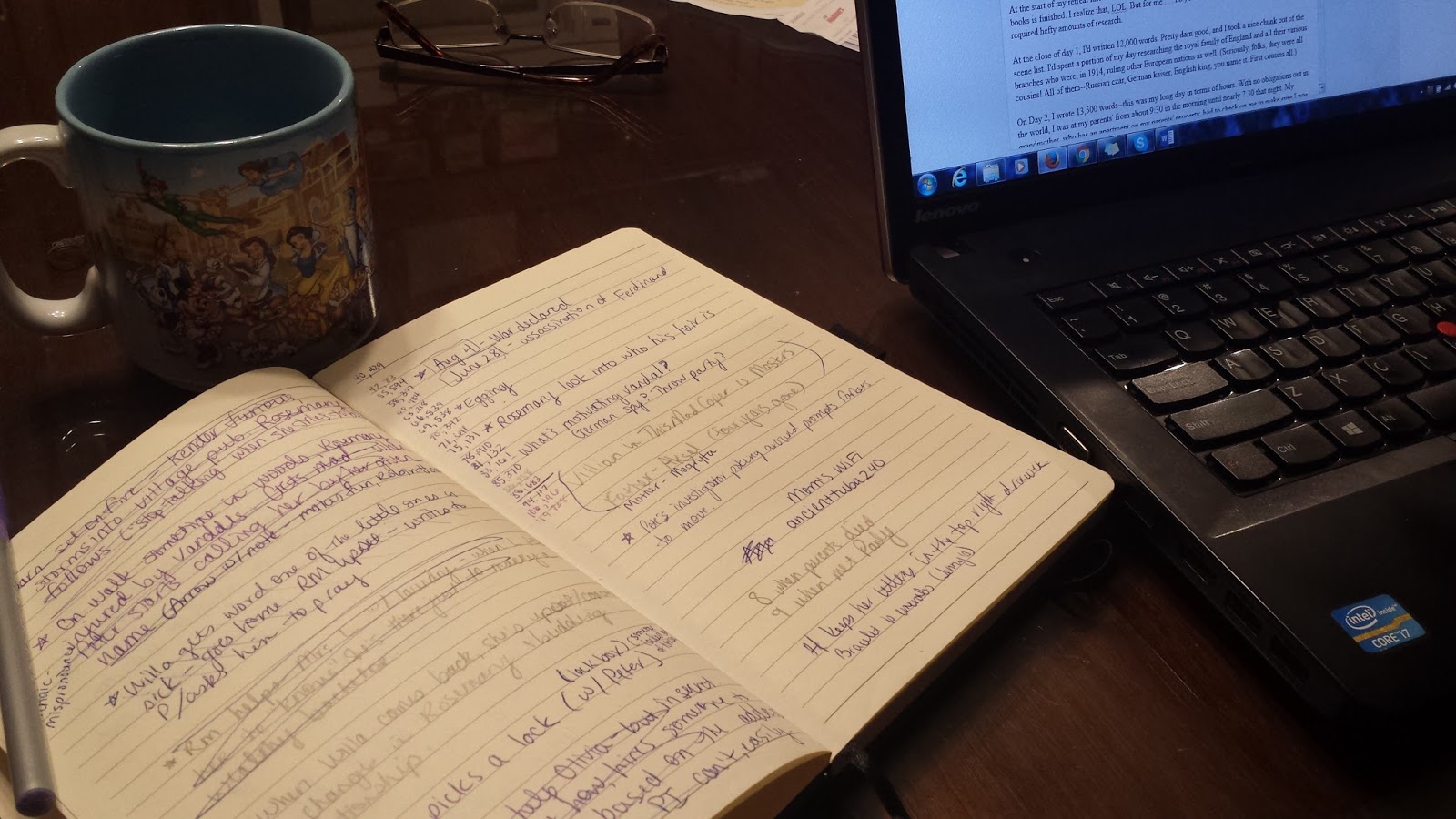
The necessities of my writing morning.
Coffee. Notes reminding me of things like character’s father’s name.
Glasses. Laptop. |
On Day 2, I wrote 13,500 words–this was my long day in terms of hours. With no obligations out in the world, I was at my parents’ from about 9:30 in the morning until nearly 7:30 that night. My grandmother, who has an apartment on my parents’ property, had to check on me to make sure I was still alive. 😉 (I had found the caramel pretzel Klondike bars in their freezer. I was awesome.)
 |
| The one I had didn’t have that many pretzel pieces–this is my official complaint. 😉 |
Best of all, at the close of my business day on Tuesday, I knew the end was very close. I would be able to finish up with just a few hours’ work on Wednesday. That is such a happy feeling!
On Wednesday, my day was interrupted pretty substantially by a doctor’s appointment I’d already rescheduled once so didn’t feel I should ditch again, LOL. One of those that took forever as I sat in the office just waiting to be seen. I had considered bringing my laptop with me (after sitting in a parking lot and typing on Monday morning as I waited for a store to open, LOL), but decided not to. I regretted that. 😉 But then, it forced me to think through my ending very carefully, at my leisure, instead of just charging through as I normally do, so maybe it was a good thing.
And then, Wednesday afternoon, I got there–The End. Woot!
Thursday, since I was still officially “off” my other duties, I wrote my synopsis for the book, while it was still fresh. And, you know, did the dishes. That sort of thing.
This week, I’ve been reading through it, integrating some threads better, fixing mistakes, and adding quotes to the start of each chapter. And still so, so happy to have this wrapped up!
So, to wrap up, a few fun things I learned last week:
- If you pick a lock to open it, you can pick it to relock it as well.
(No, Mom, I didn’t pick your locks. You gave me a key, remember?)
- Electro-magnetic security alarms have been in use since 1850! Who knew?
- Prince Edward (son of King George V) had a nickname. Guesses on what it was? No . . . nope . . . guess again. David. (The last of his gazillion middle names)
- Prince Edward, after taking the crown after his father’s death in the 30s, was only king for a year–at which point he abdicated to his younger brother so he could marry his mistress, a divorcee of whom the church (and the government) did not approve.
- Writing retreats rock, wherever they are. 😉

by Roseanna White | Apr 22, 2016 | Scavenger Hunt
Christian Fiction Scavenger Hunt Stop #9
Welcome to the Christian Fiction Scavenger Hunt! If you’ve just discovered the hunt, be sure to start at Stop #1, and collect the clues through all 33 stops, in order, so you can enter to win one of our top 3 grand prizes!
• The hunt BEGINS with Stop #1 at Lisa Bergren’s site.
• The hunt is BEST VIEWED using Chrome or Firefox as your browser (not Explorer)
• It is open to INTERNATIONAL entrants.
• PRIZES include 3 sets of all 32 books, $500 in Amazon gift cards and many authors are offering additional prizes!
• There is NO RUSH to complete this hunt—you have ALL WEEKEND. So take your time, reading the unique posts along the way; our hope is that you discover new authors/new books you might want to learn more about!
• Submit your ENTRY for the GRAND PRIZE at Stop #33 (back on Lisa’s site) by Monday night (4/25) at midnight mountain time.
~*~
Now that you know how it works, let’s get down to business!
I’m thrilled to be hosting the amazing Angela Hunt — I’m sure you’ve seen some of her many books around. I have several on my shelf, and I always know to listen up when she chimes in on one of the email groups we both belong to. 😉 So now without further ado . . .
Angela Hunt
Everyone wants to be beautiful . . . or do they?
You may remember the Seinfeld episode where Jerry is dating a super-model. This girl gets away with everything! When Jerry gets pulled over by a traffic cop, he lets his girlfriend do all the talking . . . and doesn’t get a ticket. Apparently, beautiful people get away with crimes, never have to pay for their meals, and never have to stand in line. They get all kinds of positive attention because other people like to look at perfection . . .
But history has demonstrated that beauty can sometimes be downright dangerous. It was to explore this aspect of beauty that I wrote what I jokingly call the “Bible Babes” series—books on Esther, Bathsheba, and Delilah. Esther was so beautiful that she was taken from her devout Jewish family and placed in a pagan king’s harem—trust me, that wasn’t like winning a beauty pageant. Bathsheba was so beautiful that she was raped by a king, then had to remain quiet while the king murdered her husband and her firstborn baby died. And Delilah, for reasons only she knows, used her beauty as a weapon, destroying a man of God and setting into motion a war between the Hebrews and the Philistines.
Even mythology points out the dangerous side of beauty. Helen, wife to a Greek king, is kidnapped by Paris, a prince of Troy, and a war is waged to recover the beautiful queen. “The face that launched a thousand ships” resulted in the loss of thousands of lives, or so the story goes.

If beauty is so dangerous, why do women spend so much time, money, and energy on trying to be beautiful? I ask myself that every time I sit down to tame the wild mane that lives on my head.
I believe something within us yearns for beauty—not only on our bodies, but in our homes—because we crave it. God is beautiful, his creation is beautiful, and something in us naturally hungers after beauty. We fix ourselves up because we want to please our husbands, our children, and our God. We are, after all, daughters of the King.
But God is not silent on the subject of beauty: “Don’t be concerned about the outward beauty of fancy hairstyles, expensive jewelry, or beautiful clothes. You should clothe yourselves instead with the beauty that comes from within, the unfading beauty of a gentle and quiet spirit, which is so precious to God.” (1 Peter 3:3-4).
The Lord, the Mighty One, is God,
and he has spoken;
he has summoned all humanity
from where the sun rises to where it sets.
From Mount Zion, the perfection of beauty,
God shines in glorious radiance. –Psalm 50:1-2.
Ah—there’s the crux of the matter. While there’s nothing wrong with being beautiful, the most precious beauty is cultivated within. Because beauty is from God, and of God.
Dr. Angela Hunt has written over 130 books for adults and children. She
has recently completed her second doctorate in theology and taken up
photography as a second career.
~*~
Here’s the Stop #9 Skinny:
You can order Angela’s book on Amazon, Barnes & Noble, CBD or at your local bookstore!
Clue to Write Down: of fiction
Stop #10: Angela Hunt’s site
Lost? Here’s the list of all the links in the hunt.
~*~
Extra Giveaway
In addition to the big prize you’re going for, I’m also offering a giveaway of a set of my books. If the winner is a US address, she’ll receive the Ladies of the Manor Series books 1 and 2, The Lost Heiress and The Reluctant Duchess. If the winner is international, I’m offering a complete digital set of my biblical fiction, A Stray Drop of Blood, A Soft Breath of Wind, and Jewel of Persia (winner’s choice of mobi for Kindle, epub, or PDF).
a Rafflecopter giveaway

by Roseanna White | Apr 18, 2016 | Announcements
The Reluctant Duchess has released.
Galleys of A Lady Unrivaled have been turned back in.
Now it’s time to finish up the first draft of The Name Thief, first book in the Society Thieves Series, which is due to my editors June 1.
 |
| (This image is just one I created for fun, not an actual image for the book) |
So I’m holed up for a few days with nothing but my laptop and my notes, ready to knock out the last 30,000 words of this book. You’ll see me again once it’s finished. 😉 (And perhaps checking in on Facebook from time to time.)
Until then, don’t forget to enter Rowena’s Comforts Giveaway!! (And also, note that I added a newsletter signup the right hand margin here on the blog!)
And don’t forget that this weekend is the big Christian Fiction Scavenger Hunt!

by Roseanna White | Apr 14, 2016 | Thoughtful Thursdays
It’s no secret that there are a lot of different types of people in the world. That we all have different personalities. Different outlooks. That there introverts and extroverts and whole personality-naming-systems with letters to label each part of your personality.
Yet we all expect others to be like us. Ever notice that?
It’s not that we don’t recognize people are different. It’s just that when it comes to handling situations . . . when it comes to dealing with grief . . . when it comes to solving problems . . . we cannot fathom that our way is, not just the best way, but the only way.
For instance. I’m not a neat-freak. I am capable of cleaning, and cleaning well. But I do not feel a daily drive to do this. I feel a daily drive to reach a certain word-count goal. I feel a daily drive to pray with my children. I feel a daily drive to do a certain amount of design work. I feel a daily drive to spend time with my husband. Housework slides. Which means that occasionally it gets to the point where I just can’t handle it anymore and I get a bit snappy with the rest of my family for never picking up, and I go on a cleaning rampage. That doesn’t happen often. More often is that once a week I set aside time to take care of the whole house at once.
Those in my family who have the neat-freak drive have tried to tell me that my house would be more manageable if I cleaned, say, twenty minutes every day. And I’m sure that, objectively, this is true. But the thought of finding twenty minutes every day to clean, when I’m going without a pause from 5:30 in the morning until 9:00 at night, Stresses. Me. Out. And the daily stress of, “Ah, man, when am I going to pick up??” adds up, for me, to more stress than that of finding one day a week to do it. Because that’s how I am. It’s who I am. Is it right or wrong? I’m going to go with no. I don’t think my cleaning schedule or lack thereof constitutes a moral dilemma.
And with something like cleaning, most people will shrug their shoulders and say, “Whatever works for you. To each his own.”
But when it comes to more serious topics, people are less likely to say that. As I’ve watched two different people grieve in two very different ways over the last couple months, though, I can’t help but think that it’s about the serious things that we ought to be more willing to understand that people are different.
A lady in my church recently lost a husband. And she knew herself well enough to know what she needed to do after this: establish her schedule and get out of the house. This has helped her cope with the loss. She has good days and bad days, and that’s to be expected. But she’s doing what she needs to do.
My mother-in-law is a very different type of person. When her father passed away, to whom she’d been the sole caretaker for years, everyone was ready with the same advice: “Tell her to get out.”
But to my MIL, getting out is not her feel-better thing. Getting out can cause her stress. As long as I’ve known her, she’s been more likely to want to stay home than to get out. So while, yes, taking my daughter to ballet is something she has volunteered to do on those days she needs a break from her house, what ministers to her more is something like working in her garden.
And that’s okay.
For some of us, people help. For some of us, people hurt.
But if everyone were shouting at my MIL “GET OUT OF THE HOUSE! That’s what you need!” how do you think that would make her feel? Pressured. Frustrated. Like a failure. She’d start wondering if she’s wrong to not want to go out. Which would just upset her more.
Is that healthy? Is that what anyone would be trying to achieve by giving her that advice?
Er, no.
What it comes down to is that there’s no right way to handle emotions–because emotions are different for all of us. My instinct is not to call someone when I’m having a problem. My instinct is not to cry when things go wrong. My instinct is not to throw myself into a crowd when I’m upset. Because when I do those things, they make it worse.
I try, in my writing, to examine this now and again. And when we’re engrossed in the pages of someone else’s story, we can see it. Because we know their thoughts. In life, we don’t have that advantage.
So before I judge anyone for the way they handle their problems, their emotions, their griefs, their joys, I need to stop. I need to consider who they are. I need to wonder what they need. And rather than trying to force them into my mold . . . I need to instead ask, “How can I help them where they are? How they are?”
Sometimes that means joining them at lunch at a restaurant. And sometimes it means coming alongside them in the garden.
And sometimes it means letting them know you’re praying and letting them quietly do the same.





 Roseanna M. White is a bestselling, Christy Award winning author who has long claimed that words are the air she breathes. Having successfully launched two homeschool grads, she now spends her time writing fiction, designing book covers, and pretending her house will clean itself. Roseanna is the author of a slew of historical novels that span several continents and thousands of years, as well as a fantasy series and contemporary mysteries and romances. Spies and war and mayhem always seem to find their way into her books…to offset her real life, which is blessedly ordinary.