
by Roseanna White | May 28, 2018 | Word of the Week
Time for a sweet treat of a word!
Cookie. In American English, we all know what this means. Yummy…
Tasty…
Delicious sweet treats…

My favorites are soft and chewy. Some prefer crisp and buttery. But in my opinion, all cookies are awesome. What they aren’t, however, is called the same thing everywhere, or in all of history.
I noticed when finding Colonial-era recipes that cookies were at the time called “little cakes.” What I didn’t realize was that the word cookie, which infiltrated American English by 1808, is from the Dutch koekje, which literally means “little cake.” Interestingly, while the Dutch had koekje, the Scottish also had cookie, as early as 1730, meaning “small, flat, sweet cake.” It’s thought that the American came from the Dutch, but it must surely have been influenced by the Scottish word of the same sound and meaning.
In the 1920s, the word was occasionally applied to people, especially women. The phrase “that’s the way the cookie crumbles” is from around 1955.
I admit, cookies are one of my favorite desserts. I can pass up cake, but not a cookie. What’s your favorite sweet treat?

by Roseanna White | May 21, 2018 | Word of the Week
Nice. Such a simple word, so well known…and so surprising! I happened to click onto it on www.etymonline.com because it was a trending word, and I was so shocked to see its evolution!
Did you know that nice used to mean “foolish, stupid, senseless”? Apparently it’s from the Latin nescius, which is literally “not-knowing.” (Same root as science.)
Etymologists are struck by the development of this word. From that “foolish” use in the 1200s, the earliest days of English, it progressed to “timid” round about 1300, to “fussy, fastidious” by the end of the century, then to “dainty, delicate” around 1400. By 1500 it had moved into a meaning of “precise, careful” and stayed with that until the mid 1700s, when it came to mean “agreeable, delightful.” By the early-to-mid 1800s it could also be applied to people in a sense of “kind, thoughtful”–of course, those last two meanings are still in use today…but who knew that it started out meaning something so different?
The transformation is so big that many times when we read writings from the 1500s and 1600s, it’s impossible to tell which meaning the author intended!

by Roseanna White | May 14, 2018 | Word of the Week
If you’ve been hanging around my blog since 2011 (there are a few of you–you know who you are, LOL), then you may remember that I’ve featured this word before. And you may remember it solely because it was first ever Word of the Week.
But since so many of my readers have changed, I thought it would be fun to travel back in time 7.5 years and share again the word that started it all on my blog! I’d looked it up partly out of curiosity, to see which of the two meanings had come first, and was so surprised by what I’d learned that I shared it on Facebook. Where my friends were also so surprised that they suggested I start a blog with such things. Who knew it would still be going strong now?
So, pedestrian.
 We all know its two meanings: “dull, prosaic,” and “someone who travels by foot.”
My patented Roseanna-logic insisted that the “walker” definition ought to have come first, given that it has ped (=foot) in the root.
But no! Its first recorded use is in 1716, where it meant “dull, prosaic,” in reference to literature. Why? Because if a piece of writing was “of the foot” then it was clearly as opposite as it could be of what it ought to have been–“of the mind.”
It wasn’t until the 1790s that it took on its more literal meaning of someone traveling by foot. Largely because by this time the primary adjective was already well in use and it just made sense. Also, because it did contrast nicely with equestrian.
So there you go, a look back for all you newcomers of where the blog series began. 😉

by Roseanna White | Apr 30, 2018 | Word of the Week
Today’s Word of the Week comes as a special request from Lynne F.’s nephew, who asked about grub, and how/when it came to be a slang word for food.
Well,
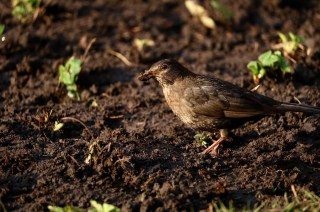
grub is the larva of an insect, and has meant that since the early 1400s. Etymologists aren’t actually sure if it’s from the verb
grub, which means “to dig around in the dirt” and has been around since the 1300s, or from the unrelated Middle English word of the same sound and spelling that means “a dwarfish fellow.”
By the 1650s, however, two different uses of the word had come into being. First, it can mean “a dull drudge.” But also, the one more familiar to us today: “food.” This sense came from birds eating grubs, but also because of how similar it sounds to bub, which was a popular drink at the time.

by Roseanna White | Apr 23, 2018 | Word of the Week
This is actually a repost of a word from 6 years ago, but my daughter asked me about it last week, so it seemed a fine time for a revisit. ?
Reckless is one of those that always confused me as a kid. I mean, why was it reckLESS when you were indicating that people were apt to wreck?

Of course, I knew there was that missing “w”…but still. For years it made me shake my head, and I rated it up there with “inflammable = flammable.” (Yeah, just try puzzling
that one out without the help of the etymology! LOL.)
As it turns out, it is indeed mere coincidence that reck and wreck are homonyms and carry meanings that can be so opposite. Reck is from a very old Germanic word that means “care, heed.” So since the days of Old English, reckless (or its original receleas) has meant “without care or heed.”
Wreck, on the other hand, is from the Old Norse wrek, which for centuries had ONLY ship-wreck meaning–flotsam, that which washed up after a ship went to pieces. It wasn’t until the 1700s that “wreck” was applied to any remains of a thing ruined. As a verb, it has carried the meaning of “ruin or destroy” since the 1500s.
So there we have it. Two totally different roots that happen to end up with identical sounds in modern English. Solely to confuse school children across the English-speaking world, I’m sure. ?

by Roseanna White | Apr 16, 2018 | Word of the Week
Some families are football families. Baseball families. Basketball families.
We are a hockey family. And since the playoff just began and we’re cheering our Penguins on, I thought I’d pause to look at one of the hockey terms. (Okay, so it was a trending word on
www.etymonline.com, which is where I actually got the idea, LOL. Still!)
When I first started watching hockey with my husband, it was a constant case of, “What does that mean? Why are they doing that?” I knew none of the rules. Even now, twelve years later, I still occasionally have to ask for clarification or reasoning.
One of the early terms I needed defined was hat trick. Simple definition: when a single player scores three points in a game. In hockey, when a player gets a hat trick, the fans celebrate it by throwing their hats onto the ice. (One night, this happened during Free Hat Night, when every fan had been given a souvenir ball cap. Oh. My. Gracious. The ice was black with them!)
But where did this come from?
As it turns out, the phrase originated in the 1870s and was used in cricket for a player who took three wickets on three consecutive deliveries. The why isn’t entirely clear. Some say that he’d be given a hat by his club, commemorating the feat. Some say he got to pass that hat around for congratulatory donations. Some say it’s surely influenced by the magician’s trick of pulling something out of his hat, which is recorded for the first time in the same few years. Probably a little bit of all of these.
By 1909, the phrase had been borrowed by hockey, for the feat mentioned above, and it’s been a term in the sport ever since!


 My favorites are soft and chewy. Some prefer crisp and buttery. But in my opinion, all cookies are awesome. What they aren’t, however, is called the same thing everywhere, or in all of history.


 Roseanna M. White is a bestselling, Christy Award winning author who has long claimed that words are the air she breathes. Having successfully launched two homeschool grads, she now spends her time writing fiction, designing book covers, and pretending her house will clean itself. Roseanna is the author of a slew of historical novels that span several continents and thousands of years, as well as a fantasy series and contemporary mysteries and romances. Spies and war and mayhem always seem to find their way into her books…to offset her real life, which is blessedly ordinary.