
by Roseanna White | Dec 3, 2012 | Word of the Week
 |
Estes Park, Colorado, Whyte’s Lake by Albert Bierstadt, 1877
|
Happy December, everyone! I don’t know about you, but with small kids in the house, the Christmas spirit has descended around here. Yesterday was spent making salt-dough ornaments, and this coming weekend my little girl will be in The Nutcracker. Gotta love it. =)
For today’s Word of the Week, I bring you another one that surprised me in some respects when I, for some reason or another, thought to look it up. Park, as a noun, has been around pretty much forever, at first meaning an enclosed area for hunting. There’s some speculation that its root comes from the word for the fencing, rather than the land enclosed. But by the 1600s, it had taken on its now-traditional meaning of a place in a town or city for public recreation.
What got me was the verb. It derived from a particular form of the noun that was reserved for military vehicles, and so became “to arrange military vehicles in a park” in 1812. So late! I kinda thought that as long as there were vehicles, there would be a word for parking them. But apparently it wasn’t park for quite a while, LOL. And it didn’t get extended to non-military vehicles until 1844.
Not surprisingly, the application to cars is more modern still. As a transmission gear, park made its debut in 1949. (Anyone know what they called it before that? Anyone? I have no clue…) And park-and-ride joined the scene in 1966.
And now that I’m firmly parked in front of my computer, it’s time to get back to trimming
Whispers from the Shadows. Hope everyone has a lovely week!
by Roseanna White | Nov 26, 2012 | Word of the Week
I hope everyone (at least those of you in the U.S.) had a lovely Thanksgiving! Ours was great and led into a wonderful weekend. The best part of which was that I didn’t have to cook since Wednesday, what with all the invitations to share leftovers. 😉
|
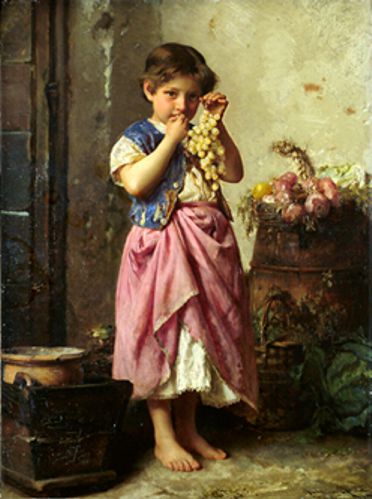
| L’enfant avec les raisins, Antonio Rotta, 1884 |
So in honor of the feast of leftover food, this week’s word is snack. It sounds a bit modern, right? But in fact it traces its roots back to the 1300s, when snack was solely a verb which described a dog biting or snapping. It took it 400 years, but by 1757, it had become the noun we know, meaning “a bite or morsel to eat.” Fifty years later the verb followed suit and meant “to have a small amount to eat,” in 1807 (in case you haven’t had your coffee yet and don’t wanna do the math). Snack bar came about in 1930.
And there we have it!
For those of you who are really observant, you might notice that I updated my blog over the weekend. It now matches my website, and also has new tabs and pages, the old ones for the
Annapolis blog tour finally going bye-bye. Do please check out the page for Ordinary Heroes, a series I’ll be starting in 2013. I need stories! =)

by Roseanna White | Nov 19, 2012 | Word of the Week
|
| Water as a–ahem–living force 😉 |
Getting down the basics, aren’t I? 😉
I had actually looked up water to determine when “water closet” came to be used for a bathroom, but there were some other interesting entries too.
And it starts with the beginning. Did you know that there used to be two words for water? One began with ap- and the other with wed-. The first was for water as a living thing, meaning “animate.” A force of life. (And fire most likely had the same thing, though they haven’t traced it so clearly.) The second was for the inanimate, regular ol’ version.
Then we get into the fun phrases. =) “To keep one’s head above water” in the figurative sense surprised me by being from 1742. I would have thought it slightly newer than that. Also surprising is the one I looked the word up for–“water closet” is from 1755.
In 1818 they were introduced to “water-ice,” a confections…like a snow cone, I should think, right? “Water cooler” joined the club in 1846, and “water polo” in 1884.
And as we’re entering Thanksgiving week, allow me to wish everyone a wonderful holiday. I know I’m super-thankful for each and every one of you!
by Roseanna White | Nov 12, 2012 | Word of the Week
|
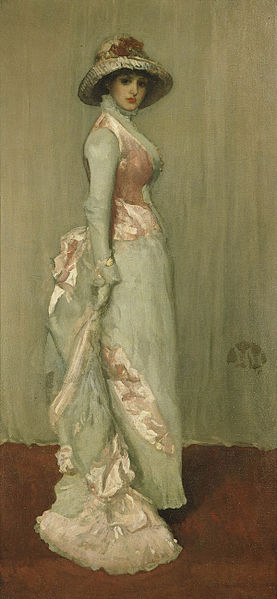
Whistler’s Harmony of Pink and Gray – 1881
Yes, I chose it because of the year and its prettiness,
not because of any other relevance. 😉 |
|
I know, right? You’re thinking “Her word of the week is what? Seriously? This chick is losing it…” 😉 But hopefully you’ll read on to see what in the world inspired me to write about what, LOL.
Last week as I was editing an upcoming WhiteFire title, I read a line where one of the characters says “What’s up?” The year is 1921, the phrase sounds modern to me, so I thought I had better look it up (even though I trust this author implicitly, things slip by us all, right?) So I tapped what into the etymology dictionary and found quite a few idioms that were older than I’d thought!
The word as a question, as a “What did you say?” dates all the way back to 1300. That doesn’t really surprise me. But I was quite surprised to see that “what’s-his-name” dates from 1690! I would have thought that a more modern phrase, personally. (The variant “what’s-his-face,” though, is from the 1960s, LOL.)
The phrase “what for,” as in “give him the what-for” is from 1873, which apparently, interestingly, came about as a smart reply to people asking the question “What for?”
And finally, the one I was looking up. “What’s up?” made its debut right around 1881. Which did surprise me a bit, I confess. It didn’t give me any idea where it came from (like that handy explanation of the what-for…) but it’s always so much fun to discover a use is older than I anticipated!
I hope everyone has a lovely week!
by Roseanna White | Nov 5, 2012 | Word of the Week
|
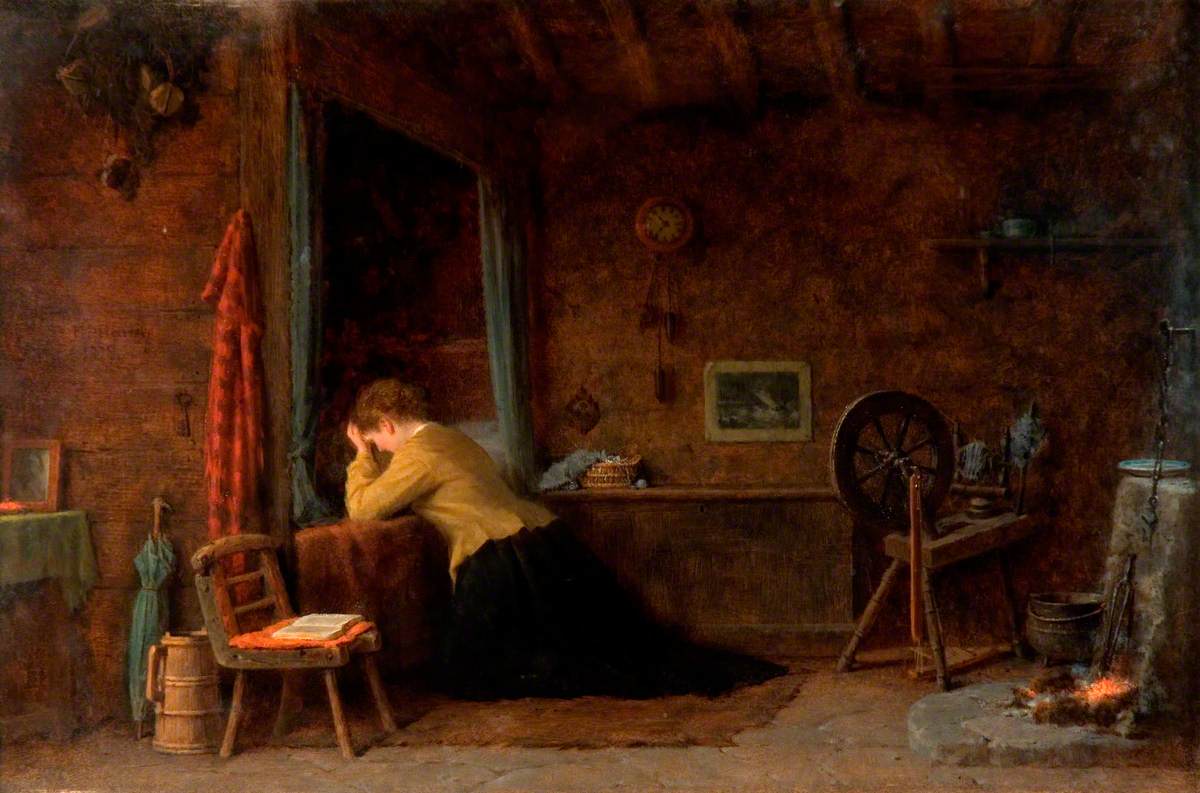
| A Prayer for Those at Sea by Frederick Daniel Hardy, 1879 |
With Election Day being tomorrow and so many already having voted early, I felt the need to spend today’s post in a word of prayer rather than a word’s etymology. I try to steer clear of politics in my online presence, and so I don’t intend to talk about candidates or my opinions–but please do join me in praying for our country and her direction.
Dear Lord, we fall to our knees before You, in awe of Your beauty and reverence. In amazement at Your love for us. When I think of Your glory, of Your wonder, of all the intricate paths You set before us, tears come to my eyes. You are true. You are holy. You are worthy of every whisper of love our lips can utter. And we worship You knowing that You are the Lord of our beginnings and the God of our ends.
Father, I know you have placed us all where we need to be, for a purpose. You have put our feet on the earth at this exact point in history because this is where we belong. And so we are intimately tied to all that happens in this world around us, even if we are apart from it as our focus is on You. You have called us to live in peace, as much as we are able, and to always, always choose righteousness. If we suffer for Your sake, it is glory. But how much better to live selflessly and so influence other for You so that our enemies become Your children!
So here we sit in this nation You have made ours, this nation founded with such lofty principles, all based on the idea of freedom. Here we sit, people on both sides of the aisle claiming that to elect the other guy would mean fewer freedoms. But Lord, we know that true freedom rests not in the decrees of man, but in the freeing liberty of salvation. We know that there is no man who can become president and set the world to rights–that such change must come from within the hearts of the people.
But we also know, Lord, that only one can win. And we pray now, on our faces prostrate before Your throne, that the man will win who will follow Your path. We pray that your angels be stationed around each polling place, that with their swords outstretched they will keep the enemy away. We pray that the ears of our neighbors be stopped against any whispers from the evil one, that their hearts be guarded against that influence. Because we know, Father God, that whatever You want, he wants the opposite, and he will manipulate mankind to achieve it. Guard us against his wiles, O Lord my God. Guard us and protect us.
Father, we pray Your will be done. In every person’s day, in every person’s decision, in every vote, in every result, in every office. Let Your will be done. Let Truth prevail and overcome any fraud or deceit. Let Wisdom dictate our decisions. Let Love cover campaigns so often focused on the negative. Let Your will be done. And let it be, please dear Lord, for our redemption and not for our destruction. Help us, through our decision, to redeem the times as You instruct us in Ephesians. Help us to be the light in this darkness. And to
Shine that light through our voices and votes.
We commit our nation, our states, our communities into Your hands. We commit our hearts, our lives, and our spirits unto You. Take us back, God of All, hear our cries. And silence our enemies to that we may hear Your voice directing us. In the name of Your precious son Jesus we pray. Amen.

by Roseanna White | Oct 29, 2012 | Word of the Week
First of all, I would like to report that I finished up Whispers from the Shadows on Thursday! Woot! It checked in way too long (130,000 words instead of the 116,000 I was to shoot for), but everyone agrees that it’s better to have too much than to run out of story with 20K to go. 😉 Now it’s time to shift my focus to editing–and hunker down as Sandy swings up this way. She’s supposed to hit us tomorrow morning, with tropical storm force winds hitting us here in the mountains. Should be interesting.
Anyway. Rereading one of my chapters yesterday, I was inspired to look up the word card to see when the phrase “playing the ______ card” came into being. So I thought I’d share my findings. =)
|
| Playing card from the 1895 Vanity Fair deck |
The word card itself is really old–the English word dates from 1400. It’s taken from the Latin charta, which means “leaf of paper,” which in turn comes from the Greek khartes, “layers of papyrus.” Which, in its turn, is probably derived straight from the Egyptian word.
The most familiar meaning of “playing cards” dates in English and French from the 1590s. The listing didn’t tell me about calling cards, but I happen to know those were around for a long while, especially popular in the 19th century. Greeting cards came about in 1869, and people who are original earned the name card in 1836 but usually had “smart” in front of it back then and came from the playing card sense.
“Card table” dates from 1713 and “house of cards” in the figurative sense is from 1640s–supposedly from Milton. To have a card up one’s sleeve is 1898; and, finally, the one I was actually looking for! LOL. To play the _______ card is from 1886, originally the Orange card, meaning “appeal to Northern Irish Protestant sentiment (for political advantage).” Who knew?
So yeah, my hero’s best friend couldn’t accuse him of playing the _____ card, which is fine. But I sure learned something in the looking up of it!



 Roseanna M. White is a bestselling, Christy Award winning author who has long claimed that words are the air she breathes. Having successfully launched two homeschool grads, she now spends her time writing fiction, designing book covers, and pretending her house will clean itself. Roseanna is the author of a slew of historical novels that span several continents and thousands of years, as well as a fantasy series and contemporary mysteries and romances. Spies and war and mayhem always seem to find their way into her books…to offset her real life, which is blessedly ordinary.