
by Roseanna White | Feb 4, 2013 | Word of the Week
|
Peasants Brawling by Abraham Diepraam
(A ragtag collection, to be sure) 😉 |
I had the pleasure of going over edits on Whispers from the Shadows last week, and my editor and I got to laugh about some of the not-in-use-yet words that slipped through. =) A few were difficult…I still don’t know what I’m going to replace them with! But this was kinda funny.
I had my British character sneering at the very thought of a ragtag collection of farmers defeating the British (again, ahem) with their pitchforks and shovels. Only, as Kim pointed out, “ragtag” was still a decade away from use. Le sigh. Apparently this phrase in reverse, “tag-rag and bobtail” has been in use since 1650, but not switched around. That didn’t make its appearance (and again, paired with “bobtail”) until 1820.
I would have been left scratching my head over that “bobtail” part, gotta say, if the etymology dictionary didn’t specify that bobtail meant “cur.” Apparently tag and rag was also a popular phrase in the 16-17th centuries.
When we first went over these edits, I had no handy substitution for ragtag. But later that afternoon, if you heard me randomly shout out, “Motley!” that would be why. 😉 When next I spoke with my editor, I happily told her my epiphany, and she made the substitution. And motley has been around since the 14th century, with even its newest meaning of “fool” from 1600.
But in looking up motley to check it, I saw another “rag” entry! Apparently at the same time that ragtag was coming into use, rag-bag made its debut too–though apparently literally, at first. It took on the figurative meaning, however, by 1864.
And now I get to shift my thinking up to that very time period. =) All set, I am, for the world of 1865. Where ragtag is acceptable, if I have an occasion to use it, LOL.
by Roseanna White | Jan 28, 2013 | Word of the Week
Just for the record, I really hated to post something new today and push
my lovely book trailer down the page. 😉 But alas, it is Monday, so time to educate! Today we’re delving into the world of science.
|
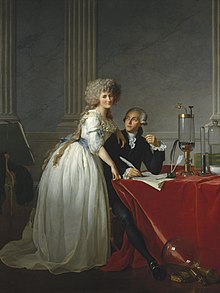
| Lavoisier, considered the father of modern chemistry |
Though I don’t recall when, I semi-recently tried to use the word
catalyst in my 1814-set
Whispers from the Shadows, in the way we today often use it–figuratively, meaning something to cause a change. But my wordy-sense (sorry, watching
Ultimate Spider-Man even now, and he keep gets a tingle, LOL) had me looking it up, and sure enough…
Catalyst is of course a chemistry word, which I knew. But I hadn’t recalled that it wasn’t used to mean a “substance which speeds a chemical reaction but itself remains unchanged” until 1902. So I certainly didn’t realize that the figurative sense didn’t come about until 1943.
What I really didn’t know was that it came from another, similar word, catalysis. This formation had the same meaning as catalyst since 1836, and before that meant “dissolution.”
Either way, not working in my book, LOL.
Hope everyone has a good week! My plans are to wrap up my main research for the third Culper book this week, and start writing next week–yay! =)
And in case you haven’t swung by lately, you may have missed my announcement that
Ring of Secrets is available from ChristianBook.com!
Click Here
And of course, don’t miss the aforementioned, totally giddyifing (sure, that’s a word) book trailer I got on Thursday!
.jpg/535px-Johannes_Vermeer_-_Zittende_Klavecimbelspeelster_(1673-1675).jpg)
by Roseanna White | Jan 21, 2013 | Word of the Week
|
| Young Lady Seated at the Virginals by Johannes Vermeer, 1670 |
I was looking up back seat and saw these entries. And given that they came up in the search backwards (entry 2 before entry 1), I had a moment when I thought seat as in a place of government–like a county seat–pre-dated the thing on which we sit. Not so, but there are some interesting tidbits with this word. =)
Seat, “thing which one sits on,” is from about 1200. No great surprise there, that it’s one of the Ye Olde English words, eh? But the second meaning of “residence, abode, established place” wasn’t long in following, coming into be by the latter part of the same century. It took it a little over 100 years to evolve into “where a government sits.”
By 1600, the literal version of the word had extended to include “the posterior of the body.” For the part of clothing covering that part, 1835. And finally, seat belt is from 1932–their first appearances being in airplanes.
On more interesting tidbit on that second meaning of seat goes back to the Old English sæt — which not only meant “a place one sits in ambush” but also “resident, inhabitant.” That, I did not know. But it’s apparently where the -set ending comes from in British town names like Dorset or Somerset (hey, I have a Somerset around here! LOL)
I hope everyone had a great weekend!
Oh, and a quick update on little Haley, for those who have been praying. They didn’t get the whole tumor–an MRI will tell them how much of it they got, somewhere between 50 and 90%. But Haley’s doing really well and has even been transferred to the general Peds ward! Please do keep praying–this isn’t over yet, and her poor parents are close to overwhelm.
by Roseanna White | Jan 14, 2013 | Word of the Week
|
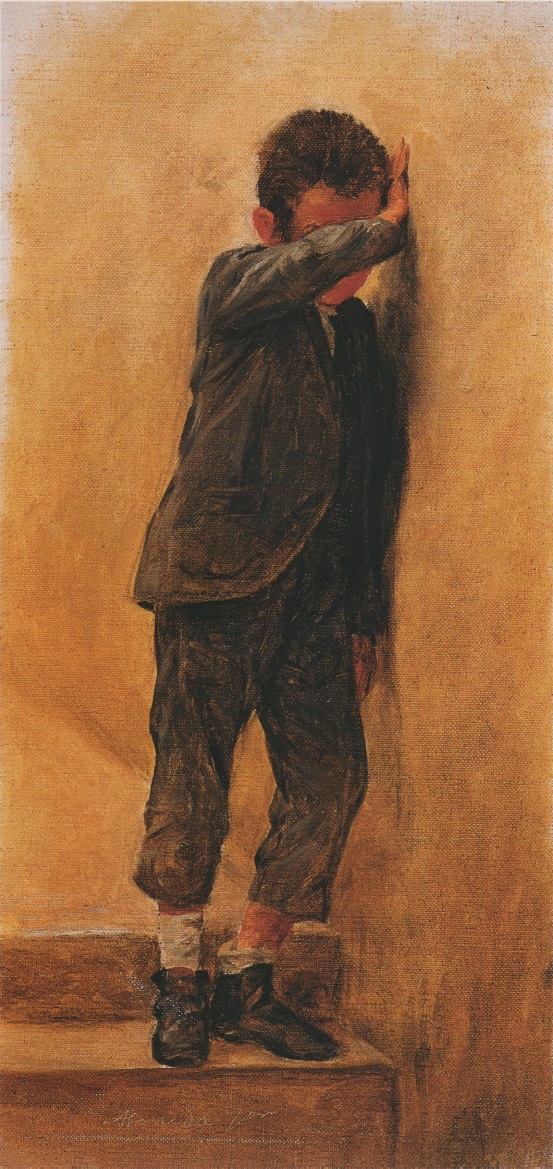
| Scolding by Jose Ferras de Almeida |
I have children. Therefore I have uttered the phrase (a time or two–ahem) “Don’t talk back.” Or perhaps occasionally, “No back-talk.” But when I had a character using the same, I ran into a problem.
Back-talk, meaning “an impertinent retort” didn’t come around until 1858. Which is, I suppose, why we see phrases like “No impertinence” in older works instead, LOL. Interestingly, the phrase is believed it have originated in literary circles, when writers tried to imitate “low” Irish idioms. Who knew?
Talk back is a form of back-talk that followed it about a decade later. For some reason I thought that one would have been the original, but shows what I know, I suppose. 😉
I hope everyone’s week is off to a great start! And stay tuned–I have some good news to share with y’all later in the week. =)
by Roseanna White | Jan 7, 2013 | Word of the Week
|
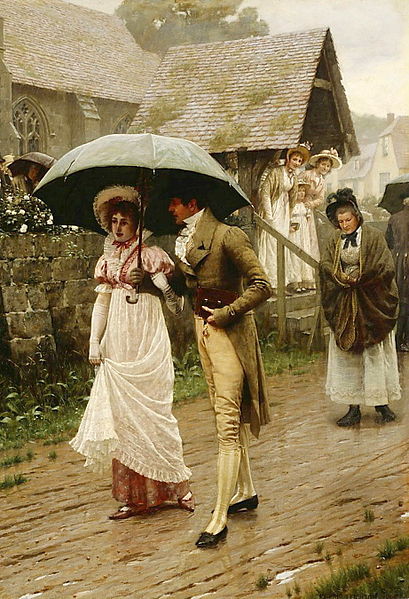
| A Wet Sunday Morning by Edmund Blair Leighton, 1896 |
Wow, it feels like forever since I’ve done one of these! LOL. Ah, the holidays. =) But the Twelve Days and Epiphany are over, my tree is down, and it’s back to the grindstone completely this week.
One of the words I’ve had to look up in the last couple weeks and surprised me is slosh. I believe I looked it up when someone in a historical referred to someone as sloshed. A few clickety-clacks and I verified that this was a colloquialism for “drunk” by 1900, so was no problem in this particular book. But what surprised me was that slosh as a verb meaning “to splash about” didn’t come about until 1844. (I have a feeling I may have misused that in a book somewhere…) And the verb meaning “to pour carelessly” didn’t follow until 1875. Who knew they were so new?
So the adjective meaning “drunk” came from the verb, and the verb came from the noun form, which made its appearance in 1814 meaning “slush, sludge.” Which is funny, because that’s the form least-used now, methinks.
And there was have it. Not until the 1800s did this word come in to play at all, and not until 75 years after the noun did the adjective transform from the verb, so that you can say lovely things like “Only when sloshed would he slosh through the slosh.” 😉

by Roseanna White | Dec 10, 2012 | Holidays, Word of the Week
|
| 1922 ad in Ladies’ Home Journal |
I remember, as a child, writing stories and assignments for school around this time of year and occasionally using the abbreviation “X-mas” for Christmas. I remember teachers telling me not to use abbreviations in my assignments, and I remember someone else (can’t recall who) telling me not to use that one for Christmas because it just wasn’t right to take Christ out of Christmas (or something to that effect) and replace it with an X.
So in my middling years, I refused to use it, thinking it somehow mean to Jesus…then later I actually learned where it came from.
Pretty simple, really. The Greek word for Christ is Χριστός. You might notice that first letter. Our X, though it’s the Greek “chi.” No paganism here, no dark, dastardly scheming to remove Jesus from his birthday. Scholars started this as a form of shorthand. The first English use dates to 1755 in Bernard Ward’s History of St. Edmund’s College, Old Hall. Woodward, Byron, and Coleridge, to name a few, have used it to. And interestingly, similar abbreviations date way back. As early as 1100, the form “Xp̄es mæsse” for Christmas was used in the Anglo-Saxon Chronicle.
So. It’s still an abbreviation and oughtn’t be used in formal writing and more than w/ or b/c, but it’s also perfectly legitimate as what it is. Always nice to discover something like that. =) And I hope as everyone gears up, they have a truly wonderful one! I’m happy to say we survived the crazy Nutcracker weekend around here. 😉


.jpg/535px-Johannes_Vermeer_-_Zittende_Klavecimbelspeelster_(1673-1675).jpg)

 Roseanna M. White is a bestselling, Christy Award winning author who has long claimed that words are the air she breathes. Having successfully launched two homeschool grads, she now spends her time writing fiction, designing book covers, and pretending her house will clean itself. Roseanna is the author of a slew of historical novels that span several continents and thousands of years, as well as a fantasy series and contemporary mysteries and romances. Spies and war and mayhem always seem to find their way into her books…to offset her real life, which is blessedly ordinary.