
by Roseanna White | Sep 13, 2012 | Thoughtful Thursdays, Uncategorized
At the beginning of August,
I blogged about the trip we took to Texas and how it opened the door for us to start teaching our kids about volunteering and helping others wherever they see a need. Well, when we got home we talked to our church about starting a monthly day of service in our area, and now we’re happy to see that coming to fruition.
We’re going to start small, with trash pick-up at a local park. Also planned are things like caroling at the local assisted living facilities in December and helping at the food pantry in November. All things we can bring the kids along for, and hopefully brighten a few days.
To make it all official, my hubby dearest is making
t-shirts for the occasion, and so we started trolling the web for some great quotes on helping others. We ended up with this one:
 |
| Quote, obviously, from Einstein. Design by Roseanna. Blinding t-shirt color that I didn’t quite capture here chosen by my hubby 😉 |
But we found so many great quotes, that I just wanted to share the ones that most struck me. My favorite was the MLK one, but it was just too long:
“Everybody can be great. Because anybody can
serve. You don’t have to have a college degree to serve. You don’t
have to make your subject and your verb agree to serve…. You don’t
have to know the second theory of thermodynamics in physics to serve.
You only need a heart full of grace. A soul generated by love. ” ~Martin Luther King, Jr.
And some other great ones . . .
“Service is the rent we pay for being.” ~ Marian Wright Edelman
“How wonderful it is that nobody need wait a single moment before starting to improve the world.” ~ Anne Frank
“Do all the good you can, and make as little fuss about it as possible.” ~ Dickens
“The best way to find yourself is to lose yourself in the service of others.” ~ Mohandas Karamchand Gandhi
“No one is useless in this world who lightens the burdens of another.” ~ Dickens
“Many small people, in many small places, do many small things, that can alter the face of the world.” ~ Anonymous
“To do more for the world than the world does for you – that is success.” ~ Henry Ford
Personally, I think these are some great things to be keeping in mind as I prepare for the ACFW conference next week. This year, my prayer for the conference is that I might be a blessing. I don’t know how better to start on that goal than to put aside thoughts of me. And think of you instead.

by Roseanna White | Sep 6, 2012 | Thoughtful Thursdays, Uncategorized
7 But we were gentle among you, just as a nursing mother cherishes her own children. 8 So,
affectionately longing for you, we were well pleased to impart to you
not only the gospel of God, but also our own lives, because you had
become dear to us.
~ I Thessalonians 2:7-8
I read these verses the other day as part of my daily reading, and they hit me pretty forcefully. Paul here is talking about how they as sharers of the gospel behaved among the Thessalonians. And as a young mom, this analogy rings so, so true.
“As a nursing mother cherishes her own children.” I nursed two kids in the past almost-seven years, and let me just tell you that when you’re doing so, absolutely everything you do revolves around that. I chose my clothes based on my kids. Dresses? Too difficult to manage. Delicate necklaces? Ha! No way, no how. Chunky belts? Forget it–they would dig into the little one. I chose my food based on my kids. Too much caffeine? No, that could make its way into the milk supply. Certain foods that I ate could give them gas. Go out to lunch without the baby? It had better be carefully scheduled in those 2-3 hours I had between feedings.
But you know, it wasn’t a difficulty. It was just the way things were. It was what I did because I love my kids and had made that decision for them. Because I love them so much I would give them my life if they needed it, so what was a dress or a favorite necklace or a third cup of coffee?
What nursing a child comes down to is your life not being your own. It revolves around them. We think not for ourselves, but for our baby. And that’s the way we’re supposed to behave toward those we’re nurturing in the Lord too?
Ouch.
I do try to consider such things as my witness, my appearance, whether my faith is shining through my words and deeds. But to that extent? I don’t know that I have. And that really makes me pause and consider.
You know when my hubby and I get into fights? When we’re both focused on our own wants and desires rather than the other’s. You know when the kiddos frustrate me most? When they wrap both hands around their wills and cling. You know when I bet the Lord shakes his head at us? Yep. When our thoughts are filled with me, me, me instead of Him.
Instead of them.
He calls us to a beautiful thing. He calls us to nurturing His other children. He calls us to a love that is selfless and pure. More, a love that is natural. All He’s asking us is to let our transformed hearts guide us in our ministerial relationships. To not let that be overpowered by our selfish sides.
But you know, it can also be painful. It can tax the body, the mind. And if they push you away? Oh yeah, the pain can get pretty bad. We see that in some of Paul’s letters, don’t we? His agony when these young Christians he helped convert, who he is trying so hard to nurture in faith, reject his teaching.
That’s the way we ought to feel. Not just shrugging it off, but seeking after them. Drawing them close again.
I always love when I discover a facet of God revealed through the way He built families, and this is definitely one of those. He loves us…and calls us to love in return. Such a simple command in its essence–but far too often overlooked in this world that tells us to focus on ourselves.

by Roseanna White | Aug 30, 2012 | Thoughtful Thursdays, Uncategorized
8 For you were once darkness, but now you are light in the Lord. Walk as children of light 9 (for the fruit of the Spirit is in all goodness, righteousness, and truth), 10 finding out what is acceptable to the Lord. 11 And have no fellowship with the unfruitful works of darkness, but rather expose them. 12 For it is shameful even to speak of those things which are done by them in secret. 13 But all things that are exposed are made manifest by the light, for whatever makes manifest is light. 14 Therefore He says:
“Awake, you who sleep,
Arise from the dead,
And Christ will give you light.”
15 See then that you walk circumspectly, not as fools but as wise, 16 redeeming the time, because the days are evil.
I read this section of Ephesians 5 over a week ago, for the umpteenth time. Before, it was those first verses I quote that always struck me. For you were once darkness, but now you are light in the Lord. Walk as children of light…
Walk as children of light. What a command! I love the constant imagery in the New Testament of light versus darkness, of being the light, reflecting the light, living the light. (Y’all might remember my post on how we should shine…). It’s something I’ve thought about and talked about a lot because, well, it’s just so powerful. So deep. So thought-provoking. It’s always struck a chord.
But this last time when I read this chapter, it was verses 15 and 16 that slammed me. See then that you walk circumspectly, not as fools but as wise, redeeming the time, because the days are evil.
Did you catch that? That bit about redeeming the time? I never had. When I pondered redemption before, it was always as something we received, that beautiful gift of Christ. He redeemed us. That means he saved us from death. Literally purchased our life with his own. According to dictionary.com, this is the technical definition of “redeem”:
1. to buy or pay off; clear by payment: to redeem a mortgage.
2. to buy back, as after a tax sale or a mortgage foreclosure.
3. to recover (something pledged or mortgaged) by payment or other satisfaction: to redeem a pawned watch.
4. to exchange (bonds, trading stamps, etc.) for money or goods.
5. to convert (paper money) into specie.
Understanding how that applies to our souls is big. Huge. But it’s used differently here. Here we are not the redeemed…we are the redeemer.
Yikes. I don’t think I ever paused to realize before the sheer responsibility Paul is showing us here. That we are the redemption of our time, of our age. Though surrounded by evil, we are to buy our neighbors more time to learn the Good News. We’re to be those ten righteous men in Sodom that would have stayed judgment. We’re to be the David for the sake of whom the nation isn’t forsaken.
We’re to be the light that staves off the darkness.
Of course it comes back to that. 😉 That is, after all, the instruction on how to redeem the times. On what it looks like when we walk circumspectly, not as fools but as wise. But I’ll no longer read that as a simple command to do–now I also see the inherent why.
Because we don’t shine into the darkness to light our own way. We shine in the darkness to draw others to Him. We shine to show the Truth to those trapped in the dim, dim cave (thank you, Plato). We shine because without us the days would be night, and there would be no reason for God to withhold His judgment from the world.
But the world isn’t ready to be destroyed. And it’s up to us to buy it a little more time. To pay with ourselves, just as Jesus did for us. To give our lives to this walk, this Way, this fight, so that just one more souls can see the path. Can be bought and forgiven. Can be redeemed.
Can then join the ranks of those redeeming. It’s a call to action, that charge. A purpose. One that changes the way I see that dark, evil world around me. Not just as something deserving destruction–but as something that needs to be saved from it.

by Roseanna White | Aug 23, 2012 | Thoughtful Thursdays, Uncategorized
I had a nice, insightful post planned for today. Filled with brilliance (ahem) and thought and pondering a scripture that jumped out at me. I was just beginning to delve into the contemplation required for it when an adorable little face appeared beside mine. Grinning. And chanting, “School, school, school.”
Yeah, see, we decided we’d start the same day my niece did–today. But I kinda forgot to take into account that on the first day of school, I don’t have to lasso my darling girl to her chair at 9 like I do later in the year–she’s begging to begin at 6:30.
So . . . yeah. That’s what my morning has been. =) Getting Xoe back into math and handwriting, introducing her new spelling book. And going over letters and numbers with Rowyn. Pulling out her reader and trying to figure out what in the world this diamond-diagram thing is they have in the copywork section of my curriculum. Convincing Rowyn that his reading lesson can wait just a minute while I read Xoe her spelling words. Needless to say, blogging has slipped just a bit this morning, LOL.
I promise you that wonderfully insightful post on next Thursday. And tell you it has to do with redemption, but an application of it I’d never considered until I read it earlier this week. And for now, back to school I go!

by Roseanna White | Aug 16, 2012 | Thoughtful Thursdays, Uncategorized
And I’ve had a pretty fun week. My birthday on Tuesday was a lot of fun, filled with discounted food. 😉 My mom took me out to lunch and my hubby/kids to dinner, and both times, part of the meal was discounted (or free) because of a delay. Which suited me just fine and made it more fun. For dinner, we drove down to Hagerstown, MD, about an hour away, to go to Outback and use my free birthday coffee coupon at Starbucks. (Yes, the nearest Starbucks is an hour away. Gotta love Western Maryland…)
On the drive down, we were going through rain, with the sun behind us, and it resulted in a perpetual rainbow, low-slung and sparkling, right in front of us on the road. It traveled with us about five miles, to the delight of us all. I claimed it was my personal birthday rainbow. 😉 On the way home, the clouds were starting to lift from the mountains and valleys back into the sky, resulting in these gorgeous pillars of mist . . . quite a sight. God spared no imagination painting the landscape for me that evening. =) (Thanks, Lord!)

And also making this week fun is that I’ve bitten the bullet and stopped
talking about starting a local book club and actually
done it. Yay! The Inspired Book Club will meet at my church Library the last Thursday of every month, beginning in September. AND folks were so excited when I started talking about it, that we’ll be chatting on Facebook the last week of each month too. So if you’re too far away to come snack and chat with us, feel free to
join the Facebook group. And if you’re near Cumberland, MD and want to join, just shoot me an email at roseanna [at] roseannawhite [dot] com and I’ll give you directions! Our book for September is Tamera Alexander’s
A Lasting Impression. And to make it even more fun, Tammy has agreed to call in during out meeting so we can ask her questions and get the insider scoop on the book.

And even if you can’t squeeze one more thing into your schedule, let’s just admire my fun little logo. Isn’t it cute? LOL. I made that after organizing the
Christian Review of Books‘s shelves in its new location at my church. (Yay, all those books out of my sitting room!) Oh, and the CRoB is also in desperate need of a local-to-Cumberland-area volunteer to donate an hour or two a week to helping me keep the list updated and get books mailed out to reviewers. If you’re interested, email me at the address above.
Not exactly a life-altering blog post, I know, but it’s been that kind of week more full of news and chocolate cake than epiphanies. 😉 Thanks again, all, for your wonderful birthday wishes!
by Roseanna White | Aug 9, 2012 | Thoughtful Thursdays, Uncategorized
|
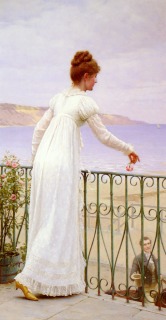
| A Favor by Edmund Blair Leighton |
I’ve always liked August. It holds my birthday, after all, and has traditionally had lots of other fun things going on. But on the other hand, it’s the end of summer. The start of school. For any household with kids, August signals a change in seasons, even though the heat of summer’s still upon us.
This year, when the page in the calendar flipped, it kinda got to me. I looked down at the project that had been my primary goal, and I see that it’s not all that far along. And that feeling of failure swamped me. That feeling of What have I been doing? How have I wasted my time?
Then I remember that I haven’t been twiddling my thumbs. I’ve been editing a lot, which is great and necessary. I wrote a novella that I’m excited to get to use for promotion between the first two books of the Culper Ring Series. And I got a good chunk done on another project.
A project that got stalled, perhaps even nixed for good. Which thought still brings me a pang.
I’m a writer–I know rejection well. I’ve had to put aside countless projects over the years. But for some reason, this one still gets me down now and then. Primarily, I think, because it’s intertwined with a couple other projects in my mind, which have also been stalled. Put on hold. Which they’ve been on so long that they’ve gone from “paused” to “stop.”
I’m not sure I can really explain this echoey sigh that fills me when I think about these things lately. I can see where the way things have fallen out is without doubt for the best. I can see that the Lord has His plan in it and have to nod at the wisdom.
But still there’s just this sense of loss. Lost dreams. Lost time spent on them when I could have been working on the project that’s a sure thing.
I have to trust there, though, too, don’t I? Trust that that time spent was for a purpose too. That it wasn’t wasted.
The funny thing is that I have no problem looking at the years spent on that pile of books in my computer that are unpublished and give them a thumb’s up. Because I learned from them, because they made me who I am, because I still hope that some of them will have their day. So why can’t I look at the month and a half spent on these projects the same way?
I’m really not sure, but it’s something I’ve been giving to the Lord again and again. And again, and again, I have to remind myself that I haven’t failed. That I’m doing just fine, thank you very much, on my primary project.
With mere weeks left in my “free” time this summer–or at least before the home school year starts–I can’t help but number my days and try to figure out how to catch up with where I wanted to be. But the real task here isn’t to write a chapter a day and edit two books for WhiteFire. The real task is to lay these stalled dreams on the alter and trust. Trust that lost dreams and lost time and lost motivation are all part of God’s plan for me to find something better. To find His path for me. To find Him in new ways.
It’s hard, when those echoey sighs billow through me. But then . . . trust always is.



 Roseanna M. White is a bestselling, Christy Award winning author who has long claimed that words are the air she breathes. Having successfully launched two homeschool grads, she now spends her time writing fiction, designing book covers, and pretending her house will clean itself. Roseanna is the author of a slew of historical novels that span several continents and thousands of years, as well as a fantasy series and contemporary mysteries and romances. Spies and war and mayhem always seem to find their way into her books…to offset her real life, which is blessedly ordinary.