
by Roseanna White | Jun 20, 2018 | Cover Designs
Sometimes authors come to me with very little idea of what they envision for their cover…and other times, they know exactly what they want. Now, knowing exactly what they want can occasionally be difficult, if that “what” is complicated. 😉 But other times, it makes it oh so easy to deliver a cover they love, quickly.
Pepper Basham has come to me several times with a very clear, very doable idea of what her next cover should be–she’s done several herself, and she has a great eye for what works. Occasionally she just needs me to handle some of the details.
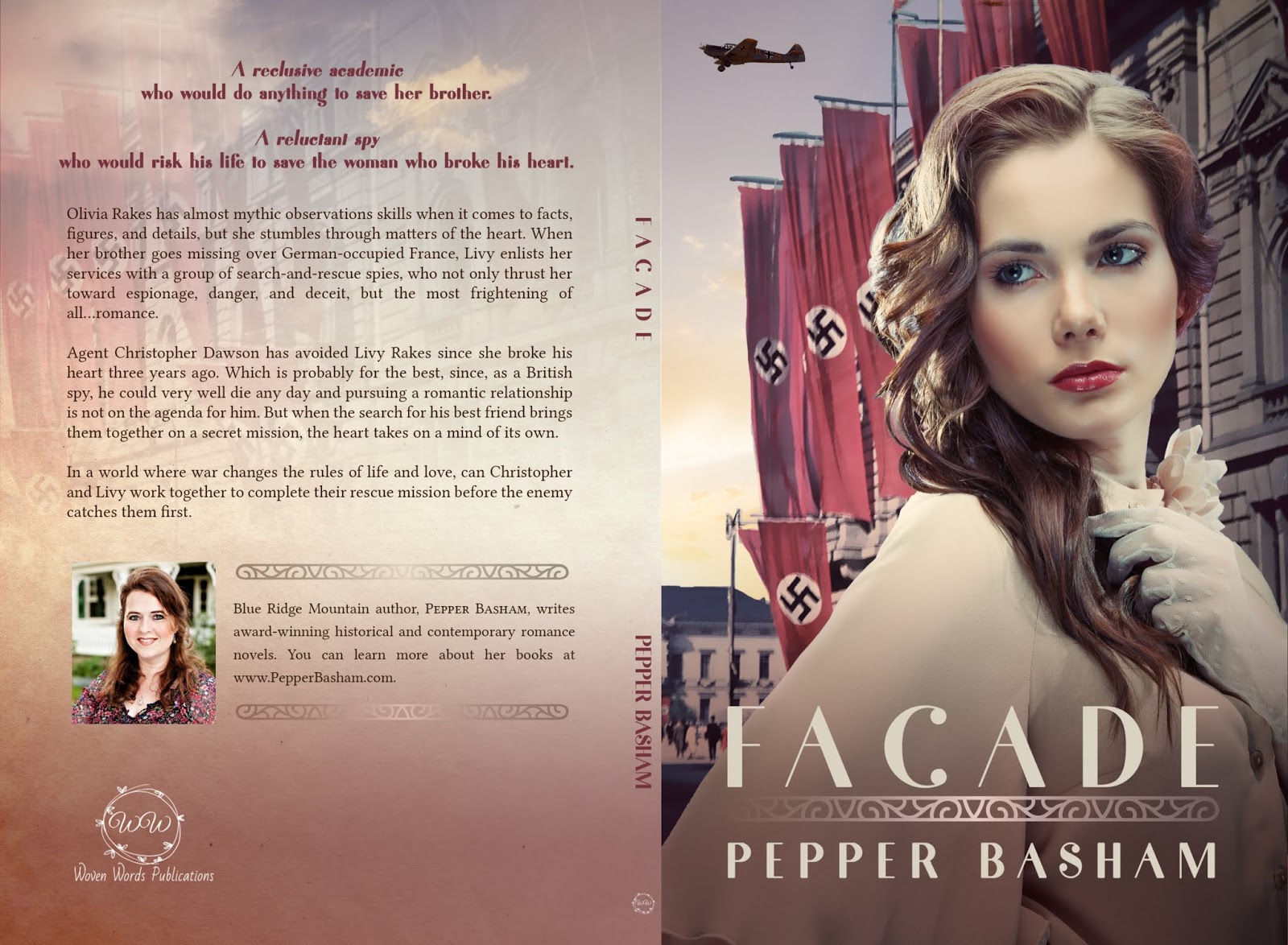
Such was the case for her WWII novella, Facade.
She knew exactly what she wanted. This model…
…over this background.
Pretty simple. So arranging that and sizing it correctly, we have this.
Not bad from the get-go, right? But Pepper hired me to punch it up a notch, so I figured I’d get punching. ? A quick one-two. First, I traded out that blue sky for something a little more interesting–a bit of sunset, golden flare.
Then, of course, I had to tweak the model’s coloring and brightness to match.
There was also a little bit of fine-tuning in there. The background image is an original WWII image, so it’s a bit grainy. I put a surface blur on it to smooth it out and then fooled with the highlights a bit to reflect my new sun as well.
One more small touch–an airplane. We added one of those to the top corner, tweaking lighting to make it reflect that sunset.
A little bit of work, but honestly, not a whole lot. This one came together very quickly. I was happy with the overall image, so it was time to turn my attention to the fonts. I figured something art deco would look great, so I chose Fragile, which I’d purchased in a package of fun fonts. I decided to keep it simple and put both the title and author name in the same font, separating them with an art deco bar. Then I just added a bit of a filter to the bottom to make those words pop.
And there’s our front!
For the full cover, I used the same background image as the front, with a paper texture overlay. Added on all the type and logos and author info, and voila! Full cover.
What do you think?
About the Book
A reclusive academic
who would do anything to save her brother.
A reluctant spy
willing to risk his life to save the woman who broke his heart.
 Olivia Rakes has the unique gift of observation, which suits her well since she prefers her books over the general populace, but when her brother goes MIA over France, Livy’s unique skills and her determination to save her brother force her into a world of espionage, deceit, danger…and the most frightening of all–romance.
Agent Christopher Dawson has never forgotten his childhood friend, and first love, Livy Rakes, but since she broke his heart, he’s avoided seeing her for years…until the search for his best friend brings them both together in the most unlikely of ways.
In a world where war changes the rules of life and love, can Christopher and Livy work together work together to unveil the mascarade before the enemy catches them?
You can also find Façade in the Timeless Love Novella Collection NOW AVAILABLE! (And whose cover I also designed, LOL)

by Roseanna White | Jun 18, 2018 | Word of the Week
Yesterday was my wedding anniversary–17 years since I first said “I do” to the love of my life. ? So naturally, today I thought I’d take a look at the words!
Wed is from Old English weddian, which means “to pledge oneself, vow; to betroth, to marry.” This is similar to other Germanic languages’ words, and while those other languages still reflect the original in their words today, English is a bit unique. While we retained wed in wedding, most often people today don’t say they hope to wed so-and-so–it sounds archaic.
English has instead adopted the French marier as well, giving us two options where other languages have stuck with one. Marry has pretty much the same meaning as wed, and it joined the English language in the 1300s, so it’s certainly been around a while.
Kind of interesting to think, though, of how the two have been assigned certain typical functions, right? Like we never ask for a piece of marriage cake. Nor do we look for our marriage gown. And yet we don’t exchange wedding vows on the day. We’ve come to view wedding as the specific event in which we bind ourselves, and marriage as the ongoing state (there’s the old-fashioned sounded wedlock for that too, but we don’t hear that much anymore, do we?). Which is rather interesting, since its early uses were also just for the ceremony, the initial pledging.
Regardless, I’m looking forward to another year with my husband. If you’re married, in what month is your anniversary? I’d never imagined I would be a June bride–I always wanted a December wedding, but the allure of a beach wedding instead drew me away from all my childhood plans, LOL, and I have no regrets! How about you?

by Roseanna White | Jun 14, 2018 | Thoughtful Thursdays
We set goals.
We work hard.
We sweat.
We cry.
We bleed.
We tumble down exhausted.
We stretch out our hands, willing our fingers to reach that last . . . single . . . inch.
Did we get there?
There. The end goal. The place we want to be.
There. The thing always just out of reach.
There. The place that, when we think we are there, can slip away the moment we’re not looking.
Have you been in that position? Where you think you’ve gained ground, only to lose it? Or where you feel like you’ve fallen just short of your goal?
Have you, on the other hand, been resting long and safe in this There, not stretching for another goal when maybe you should be?
I’ve been giving a lot of thought this last week to my there. My here. Where goals and realities meet and where they clash. What I count a failure and what I count a success, and what’s really within my power to change.
And I keep coming back to one simple truth.
There can be anywhere–but it’s only a success if I’m in the There where He wants me to be, fully reliant on Him. Sometimes, at least for me, success means taking things for granted. Success means slipping into pride. Success means that I begin to think I can instead of He can. In those moments, success in the world can mean failure in the soul.
Thank you, Lord, for reminding me always that while I’m called to do Your work, I’m not called to do it on my own strength, but through Yours. ONLY through Yours.
What is the There that you’re reaching for right now? Is it close? Too far? Are your in a period of straining or a period of rest?
Are you stretching far enough?
And most importantly, are we stretching our hands out only with His?

by Roseanna White | Jun 13, 2018 | Books, What We're Reading
A couple of weeks ago, I posted a question on Facebook, asking for audiobook recommendations. I thought it would be handy to compile the list I received before they get swallowed by Facebook history and impossible to find. 😉

I’ve never been a big audiobook listener. Up until now, I’ve listened to exactly two full works, and one partial. The two successful ones I listened to while knitting. The partial, I was just trying to get a handle on an accent and the accompanying spelling, so I just needed to compare the two for a few chapters. Which was all I could handle. Because I read fast, and the narrator, while very talented, read
s-l-o-w, and I couldn’t handle it for long. I am not patient with such things, LOL.
In addition to my impatience, I also am rarely alone in a quiet environment. As in, one without interruptions. It never seemed feasible to really get any good listening in, when interruptions meant having to press a button and then find my place again, rather than just looking up from a page.
But here’s the thing. I told myself I was going to exercise more regularly this summer and (hopefully) create a good habit. But I hate exercise. I mean, seriously. It always feels like a time drain, drudgery, useless. I can enjoy walking, but I don’t have many places I can walk where I live. So I decided I would have to treat it like folding laundry, one of my other dreaded tasks–give myself something to look forward to. For laundry, that meant a TV show on Netflix or Prime that I picked out, just for me. (Unprecedented in my house, LOL. Usually, if someone hands me the remote, I just turn the set off.)
It worked for laundry. I now actually look forward to folding. I’ve watched the complete series of White Collar and Gilmore Girls like this, and now I’m just having fun with Say Yes to the Dress. So I’ve been experimentally using audio books as the same sort of incentive for exercise. And thus far, for the past two weeks, it’s been working like a charm!
My first book selection was based mainly on my Library’s limited Overdrive selection of Christian fiction. They had exactly 11 that were labeled such. Seven of which were Amish fiction, which isn’t my preference. Two others of which I’ve read. That sure narrowed down the choices! So I ended up selecting one I’ve long wanted to read–have on my shelf, as a matter of fact, in paperback, but never got around to. Pearl in the Sand by Tessa Afshar. I’ve chatted with Tessa and greatly admire her, but I’d yet to pick up one of her books! Bad, Roseanna!
And it’s been amazing. Love it, and I can definitely see why she’s such a popular Bib-fic author! But I’ll be finishing it up in the next day or two, so it’s time to select my next read, hence revisiting the list of recommendations.
Here’s what’s come in already. I’d love to hear your rec’s, if they’re not already on there, and just to share these with you in case you’re also on the hunt!
I’ve divided these into genres…though I was working quickly, so if anything is mis-filed, don’t sue me. ? I didn’t divide out YA, and these are a mix of Christian and mainstream titles. I know that listening methods vary, so the links below will take you the book’s Goodreads page.
The Guernsey Literary and Potato Peel Pie Society by Mary Ann Shaffer, Annie Barrows
SPECULATIVE/SUPERNATURAL/SCI-FI/FANTASY
What is your favorite Audiobook?

by Roseanna White | Jun 11, 2018 | Word of the Week
This one is a special request from my daughter, who came across it in a book. ?
So, tootles. Being a 90s tween/teen, I grew up hearing this word as “goodbye” (or maybe it was toodles? Hard to say, as apparently it never appeared in writing, and it has no entry in any dictionary I can find…And my kids, being children of the 2000-10s, think of Toodles as a character on Mickey Mouse Clubhouse, so…)
But in fact, tootles is from the 1820s as “a frequentative of toot.” Now, first of all, I’ve never noticed another word described as “a frequentative of.” Spellcheck doesn’t even think “frequentative” is a word, LOL. But it just means exactly what you’d think–“when it happens frequently.” So tootle is when you toot frequently upon a horn or flute, for example.
Interestingly, and the use that grabbed my daughter’s attention, is that it later came to mean “to drive or move along in a leisurely fashion.” I can’t find a particular date on when that came into use, but she had encountered a sentence where the characters were tootling along in their car, which apparently struck her as hilarious.
So there we have it! Happy Monday!



 Olivia Rakes has the unique gift of observation, which suits her well since she prefers her books over the general populace, but when her brother goes MIA over France, Livy’s unique skills and her determination to save her brother force her into a world of espionage, deceit, danger…and the most frightening of all–romance.


 Roseanna M. White is a bestselling, Christy Award winning author who has long claimed that words are the air she breathes. Having successfully launched two homeschool grads, she now spends her time writing fiction, designing book covers, and pretending her house will clean itself. Roseanna is the author of a slew of historical novels that span several continents and thousands of years, as well as a fantasy series and contemporary mysteries and romances. Spies and war and mayhem always seem to find their way into her books…to offset her real life, which is blessedly ordinary.