
by Roseanna White | Jul 3, 2018 | 20th Century, Companion Guides, Remember When Wednesdays
I’m posting my “Remember When” a day early this week, in deference to Independence Day tomorrow. Just pretend it’s Wednesday. ?
These days, when someone asks you what time it is, you might just pull out your cell phone. But until recently, that certainly wasn’t the norm, right? You would have looked at your wrist–and many of us today still do. (I say “us,” but the sad truth is that I rarely wear a watch–it hits against my laptop keyboard and is uncomfortable, and since I’m home most of the time, I can just look at a clock, so…)
But wristwatches–arguably the norm for timekeeping for the last century–were once the new kid on the block. And we owe their popularity primarily to one man.
Hans Wilsdorf.
Born in Germany in 1881, Hans and his brother and sister were orphaned when he was 12. His uncles decided that in order to see to the childrens’ futures, they would liquidate the prosperous family business and equip the children with the means to be self-reliant. They were sent to boarding school, where Hans showed great promise in languages and mathematics. His fluency in multiple tongues led him to an apprenticeship at a pearl exporter with a worldwide sales organization–something that taught him much about business.
From there he was hired in the year 1900 by a French watchmaking firm. Again, it was his linguistics skills that got him the job, but he quickly came to love and appreciate the world of watches.
In 1903, Hans moved to London to work for another watchmaking firm. He ended up marrying an English woman, applying for and receiving English citizenship, and eventually began his own watch company with his wife’s brother–Wilsdorf & Davis.
But Hans wasn’t satisfied to just make traditional pocket watches in the traditional way. Hans had a vision of a “wristlet.” A watch worn on the wrist. And he had a dream of being a watchmaker so respected that it would be his name that sold a watch, not the trader who sold it (as had always been the case).
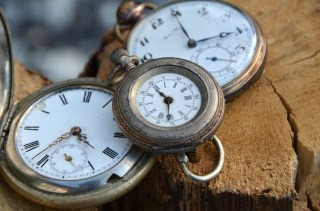
So Hans set out on a journey. First, he utilized the Swiss watch movements he’d learned so much about in his previous jobs to acquire the best, most accurate workings possible. Then he soldered a strap onto a small pocket watch and strapped it around his wrist. But there were issues that needed to be overcome–the arm moves a whole lot more than a person’s body, with more violent motions. This was terrible for watches. Such jostling usually damaged the works and make them, well, not
work. Plus, there was the matter of dirt and other particles getting into a watch case. In a pocket, the watch was protected from such undesirables. But on the wrist? They’d get grimy, fast. And that would gum up the works. So that, again, they wouldn’t work.
Through a series of different prototypes, Hans Wilsdorf worked out these issues. He created a case with a gasket to seal it from dirt, and utilized works so precise and robust that not only did the jostling not destroy them, but the watch still remained accurate.
In fact, his wristlet was honored with the Certificate of Chronometric Precision–an award that had until then only ever been issued to marine clocks.
During this time, Hans was trying to come up with a name for his company that wasn’t just his name. He wanted something that would be pronounced the same in German, French, and English. Something that was easy to say, concise, and had that certain something when one heard it. It took him quite a long time to hit upon the name he felt embodied all those things.
 Rolex.
In the 1910s, he began to do the unthinkable. He put Rolex on the face of a few watches. Now, this was unheard of. The face of a watch usually had the trader’s name, because that was who people trusted. The manufacturer’s name only went on the back of the case. Hans knew he was treading on dangerous ground…but at that point, most of his wristlets were being shipped out of England, to Europe. So what were they really going to do if his company name appeared on, say, 1 of every 6 watches? Nothing. So that’s how it began. First on one, then on two, then on half, and eventually all of his watches bore the name Rolex on the face. And the traders accepted them because they were the best watches to be found.
Today, of course, we know the name Rolex. But it was still quite a journey from those early days to the company that is now a byword for luxury. Come back next Wednesday for the rest of the story, and to discover how this fun history worked its way into
An Hour Unspent!

by Roseanna White | Jul 2, 2018 | Word of the Week

It’s summer. And so, as I was casting around looking for words to feature, my daughter said, “Do something summery! Like, you know…a carnival, or the fair.”
When I’m writing this, our County Fair has just finished up, and the neighboring county’s is scheduled for a few weeks from now. But I have to confess, I’ve never researched the history of these traditional events.
I started, of course, by looking up the word. First of all, I discovered that fair, the adjective, and fair the noun aren’t related at all. The adjective dates back to the Old English fæger, meaning “pleasing to the sight, beautiful, morally good.” Similar words can be found in other Germanic languages.
The noun, however–“a regular meeting in a city or town for buying and selling”–is from the 1300s, Anglo-French, from the Old French feire or faire. I had no idea these were totally different words, from different languages!
Back in the day, a fair was much like a market. But centuries ago, big events (often city- or county-wide) began to be scheduled for once a year, where people didn’t just buy and sell, they came to see the latest innovations, enter their food and livestock into contests, and basically stay up-to-date with the rest of the world.
The earliest county fair in America is recorded in 1641, in New Amsterdam. By the 1800s, they could be found in just about every county. They were still primarily agricultural expos. This was where new farm equipment was demonstrated and new techniques discussed. But by this time, a bit of the carnival atmosphere had also come in. Games, contests, and competitions offered something for everyone.
I love that these events are still a part of our culture! I admit that my family mostly likes to go for the rides…and maybe the food, LOL. But I love that horse-pulling competitions have just morphed into mud-bogging and demolition derbies. That people still enter their livestock into competitions, and people still bring baked goods to pit against their neighbors’.
Do you go to your County or State Fair? If so, what’s your favorite part?

by Roseanna White | Jun 27, 2018 | 20th Century, Companion Guides, Remember When Wednesdays
 When the design for A Name Unknown, book 1 in the Shadows Over England Series, was shone to me and I saw the spine for the first time, I was so excited to see the series logo they’d come up with. Big Ben’s clock tower.
Big Ben says London. Which is what the designers were no doubt trying to invoke, as my family of thieves are firmly Londoners. But for me, it was more than that. Because in the third book of the series,
An Hour Unspent, that iconic clock actually plays a role in the story.
For starters, a bit of naming. Most of us think of “Big Ben” as the clock, but it’s technically not. Big Ben is actually the bell. The clock is the Great Westminster Clock, though over the years the name Big Ben has come to be associated with the entire structure. So now that we’ve got that straight… ?

The clock tower was designed by Augustus Pugin and completed in 1859. Pugin was an architect, one who is most remembered for redesigning the interior of Westminster Palace and the tower in question, which has become one of the most iconic symbols of England. Though he also designed the face of the clock, the mechanics of the thing he wisely handed over to someone else.
But interestingly, the movement–the gears and weights that make a clock work, and in this case, work with amazing reliability–was actually designed by two amateurs to the field. Edmund Denison, a lawyer, and mathematician George Airy. The construction was the only part undertaken by an actual clockmaker, Edward Dent.
The Great Clock’s inner workings are so precise that a penny sitting on the pendulum is all it takes to make slight alterations to the time. That one little coin will make an adjustment of nearly half a second a day. That doesn’t sound like much, but it allows for small incremental adjustments to keep the clock accurate year after year. The pendulum still has a stack of old coins on it, and the clock is still hand-wound three times a week.
In my story, I gave the job of upkeep of the Great Clock to my heroine’s father, a clock maker. This part is purely fictional, of course, but it would have been considered a great honor to be tasked with such a responsibility, and in my story that’s the proof of Cecil Manning’s proficiency in his trade, even though he’s by no means made himself rich.
That honor goes to another historical figure that my fictional Manning claims as a friend, who revolutionized the timekeeping world. But you’ll have to come by next Wednesday to learn about that…

by Roseanna White | Jun 25, 2018 | Word of the Week
I love that
www.etymonline.com has a list of trending words. Sometimes I click on them solely out of curiosity…like when I saw
circus on there today.
Last May my family journeyed to Charleston, WV to attend one of the final shows of the Ringling Bros and Barnum & Bailey Circus, and it was frankly amazing. So amazing that we really wished we’d given it a try way earlier so we could have attended more and caught all their different shows. Up until then, I’d never gone to a circus, be it large or small, though a tiny little one set up once on my high school’s grounds. I saw the elephants from the road, but we had something else going on that weekend and I couldn’t go. Kinda wish I had.
But anyway! Did you ever notice that circus looks an awful lot like circle? And circumference? And all those other circ- words that denote something round? This isn’t a coincidence. The word comes directly from Latin, where it meant “a ring, a circular line.” It was used in Ancient Rome for the open-roofed enclosures used for races and so on. The Latin word had been borrowed from the Ancient Greek kirkos, which meant the same thing.
In the early 1700s, the word was applied in English to buildings arranged in a circular pattern, hence Picadilly Circus, and also to a ring road. By the end of the 1700s, it had also been applied to the arenas used to showcase feats of horsemanship, acrobatics, etc.–but at first, it was just for the tent. It took about 40 years for it to come to mean the company or traveling show itself by 1838 or so. Another twenty years, and it had taken on the metaphorical sense of “a lively uproar, a hubbub.” And finally, during WWI, it was used to describe a squadron of aircraft.
Have you ever gone to a circus? What did you think of it?

by Roseanna White | Jun 21, 2018 | Thoughtful Thursdays
Over the weekend, my husband and I took a drive to meet up with some good friends for a dinner, halfway between where we live. We’ve been trying to do this somewhat regularly, and it’s inevitably a wonderful evening.
This time, we realized that it’s been 18 years since we all met and became friends–our first week of college. That’s half our lives. And after being a bit staggered at that, we took a few minutes to laugh and just be glad that we’re still friends. That even though sometimes a year has gone by without us getting together, as soon as we’re back in each other’s company, it’s like it’s only been a few weeks.
I know most of us have friends like that. The kind that can just pick up where we left off. The kind with a firm, solid foundation that time can only temper, not crack.
It’s especially wonderful to know that these friends are those kinds of friends, because we’d talked about it in our college days. In those first few years, as we began losing touch with high school friends and realized that, sadly, some were just “high school friends,” we expressed our desire to be more than just “college friends.” And we are.
Certainly, I still have friends I love from my earlier days, from childhood. We too can get together and it feels like it hasn’t been as long as it’s been. But let’s face it: we all also have friends for a season. Or friends in particular circumstances. We have work friends that don’t translate into best friends. Or maybe we have church friends that we never see out of church. I have writing friends that I only ever talk to online now and then, occasionally meet at a conference–we get along, we have a great time, but that’s all it is.
But then there are the ones that transcend the type or circumstance, right? Stephanie began as a writing friend, a critique partner, but we certainly talk about more than writing now. We talk about everything. It was strange, eight or nine years ago, to realize that this young woman I’d only ever met once, who I emailed every day, had become my best friend. And yet now, all these years later, it’s a given part of our lives–that our best friend lives a thousand miles away, we only see each other in person once a year, but we can still be there, daily most of the time, through the wonders of the internet.
There are still Martin and Kimberly, with whom we can have conversations filled with depth and laughter and insight, the silly and the profound. We can know that whether it’s been a month or a year, we’ll pick up where we left off.

I’m so grateful that God brings people into our lives as we need them. Some for a season. Some for a particular reason. Some forever. I pray that I can be the kind of friend each of
my friends need–again, sometimes just in glimpses, sometimes steadily and forever.
Do you have any friendships that you were surprised to find had deepened beyond the season or type? Or one that has persevered for decades? How did you and your best friend come to be best friends?



 So Hans set out on a journey. First, he utilized the Swiss watch movements he’d learned so much about in his previous jobs to acquire the best, most accurate workings possible. Then he soldered a strap onto a small pocket watch and strapped it around his wrist. But there were issues that needed to be overcome–the arm moves a whole lot more than a person’s body, with more violent motions. This was terrible for watches. Such jostling usually damaged the works and make them, well, not work. Plus, there was the matter of dirt and other particles getting into a watch case. In a pocket, the watch was protected from such undesirables. But on the wrist? They’d get grimy, fast. And that would gum up the works. So that, again, they wouldn’t work.
 Rolex.


 Roseanna M. White is a bestselling, Christy Award winning author who has long claimed that words are the air she breathes. Having successfully launched two homeschool grads, she now spends her time writing fiction, designing book covers, and pretending her house will clean itself. Roseanna is the author of a slew of historical novels that span several continents and thousands of years, as well as a fantasy series and contemporary mysteries and romances. Spies and war and mayhem always seem to find their way into her books…to offset her real life, which is blessedly ordinary.