
by Roseanna White | Oct 29, 2014 | Remember When Wednesdays
I’m happy to report that a week or two ago, I got to fill out cover information for The Lost Heiress. YAY!!! I love the cover aspect of a book, and the designers at Bethany House always do such a fabulous job that I just know I’m going to adore whatever they come up.
One of things that I’ve found is invaluable to cover designers is a good Pinterest board. I have a pretty full one for The Lost Heiress…and am just getting started on my board for the sequel, The Outcast Duchess. And…yeah. It could use some help, LOL. Things like 1912 fashions shouldn’t be too hard, and I’ve got a couple great pictures of the castle my heroine’s home is based on, and on Loch Morar.
Most recently I put my husband on the task of figuring out what kind of car Brice, the Duke of Nottingham, would drive–we decided it would definitely be an Austin. Austin was not only a British company (and Brice would totally go British), it was the one most popular with the nobility. And see, where Justin and Brook in The Lost Heiress are interested in cars for cars’ sake, in the engineering and the innovation, Brice is more the “What a nifty little machine. I think I’ll have one.” type of guy. 😉
So here is Brice’s car…
And Emma Watson (when she isn’t styled for sexy) is a pretty decent Rowena Kinnaird…
But I admit to some trouble trying to find my perfect Brice. He needs to be oh-so-handsome. Swoon-worthy. Suave, genteel, elegant. With a healthy dose of wit and perpetual good humor. I’ve been toying with maybe using Colin O’Donoghue (who I adore as Hook on Once Upon a Time)
…but I don’t know. He does a fabulous rogue, but Brice is more smooth charm that roguish charm. So I am totally open for suggestions of other tall, dark, and handsome heroes. 😉 So…who are you favorite actors that fit the bill?

by Roseanna White | Oct 27, 2014 | Word of the Week
Hard to believe I’ve never looked this one up before, eh? LOL
My daughter has asked me a few times where the word novel comes from. I had some inkling, knowing my roots and the fact that novel can mean both “something new” and the fiction stories I so adore. But this morning I thought I’d flesh it out a bit.
Novel is from the Old French which is turn from Latin novellus, meaning “new, young, recent.” It’s been in English since the 15th century as an adjective (“what a novel idea!”), but was seldom used until the 1600s.
As a noun meaning a “fictitious narrative,” it dates to the 1560s, and following the same root. A novella was originally “a new story” and from there shifted to exclude the “new” aspect. Originally, it was used for short stories included in a collection–like one of Chaucer’s tales, for instance. Then came to be used for longer works by about 1630. Prior to that, such works were called romances.
Novelist dates from 1728, and novelize, which originally meant “to make new,” first appeared as such in the 1640s, morphing into “to be made into a novel” round about 1828.

by Roseanna White | Oct 23, 2014 | Thoughtful Thursdays, Uncategorized
It’s Xoë’s birthday. That means cinnamon rolls and homemade macaroni, and a day off school (woo hoo!). It means presents and pink and laughter and fun. And a mommy who solemnly swears to stay off her computer most of the day.
Of course, Xoë isn’t up yet, so here I am. 😉
I had preconceived notions of motherhood–who doesn’t? I thought I’d be perfectly patient all the time, nurturing my babies to adulthood with wisdom and boundless love.
I’ve got the love part. And I sure try to be wise. Patience…well, let’s say parenthood has taught me a lot in that department.
And though I have moments of temporary insanity when I walk into the living room and it looks like a toy bomb has exploded, those moments are far, far outweighed by the ones where I draw my kiddos close and think, “Yep, this is it. This is what life is about.”
Xoë is my firstborn, and she’s such a special little girl. I can’t quite believe she’s 9 today (HOW DID THAT HAPPEN???!!!), but I figure it’s a good time to make a list. Nine reasons out of the gazillion that I love my brave little princess.
1. She’s always thinking about others. She shares gladly with her brother (most of the time, LOL) and even more gladly with cousins and friends. She’d rather make sure those she loves are happy than herself. I’ve never met a child more eager to help. (She loved being my helper at book events, like in the photo above.)
2. She’s smart. I’ve yet to introduce a concept in school that she hasn’t grasped within a day or two. (Okay, Roman numerals took a few months–but when she got them, she got them with a vengeance! She’s now quicker at them than I am!)
3. She’s clever. Which is different from smart, LOL. I love hearing the witty things she says, the clever little jokes she’ll make. Makes my day every time. =)
4. She believes in celebrating. I’m talking, any occasion she can come up with. We had a First Day of Fall Festival just last month, and she’ll make decorations and banners for whichever party she decides to throw in a given week–and this girl plans months in advance. I pray she never loses that heart to rejoice over the little things! It makes life so much brighter. =)
5. She’s not afraid to be crazy. Nothing makes me grin more than when she does a silly little walk or dance.
6. She’s still a little girl. In a world where kids idolize TV stars and musicians, where I often shake my head at how primary schoolers try to act like 17-year-olds, my little girl is just that. A little girl. I know part of that is likely due to our lovely little homeschooling bubble, but I’ll keep it that way for a while longer, thanks. A 9-year-old should be a little girl!
7. She’s thoughtful. Just last night when she heard the reports of the terrible events in Canada yesterday, she asked, “What’s terrorism?” And then, after I explained it, “But why would anyone do that?” We had a rather lengthy discussion on it all…
8. She’s creative. She draws, she writes stories, she designed in Photoshop…yeah, I know. Sounds like me, LOL. But seeing what she creates always leaves me with this big ol’ glow of pride…
and..
9. She’s not afraid to be herself. Over the years she’s ended up among some pretty relentless leaders–her cousin, the neighbor girl, etc. And she rarely insists on being the leader. But she also isn’t afraid to say, “No, let’s not do that.” No matter who she’s with, she’s Xoë.
And oh, how I love my Xoë. Happy birthday, pumpkin!
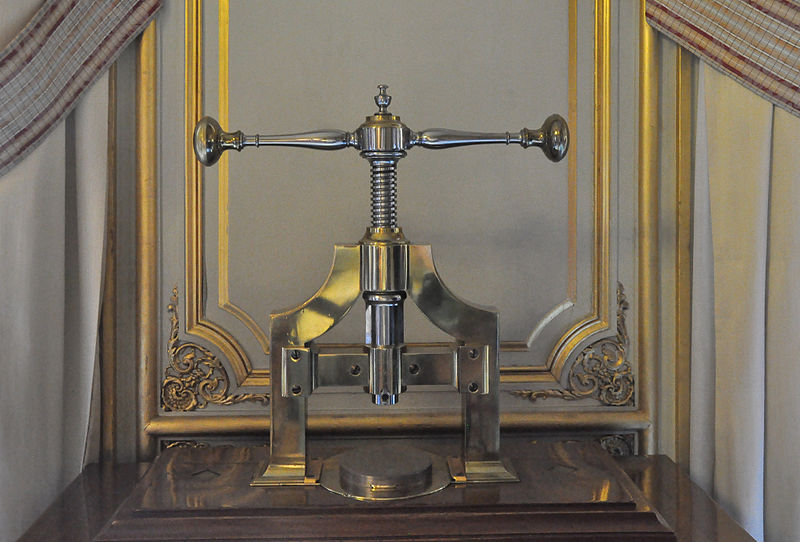
by Roseanna White | Oct 22, 2014 | 17th-19th Centuries, Remember When Wednesdays
I’m up on Colonial Quills today, and I’m talking about . . . what? A giant screw? A printing press? Huh?
Yep. Our homeschool year has been full to bursting with oh-so-interesting fun facts about early America, but this one won the right to appear on the CQ. 😉 Hop over to read the full article!
The year was 1620. The crowd of passengers crammed into the small vessel
numbered 101. Among them were adventurers, seekers of fortune…and a
group of Separatists who wanted a fresh start in a new land where they
could worship as they saw fit.
We’ve all heard the story of the Mayflower. But I confess that
for many years it was just a tale trotted out at the end of November,
and I had always been far more interested in making paper-bag Indian
vests and coloring my cornucopia than in some of the finer details of
the Pilgrims’ journey. Of course, that was before I became a history
nerd, so it’s only to be expected that now, as I’m reading those old
stories to my kids in our homeschool curriculum, they’re the ones
coloring happily away while I pause in my reading to go, “Wow, I never
knew that! Just think of it…”
Read the Full Article

by Roseanna White | Oct 20, 2014 | Word of the Week
Today’s word comes to us by me literally clicking on a random letter at www.EtymOnline.com and then a random page within said letter and scrolling down until something caught my eye. 😉 The lucky word was perk.
The first meaning of perk in English came from Old North French and meant “to make oneself trim or sharp.” From the late 1300s, this word was inspired by preening birds–the French word it’s taken from means “perch.”
By the 1520s, it had expanded to mean “to raise oneself briskly.” Interestingly, the term perk up didn’t follow for another 140 years (language changed so much more slowly back then!)
The verb that we use for how we make our coffee is actually a shortened, altered form of percolate, which is completely unrelated, and came around in 1934.
The noun form, as in “a highlight or bonus” is from 1869, another shortened, altered form–this time of perquisite, a mid-15th century word from Latin that means “profit, thing gained.” Yeah, I had no clue about that one!



 Roseanna M. White is a bestselling, Christy Award winning author who has long claimed that words are the air she breathes. Having successfully launched two homeschool grads, she now spends her time writing fiction, designing book covers, and pretending her house will clean itself. Roseanna is the author of a slew of historical novels that span several continents and thousands of years, as well as a fantasy series and contemporary mysteries and romances. Spies and war and mayhem always seem to find their way into her books…to offset her real life, which is blessedly ordinary.