by Roseanna White | May 24, 2016 | Giveaways and Contests
Hello, gentle reader, and welcome to the first annual
British
Blooms and Books giveaway!
This week, we’d like to celebrate the Royal
Horticultural Society’s Chelsea
Flower Show with you.
After enjoying this post, please visit
each of the other five authors’ blogs
(links
provided below) and, after a bit of reading fun,
follow one simple instruction
and then leave a comment in order on each,
to be entered to win a fabulous,
British Blooms and Books prize.
(US winners only, please, due to shipping the
petit fours. Sorry, non-US friends.) Enjoy and thank you for stopping by!
~*~
Heather
I have always been intrigued by English gardens, and much preferred flower gardens over those ever-practical vegetable gardens (what can I say–I guess I’m not very practical! LOL). When I began my Ladies of the Manor Series, one of the things I loved was viewing the English countryside–and blooms–through the eyes of my heroines.
In the first book of the series, The Lost Heiress, Brook hails from Monaco. A densely-populated city on the Mediterranean coast, Monte Carlo was vastly different from the Yorkshire countryside where Brook ends up. I had so much fun looking up images and videos of the region and then seeing them through Brook’s eyes.
One of the first images she sees as the train crests a hill is wild heather. Even in my Appalachian home, I love coming around a turn and seeing swaths of green and purple. Brook, accustomed to the arid climate of Monaco, finds this sight breathtaking. Even more than the cultivated gardens of her new home in Yorkshire, she loves the wildflowers she sees when she’s out riding toward the North Sea.
In the second book of the series, Rowena is from the highlands of Scotland, where that beautiful purple heather is one of the native species that thrives. In the opening of the book, autumn is upon them, and she’s looking out over a brown landscape, feeling as cold and lifeless as the drying grasses. But throughout the pages of the book, as she escapes the shadows of her past and ends up in Sussex, in the south of England, her world begins to look brighter. And she begins to treasure those small beauties that God places in her paths.
Wildflowers in bloom. Heather rolling across the hills. Blue skies after a dark night.
Join Rowena in the gardens of both Whitby Park (from The Lost Heiress) and Midwynd (her new home in Sussex) in The Reluctant Duchess.
To enter the Giveaway:
- Please sign up for my newsletter (there is also a quick sign-up form in the right sidebar, on top!)
- Comment below to be
entered to win the grand prize.
- Visit the other authors’ links below, comment, and complete their bold-faced condition.
~*~
One grand prize winner who
comments on each of the six authors’ blogs and agrees to the one boldfaced condition posted at the end of each post will win a
signed copy of each of the books plus
delivery of six English hat petit fours to enjoy while you read!
Name will be drawn via random.org
~*~
Finished? Well done! Please visit
these other fabulous authors of England-set historicals to see what flowers
mean to them and their heroines.

by Roseanna White | May 19, 2016 | Thoughtful Thursdays
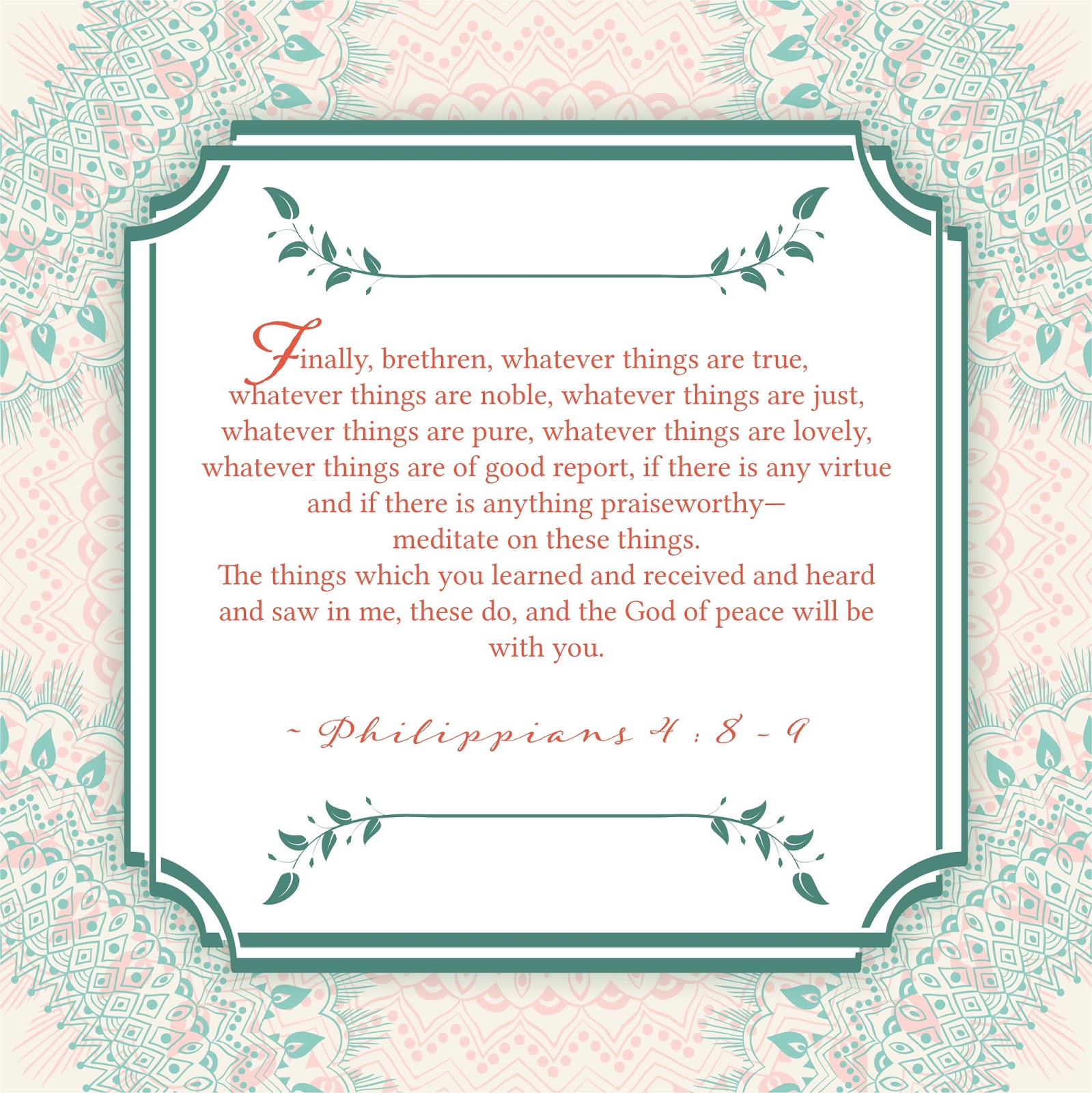
I daresay we’ve all read Philippians 4:8-9. I know I’ve read it many times. I’ve heard it quoted. I’ve read bloggers
and reviewers who make it their mantra . . . and occasionally I have been
seriously irritated when people condemn something using this as their excuse.
Because God’s word is beautiful . . . but sometimes people . . . people
use it as a bludgeon. Or worse, as an excuse to look only at the surface of a thing. To take the easy way out.
Last week, I was finishing up our read-alouds for the homeschool year, and Philippians was our final book. Chapter 4, obviously, our final chapter. A great way to end a school year.
Because the kids sometimes had difficulty following the New King James version of Paul’s epistles, I’d been reading from The Message. Here’s how it puts verses 8-9.
The two aren’t terribly different, but a few words are. We have:
True
Noble
Just/Reputable
Pure/Authentic
Lovely/Compelling
Of Good Report/Gracious
I think we can all agree with what Paul is saying here–that by focusing, dwelling, meditating on these righteous things, these good things, on what is holy, we keep ourselves better aligned with God. Absolutely.
Here, however, is the question–what is true? What is noble? What is just and reputable? What is pure and authentic? Lovely? Compelling? Of good report and gracious? What is full of virtue and praiseworthy?
It seems like it should be a simple question.
But it’s not.
What if, for instance, you’re reading a Christian book and you find something objectionable in it? To keep it only somewhat objectionable, let’s say that it’s mentioned that someone curses or makes a rude gesture or sins outright.
Should we toss that book aside, because it’s not dwelling on good things?
I’m not actually talking about my books in particular, LOL. I’m talking about many discussions I’ve seen over the years. Including a statement made with what I deem infinite wisdom a few days ago: if you refuse to read anything that mentions sin . . . then you can’t read the Bible.
How does God show us His light? His glory? His righteousness?
By comparing it to darkness. To deception. To sin.
How does God show us His ultimate love in the form of Jesus?
By sending him into a dying world, to be treated as a criminal and murdered.
How does God teach us how to seek after His heart?
By telling us the stories of those who did, and those who didn’t, and those who mostly did but failed here and there. Or mostly didn’t but then saw the Truth.
A few weeks ago, I had a Skype call with a college class that was teaching Christian fiction writing, and one of the questions they asked was, “What place do dark themes have in Christian fiction?”
I answered them with the answer I’ve come to after many years of thinking about. Praying about it. And trying it out.
I don’t approve of darkness in Christian fiction for the sake of darkness. I don’t like it for shock value or to prove a point. I don’t like being left with darkness at the end of the book.
But God’s light shines brightest when there is darkness surrounding it that is trying–and FAILING–to snuff it out. God’s mercy is the most striking to those who have suffered. God’s leading is the most meaningful when you were lost. God’s healing is the most miraculous for those are sick and dying. God’s grace is the most beautiful in the face of the ugliest sin.
What is true? What is noble? That there is ugliness and nastiness and sin in this world, but that God is bigger. What is just? That we are deserving of death for our sins. What is pure? That He washes those sins away. What is lovely? A sunrise after the darkest night. What is gracious? A Father who gathers His children close and wipes away their tears and whispers that He loves them, no matter what has come before. That they can rise up and sin no more.
There will be dark themes in my books–some more than others. There will be ugliness, and there will be heartbreak, and there will be sin. Because then there will be grace, and there will be redemption, and there will be change. Because that is what speaks Jesus to a hurting, sinful world. Not the picture of a perfect life that they can’t relate to because it doesn’t exist–the picture of a broken world made whole through Him.
I mediate on that a lot. Not on things that look pretty on the surface–on things made beautiful by Him.
And the peace of God is with me.

by Roseanna White | May 18, 2016 | 17th-19th Centuries, 20th Century, Ancient World, Remember When Wednesdays
I’m a historical fiction writer–and a historical fiction reader. I have always loved to learn history (or reinforce it) through a fictional story. For me, for my mind, that makes facts stick in ways that an article or non-fiction book seldom make it do. It makes it come alive. It makes it walk and breathe.
Over the weekend, I was hanging out with my family and with a man named Sascha–back in 1993, he came here from Germany for a year and stayed with my family as a foreign exchange student. We’ve seen him several times since, but the last was, for me, 16 years ago, when he came in for my high school graduation and stayed in for my sister’s wedding in July, traveling with friends for the weeks in between. Last year in May, he got married in Palermo, and my parents went to the wedding. Now he and his new bride came for a visit here.
Somehow, the talk around the dining room table turned to different parts of history as we ate. We talked about volcanoes, and I had to tell about the one in Mexico the kids learned about in Hill of Fire (by Thomas Lewis), an early reader about a volcano that came up out of a farm field and erupted in 1943.
We talked about the beautiful, intricate wood carvings he brought for us from the small German village where his father was born and raised, and I was reminded of the amazing carvings in The Seven Wonders of Sassafras Springs (by Betty G. Birney–a really, really cool book for kids, and which adults can enjoy too, if you’re looking for a read-aloud!)
Sascha brought chocolates, as well, including some Ferrero Rocher from Italy, in their shiny gold wrappers. My niece loves any chocolates in shiny wrappers–she refers to them as “chocolate balls of deliciousness” and collects those wrappers . . . which, of course, reminded me of the candy wrappers in The Kitchen Madonna (by Rumer Godden), and how the inventive children used them to create something beautiful and meaningful. And how the quest for each piece of paper, each scrap of material changed hearts and lives.
And those are just a few examples from dinner. Over the course of the weekend, various conversations also touched on the Baptist movement in Sweden (Gathered Waters by Cara Luecht), the Iconoclastic Fury in Holland (The Sound of Diamonds by Rachelle Rea), WWII in Holland (The Winged Watchman by Hilda van Stockum).
How the Russian Orthodox church was separated from the Western church (research for A Lady Unrivaled). We talked about the early church before the Bible was canonized, and I brought up what I’d learned when researching for Giver of Wonders.
It’s possible I talk about history more than the average person, LOL–it’s one of my passions, it’s what my writing involves, plus I homeschool my kids, so I’m reading it with them every day. But it’s history that I remember so well because of story. History that’s real to me because characters have made it so. History I rarely forget, because those stories have become a part of my heart, a part of my life.
I’m always baffled by people who don’t read fiction. Or, no–I understand those who just aren’t inclined toward it, whose minds work differently than mine. What I don’t understand are people who scoff at those of us who do enjoy fiction, especially genre fiction. Who deem it stupid or foolish or a waste of time, who call it “not real literature” and feel so superior because they only read non-fiction or so-called “literary” works.
To me, it’s the difference between a line drawing and a realistic painting. Between an indistinct statue and animatronics. To me, a compelling story makes what was real come to life again.
And so, whenever I come across those scoffers, I just smile. And I talk about whatever subject they’re talking about, the things I’ve learned about it . . . and the stories that brought it to life. I don’t ever apologize. I don’t really argue. I just prove the point. Yes, I write romance–and there are a ton of scoffers over that. I write historical romance. I read fiction of every genre and variety. Non-fiction when I must, to research, but it’s usually what I can weave into my story that I really remember. And I can talk intelligently. I know things they don’t, and I’m excited learn things I didn’t already. I can challenge them, and accept challenges in return.
And for me, it’s all thanks to fiction.

by Roseanna White | May 16, 2016 | Word of the Week
After the release of A Lady Unrivaled in September, my Ladies of the Manor Series will be at an end. And my Society Thieves (if that’s the name we keep) Series will begin.
Now, given the title of the series, and the fact that the first book, as of this moment (again, titles and names change a lot, LOL) is The Name Thief, it ought to be no great surprise to anyone that one of my characters is a thief.
And given that one of my characters is a thief, I obviously had to mention a few of her past exploits. The heists she has pulled off.
There’s just one problem with stating it like that–the word heist didn’t exist until well after my 1914 setting (thank you, Stephanie, for pointing this out!)
Now, this is a great disappointment to me, because I like that word. I don’t know why, exactly, I like that word. But I do.
The word is American slang (another mark against it for my British characters), and is thought to be a dialectical variation of hoist–which would be used in stealing much like “lift.” It was a noun first, from 1930, and then a verb in 1943. Interestingly, heister (thief/shoplifter) is traced back to 1927. Older, but still not old enough for my purposes!
Which of course left me with the problem of figuring out how Rosemary would be referring to “the museum heist” when heist isn’t an option. Thankfully, job was in use as “a planned crime” sine 1722. So that’s now how she thinks of everything that had been called a heist. 😉
Hope everyone has a great week!

by Roseanna White | May 12, 2016 | Thoughtful Thursdays
Back in the early days of my publishing career, my only books were from WhiteFire. Which is, of course, our company. This meant that in those first years, I knew of pretty much each sale. Individually. I could track my every effort to know which ones were working. Half the time, the sales of paperbacks came through our store–which means I packed them up myself. I signed them. I put them in the envelope. I sealed that envelope with packing tape and put on the label.
I prayed over each one I sent out. Because I knew that every person to read my book was trusting me. They were giving me the gift of a few hours of their time–and in return, I prayed that God would minister to them some way, somehow, through my words.
These days, I don’t have that. And while I’m very, very grateful to be selling more books than I can pack up in my kitchen (very, very grateful!) . . . there was something about those early days. There was something about putting my hands on every copy of my book and pausing to think and pray about the person who would be reading it.
There was something about it that made me very aware. Aware of each person.
People I’ve never met. People whose names I never would have known had they not put an order in. People who were, in some ways, nothing to me.
People who are everything to God.
How often do we really stop to think about how precious strangers are to Him? I began thinking about this last night because my church was having a Skype call with a fellow from our denomination involved in church planting. We were gathering information so we can help by being a sponsor church to a new plant–much like our sponsor church had helped us not so long ago. And as we were talking, this theme kept peeking out.
That spreading the incredible message of our Savior isn’t about making the deal or closing the sale. It’s about giving. It’s about serving. It’s about relationship.
It’s about each one. Each person who hears of Him through us. It’s about what our amazing God wants to do in their life and how He lets us help.
Reaching out to others for Him is a responsibility. It’s an imperative that Jesus issued in that Great Commission as one of His last acts on earth. But it’s also an honor.
Does it feel like it to you? It doesn’t always to me. More often, I’m not even thinking about it. I’m just plodding along, doing what I do.
But then I have to stop. And I have to remember those early days of packing up books. Sometimes that felt like drudgery too, until I shook off that and realized that this was something special. This was the fulfillment of a dream. This was people giving me hard-earned money for my stories. This was people inviting my words into their home, into their heart. That, friends, is something far more than plodding along, just as serving Him in other ways should be.
So, my newest challenge to myself–to remember that Each One is important. Each One who reads my books . . . who hears me play the piano at church . . . who reads my blog or sees me on Facebook. Each One whose name I don’t even know or can’t remember. Each One who needs Him. Each One who knows Him and loves Him. Each One.
Each One is someone to Him.



 Roseanna M. White is a bestselling, Christy Award winning author who has long claimed that words are the air she breathes. Having successfully launched two homeschool grads, she now spends her time writing fiction, designing book covers, and pretending her house will clean itself. Roseanna is the author of a slew of historical novels that span several continents and thousands of years, as well as a fantasy series and contemporary mysteries and romances. Spies and war and mayhem always seem to find their way into her books…to offset her real life, which is blessedly ordinary.