Remember When . . . Tea Came in Bricks

Remember When . . . Tea Came in Bricks

It was nearly five years ago that Carrie Pagels made mention of “brick tea.” I don’t even remember now how it came up, but I believe she’d purchased some from a local plantation home and was offering it to one of us here at CQ as thanks for helping with a project. Now, I had no idea what in the world she was talking about. And so far as I could tell in my search, she’s never talked to us about it on the blog. So I decided to resurrect the post I’d done 5 years ago that talked about this fun tea and what I learned about it after this arrived in the mail:

The moment I withdrew this brick from its bag, the scent of tea wafted up to me. My daughter, who runs to the kitchen the moment she senses a package being opened, rushed out just then, saw the brown-paper-wrapped block, and said, “What’s that?”

My answer was to hold it out and say, “Smell.”

You should have seen her eyes light up with delight and disbelief as she squealed, “Tea?!”

Tea has been a staple of many societies for centuries. But loose leaf tea is hard to transport, so back in the days of the silk road in Asia, the Chinese discovered that if they use forms to press the tea into standard sized bricks, they can transport them with ease, and the tea lasts through the journey.

This became such a standard that tea bricks could be used as currency, and this was the way most tea was transported for hundreds of years, all the way into the 19th century. So the tea tossed into Boston Harbor during the Boston Tea Party? That was bricks.

Naturally, when something is used so long, for so many purposes, there comes to be a rhyme and reason to each part of it.

I don’t know if you can read the label on this, but if you do, you’ll find its “translation”–what each part of it means.

The front of this particular brick has details that let buyers know that this tea comes from a company managed by more than one person, and is manufactured by Enterprise Company Tea and the Chinese Lee family.

The back of the brick is separated into squares that can be used as currency. One square, for instance, might equal the price of a chicken.

In addition to being brewed, the tea traditionally pressed into bricks can also be eaten. I don’t intend to try that, gotta say.

I thought for sure, five years ago, that I would immediately start breaking bits off and using them. But I didn’t. Because it was so pretty and interesting, my Brick Tea still occupies a place of honor on my hutch. Occasionally I pick it up and smell it. And tell myself that maybe someday I’ll brew myself a cup with some real history.

But mostly, I just love looking at it and knowing what it represents.

Word of the Week – Kulturkampf

Word of the Week – Kulturkampf

Yes, that’s right, today’s word of the week is German. 😉

In my edits for A Name Unknown, my editor had asked me to check the history of the phrase “culture war,” as it felt modern. I’d used this phrase to describe events in Germany at the end of the 19th century, because, well, that’s what my history book had called it, LOL. But history books do tend to use language from the time they’re writing in rather than the time they’re writing about, ahem. So I took the advice and looked it up.

What I found was that the German word for culture war, kulturkampf, was actually coined at the time specifically to describe these events. The German chancellor Von Bismark (described by other politicians of his day as “a demon”) launched this war in Germany against the Catholic church specifically, but most other Christian churches took it as a sign to beware as well. For perhaps the first time in centuries, since the Church had fractured, Protestants and Catholics joined together to fight political forces that would wipe them out.

Of course, learning that this word would have been in legitimate use at the time doesn’t make it sound less out of place in my manuscript. 😉 So my challenge was trying to figure out how to use it well. And my answer was to start with the German word.

Hope everyone has a great week! I had a fabulous time at Montrose Christian Writers Conference and am now looking forwarding to getting back into my writing groove after being in teacher/editor mode all week. =)

Giver of Wonders Launch Team!

Giver of Wonders Launch Team!

While I’m at the Montrose Christian Writers Conference this week and away from normal blogging, I thought it would be the perfect time to let the blog do some work on its own. 😉

And so, it’s time to build the Launch Team for Giver of Wonders!

Giver of Wonders is a couple things–it’s my first Christmas story. It’s a biblical novel. It involved the same Visibullis family readers have come to love through A Stray Drop of Blood and A Soft Breath of Wind, but 150 years later–so none of the same characters, no related plots. Instead, we see what one branch of the family has turned into as Christianity has spread throughout the Roman Empire. Cyprus and her sisters end up in Patara, Lycia (present-day Turkey) when a Wonder Worker lives there . . . a Wonder Worker the world now knows as St. Nicholas.

Official blurb:

A miracle once saved her life ~ will another give her a future?

Cyprus was little more than a child when a fall left her paralyzed…and
when the boy known as the Wonder Worker healed her. Ever since, she has
wondered why the Lord spared her, what he has in store for her. But her
pagan father thinks she was spared solely so she could be introduced to
the wealthy Wonder Worker, Nikolaos.

Nikolaos has never
questioned that his call in life is to dedicate himself to the church
and to God. Never, that is, until he and his cousin Petros meet the
compelling Cyprus Visibullis. For years he struggles with the feelings
she inspires…and with the sure knowledge that Petros loves her too.

Petros knows he will never be good enough for Cyprus’s father to
consider him as a match for his favorite daughter ~ not as long as
Nikolaos is there. But when tragedy strikes the Visibullis family, he
will do anything to save his beloved. Unfortunately, his beloved is
determined to do anything to save her sisters ~ even at the cost of
herself.

As the festival of lights bathes their Greek city in
beauty, Cyprus, Petros, and Nikolaos celebrate the miracle of their
Savior s birth together one last time. And in remembrance of their
Lord’s greatest gift, one of them will make the ultimate sacrifice for
the others…and a centuries-long tradition will be born.

L A U N C H      T E A M     B A S I C S

For those who have been on previous launch teams, you probably already have an idea of how this will work. I will:

  • Create a private Facebook group for all launch team members to join
  • Send you complimentary copies of the book prior to its release
  • Have a special giveaway for you guys only
  • Share lots of behind-the-scenes info and come to you first for opinions and with ideas

Members of the team will:

  • Write reviews to post to social media/online retailers
  • Consider asking local libraries/bookstores to stock the book
  • Share ideas with each other on ways to promote
  • Promise to help spread the word through word of mouth, online postings, etc.

There will be two different options you’ll be able to sign up for. These are:

  • BETA READER – beta readers will receive a digital file in September, two months before the book releases. They will have the opportunity to share their opinions and anything they catch in the manuscript with me. When the book releases, they can then post a review and do other usual launch team/influencer stuff, but they’ll have had a sneak peek. Beta readers will have one month to read the manuscript before I need their feedback, but they can write a review at any point.
  • INFLUENCER – An influencer is a launch team member who receives a final copy of the book around the release date. I will only have 20 paperback copies (to US addresses only), but more digital copies. I can send your preference of digital version–mobi file for your Kindle, epub for other devices, or PDF for your computer. As an influencer, you agree to help promote the book by posting photos to social media, writing reviews, and just generally helping to spread the word.

    If more readers sign up than I have specified copies for, I’ll be selecting my team based on what ideas you put in the form/your social reach/review history/level of enthusiasm. Same for choosing recipients of paperbacks versus digital copies. So get creative! 😉

Thank you all SO MUCH for you interest in helping me spread the word about Giver of Wonders! I couldn’t do it without you amazing readers!!!

(You can also fill out the form here.)

A Lady Unrivaled ~ Influencer Sign-Up

A Lady Unrivaled ~ Influencer Sign-Up

Thank you for your interest in helping me promote A Lady Unrivaled! I’m so excited for this book to release, and so blessed to have readers like you who want to help me spread the word. =)

At this time I only have 15-20 slots open for paperback reviewers, so I’ll have to make a decision based on who I feel will best help with the promotion efforts. How you plan to help will play a role in deciding this, so get creative. 😉

For those who prefer digital copies, or if you don’t have a U.S. address, you can sign up to receive a digital ARC (advance reader’s copy) via Netgalley; my publisher will send you a widget. Fill out this form instead.

And don’t forget that I’ll be building my influencer team for Giver of Wonders next week!

Ready? Set . . . Fill!

Remember When . . . A Quick Lesson in Coinage

Remember When . . . A Quick Lesson in Coinage

Sometimes the questions a novelist asks leads to answers a novelist didn’t anticipate.

Today, I had the thought that a character should be flipping a coin into the air. So I headed to Google to determine with British coin my character should be flip in 1914. And ended up with an interesting lesson in coinage.

Being not British, I didn’t realize that there was a fairly huge change to the currency in 1968. These days, they use “decimalization” much like we Americans do, with 100 pence to the pound. But prior to that–so certainly in 1914–there were actually 240 pence to the pound. Twelve pence to a shilling, and 20 shilling to a pound.

I’m not sure how I’ve managed to write so many book with English or British characters and settings without looking this up before! Sheesh!

These are the current coins, of which I imagine I’ll collect a few while in England this fall to add to my foreign currency collection (by which I mean the bowl we’ve tossed Euros, Pesos, Canadian coins, and Bulgarian coins into).

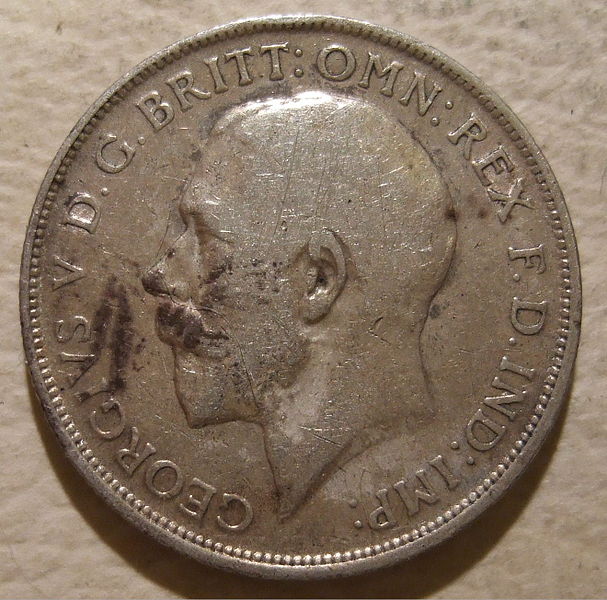
These are not, of course, what my mysterious villain would have been tossing into the air in 1914. No, I think he’d be tossing up a George V florin, worth 2 shillings and nearly an inch in diameter.

Interesting note for Americans who are as ignorant of all this as I was, LOL–each monarch had the coins redesigned with their profile upon ascension. So while Victorian coins would all have had the Queen upon them, all new coins during King George V’s reign, for instance, would have had him. A bit different from our Jefferson nickles and Washington quarters and Lincoln pennies that never change. =)

That concludes your very short lesson in historical British coinage. Now back to the man flipping a florin… 😉