
by Roseanna White | Dec 14, 2015 | Word of the Week
I am sometimes baffled by how things come into our cultural consciousness…and change over the centuries. Cue the elves.
Elf comes from Germanic folklore, with equivalents in Norse and Saxon mythology. The word itself hasn’t changed much since Old English in spelling, sound, etc.
The meaning, however…
Back then, an elf was considered to be a mean-spirited goblin-like creature with quite a bit of power. Descriptions range from creatures who are merely mischievous to “evil incubus.” Since the mid-1500s, it’s been used figuratively for a mischievous person. They were thought to create knots in hair (oooookay) and hiccups.
Over the centuries, they gradually took on new roles in people’s minds. They were occasionally referred to as “house gnomes,” and while they would act with traditional mischief if not treated properly, they were thought to scare off true evil spirits from your house if you treated them properly–people were known to leave out gifts of food and baubles to appease them.
It wasn’t until the mid-1800s that Scandinavian writers took this ancient tradition and decided it would be fun to apply it to Christmas. Popular writers of the day began crafting stories that assigned elves the new role of being Santa Claus‘s helpers. By this time traditional belief in elves had pretty much fallen away, so people seized this new thought that sort of revived an old belief, but in a nice, cute way. Visual artists joined this new movement and began painting pictures of what we now identify as elves–cute, small, sprite-like creatures who are all goodwill…at least unless a child in naughty, in which case some old mischief might sneak out and cause them to replace goodies in a stocking with switches or lumps of coal.
So there we have it. Elves. 😉

by Roseanna White | Dec 7, 2015 | Word of the Week
Since it’s getting rather frosty outside here in the Appalachians, I thought today we’d take a look at ice…or rather, at when some of its idioms came into use. =)
Ice itself is from Old English, from Proto-Germanic is. There are cognates for it in quite a few other languages that also derive from that old-old-old German tongue. Our modern spelling began to appear in the 1400s.
Having been part of our language for so long, it’s no surprise that eventually it began to be used in idioms. The oldest of these is to break the ice. It has been meaning “to make the first attempt” since 1580! I had no idea it was so old. But it comes about as a metaphorical allusion to boats breaking up the ice in a river.
The 1800s brought us quite a few uses. The term ice age was coined in 1832. Ice fishing began to be spoken about in 1869 (which makes me wonder…was the activity itself first practiced then or did people use to call it something different?). Thin ice, in the figurative sense, first appeared in writing in 1884. On ice–as in, kept out of the way until needed–is from 1890.
And finally, the use you may have spotted in The Lost Heiress. Ice as a slang for diamonds is from 1906. (I totally would have thought it a product of the 1920s before I looked it up for use in my book. Shows what I know, LOL.)
Stay warm, everybody!

by Roseanna White | Nov 30, 2015 | Word of the Week
I was surprised to realize this weekend past that the Advent season is officially begun–I thought it would start next weekend, but my calendar is obviously off. 😉
As a child, I knew that advent marked the season leading up to Christmas…but it wasn’t until later that I realized advent actually meant “the approach, arrival, or coming.” But once I learned that bit of information, I naturally assumed that the word had always meant “the approach, arrival, or coming,” and hence was applied to the Christmas season as it counted down to the arrival on earth of our Savior.
As it happens…not exactly.
It wasn’t until 1757 that advent took on that general meaning–then that people may have begun saying things like “the advent of summer” or the like. Until then, the word meant only the Christmas season.
Advent was present in Old English as such, taken from the Latin adventus (which does indeed mean “coming, arrival” etc.), but in Church Latin (what would have been used in English-speaking realms at the time) it was used only for the season leading up to Christmas.
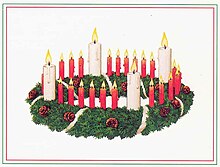
As for the Advent wreath many churches and families keep today–the tradition was begun by a German pastor and missionary, Johann Hinrich Wichern, in 1839 (though there were a few earlier versions that didn’t catch on dating back to the Lutherans of the 16th century). The original version counted down the whole month for the children of the mission school where he served, with 20 red candles and 4 large white ones.
The purple and rose candles most churches use today were made to match the liturgical colors in the Catholic church for those Sundays in December.

by Roseanna White | Nov 16, 2015 | Word of the Week
This one is quick–but interesting!
Anyway dates from 1560, though it was traditionally two words until the 1830s. And up until modern history, it was quite literally “any way.” As in, Is there any way I can help you? I’ll get there any way I can. It quite literally meant “in any manner.”
It wasn’t until 1859 that it took on the sense of “regardless” that it now often has. So, historically, no “I’m going anyway!” unless you mean “by any path.”
Yeah, pretty sure I may have used that one incorrectly at some point or another, LOL. But now we know!

by Roseanna White | Oct 26, 2015 | Word of the Week
About a month ago, a lady at our church volunteered to teach knitting classes. Having been crocheting since she was 9 and then knitting as well when she moved to our area and began working in a yarn store, Ms. Judith knows her stuff!
I joined mostly because Xoe has taken a few classes and needed a few more, LOL. And I figured, this way I could help her. I wasn’t expecting to fall in love with it, but boy have I!
So today, our word of the week is knit.
The word has been around since Old English, meaning “to tie with a knot, bind, fasten.” And while the art of knitting has been around so long no one knows exactly when it started, the word has been in English with the particular meaning of “to do knitting” only since the 15th century. (Only . . . LOL)
Interestingly, referring to a piece of knitted work as “knitting” is quite new! That only joined the English language in 1848. (Wondering now what they called it before…)
(Those are my knitting projects thus far in the photo – starting at the left, we have a stitch I just wanted to try so did something that ended up the size of a pot holder, LOL. Didn’t like the yarns though so stopped. Then I decided I’d do a cable knit scarf. I still had lots of the yarn, so I made a cable-knit hat to match [it’s finished, but I didn’t take a finished photo yet]. Those are the same yarn in the two middle pictures, just different lighting, LOL. And finally, I’m trying some toy patterns, so I did a star fish. Just finished that this weekend, and am currently working on a bat!)

by Roseanna White | Oct 12, 2015 | Word of the Week
Last week, Rowyn was reading Amelia Bedelia, who classically misunderstands commands that include words with more than one meaning. Early on in the story, she’s working on a list of chores from her employer, who instructs her to “draw the drapes.” Naturally, she sits down with a marker and paper and draws those drapes.
I’m totally raising my kids up right–Rowyn asked, “Why does that word mean both things?”
So Mommy the Lover of Etymology replied, “I think it’s that draw means, ‘to pull across.’ So you draw the drapes closed, along their rods…or your draw your pencil across the page, which eventually got shortened just to draw. It’s also why drawers are called that–because you pull them out.”
Score one for Mommy, who was right on. 😉
Draw dates from about 1100, its meanings including both those things, plus to “draw a weapon.”
As a noun (specifically, when something like a game has no winner), it has existed since the 1600s, and in the sense of “something that will draw a crowd” from about 1881. To draw a blank is an expression that came about from the lotteries and dates from 1825.





 Roseanna M. White is a bestselling, Christy Award winning author who has long claimed that words are the air she breathes. Having successfully launched two homeschool grads, she now spends her time writing fiction, designing book covers, and pretending her house will clean itself. Roseanna is the author of a slew of historical novels that span several continents and thousands of years, as well as a fantasy series and contemporary mysteries and romances. Spies and war and mayhem always seem to find their way into her books…to offset her real life, which is blessedly ordinary.