
by Roseanna White | Jan 2, 2018 | Announcements, Book News, Giveaways and Contests
J a n u a r y 2 – J a n u a r y 1 6
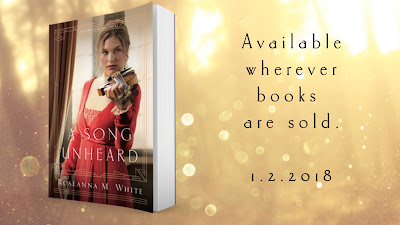
It’s release day for A Song Unheard! And we all know what that means around here. Time for a giveaway!
I had fun pondering what gifts to offer with this one, and I hope you guys enjoy what I found! So without further ado, allow me to present Willa’s Song Giveaway, including:
- A signed copy of A Song Unheard, for obvious reasons 😉
- A paperback copy of Agatha Christie’s first novel, The Mysterious Affair at Styles, featuring her detective who is a Belgian refugee–one of the only lasting reminders that England had once been filled with them.
- Magnetic book marks with music notes and clefs, for marking your pages in those books
- A violin puzzle box, with a small opening for your treasures (be they a cypher key or, you know, something more ordinary like…
- A sterling silver treble clef necklace, for you or another music lover in your life
- A music-themed journal so can write down all your symphonic thoughts (pages have a faint treble clef as well as standard lines)
- A music-themed ceramic travel mug
One grand prize winner with a U.S. address will receive all those prizes! But wait (ahem), there’s more! 😉
For one Second Place winner (open to international residents as well!), I’m also giving away a $25 gift card to iTunes or Amazon, so you can stock up on the music of your choice! (Okay, so there’s no way to designate them for music, but you know. For the purposes of this giveaway, that’s what I’m going to say you should spend it on. Though if you’d rather buy books, who am I to complain? LOL)
Have you seen the book trailer yet?
You can watch this beautiful (1 minute long) glimpse into the story, narrated by my English friend Elizabeth and featuring the original composition “Willa’s Song” written by Jessica Brand and performed on the violin by Taylor Bennett right here! (It’ll get you an extra entry into the giveaway too!)
a Rafflecopter giveaway

by Roseanna White | Dec 22, 2017 | Holidays
I’m wishing everyone a wonderful Christmas! I’ll be taking a break from blogging, but I’ll be back on January 2 … with some fun. That will be release day for A Song Unheard, so in usual Writing Roseanna fashion, I’ll be celebrating with a big giveaway! Be sure to check in then to get in on the fun.
In the meantime, I hope you enjoy the time with friends and/or family. Here’s wishing you a holiday season filled with Joy, and much time for reading. 😉

by Roseanna White | Dec 21, 2017 | Author Interviews and Guest Posts, Thoughtful Thursdays
Today I’m happy to welcome my friend and fellow biblical fiction writer Mesu Andrew to the blog, with a very special post. To go along with her upcoming release, Isaiah’s Daughter, Mesu has written a small devotional that is available as a free download to anyone who pre-orders her novel! And she’s here today to share one of those 14 devos…as it’s very appropriate to the season. Please join me in giving Mesu a warm welcome!
~*~
Isaiah’s Daughter
14-Day Devotional
Day Twelve
“The virgin will conceive and give birth to a son, and will call him
Immanuel.”
~ Isaiah 7:14 ~
Which aspect of
Jesus’ birth is most amazing to you?
 |
| Christmas print – will be mailed to anyone who pre-orders |
I have two
daughters and was honored to attend each of their first births. Watching my
babies give birth to babies was an amazing privilege but pales in comparison to
watching them be mothers. Mothering is
not for the faint of heart, and I’ve often pondered the impossible task Jesus’
mother faced. So much intrigues me about her conception, Jesus’ birth, and her
life as a mom.
What was it like
to create in her womb the God who created her? Was her birth experience more or
less terrifying, knowing the Son she bore was God’s own? Instructed to call
Him, Immanuel—God with us—how did she
parent God?
I’ve heard folks
say it would have been easier to believe in God if they’d lived while Jesus
walked the earth. I’m not so sure. While we have the benefit of hindsight, Isaiah’s
conservative theology might have struggled to embrace God’s Messiah. Even Mary,
who lived moment-by-moment with a divine toddler, teenager, and adult Son, remained
as confused as His other disciples until the Spirit was given at Pentecost (Mark
3:20-21). Seeing doesn’t always make
believing easier. Jesus’ brothers refused to believe He was the Christ (John
7:3-5) until after His death and resurrection. Only then did James believe his
Brother had been God With Us, the
perfect representation of the Father’s glory.
“The Son is the
radiance of God’s glory and the exact representation of his being, sustaining
all things by his powerful word.
After he had provided
purification for sins,
he sat down at the
right hand of the Majesty in heaven.”
~ Hebrews
1:3 ~
I think many in
Jesus’ day discounted Him as the Messiah because He was too common. He wasn’t
spectacular in any way.
“He grew up before him
like a tender shoot, and like a root out of dry ground.
He had no beauty or
majesty to attract us to him,
nothing in his
appearance that we should desire him.”
~
Isaiah 53:2 ~
What if we—the
Ones to whom the indwelling Holy
Spirit is available—actually have the easier path to faith. Immanuel dwells through
His Spirit in all who believe in
Jesus Christ. Perhaps Isaiah would envy us.
[Jesus said to His
disciples,]
“But very truly I tell
you, it is for your good that I am going away.
Unless I go away, the
Advocate will not come to you;
but if I go, I will
send him to you.”
~
John 16:7 ~
What
benefits did the disciples have with a flesh-and-blood Savior that we don’t?
What
benefits do we enjoy with the indwelling Spirit that the disciples couldn’t?
 |
| Quote card ~ will be mailed to anyone who pre-orders |
About the Book
Ishma
comes to the prophet Isaiah’s home as a five-year-old orphan,
devastated after watching her family destroyed and living as a captive.
With tenderness and care, her lively spirit is revived, and the prophet
and his wife adopt Ishma, giving her a new name—Zibah, delight of the
Lord. As the years pass, Zibah wins Prince Hezekiah’s favor, a boy
determined to rebuild the kingdom his father has nearly destroyed. But
loving this man awakens Zibah’s painful past and calls into question the
very foundation of her father’s prophecies. Can she learn to rely on
only Yahweh, who gives life, calms fear, and conquers nations?
Isaiah’s Daughter releases January 16, so this pre-order deal is good until the day before! You can find it on Amazon, Barnes and Noble, CBD, Parable, Lifeway, or see the full list of retail affiliates from the publisher.

by Roseanna White | Dec 18, 2017 | Word of the Week
Did you know that yule and jolly are from the same root? According to some sources, both come from the Old Norse jol (that J would be pronounced like a Y–see my word of the week on the letter J), which was borrowed into Old French as well, as jolif, which originally meant “festive.” Modern French now has joli, which means “pretty, nice.” And English, of course, has jolly.
But what about this whole “yuletide” idea, meaning Christmas? The yule log? Well, way back in the days of Old English, that Old Norse jol was a heathen feast. As Christianity came in and took over, they applied the English cognate geol to the coordinating Christian festival–Christmas. Old English, you see, already had the word giuli (which sounded very similar)–the Anglo-Saxon name for the winter season (December and January). It wasn’t a specific festival, but rather a two-month stretch in which many feasts occurred. But upon conversion to Christianity, the meaning of giuli narrowed to the twelve day feast of the Nativity (beginning Dec 25). By the 11th century, Christmas became the more popular word in most of England, except the northeast.
How did it come back, then? Well, there had always been a few holdouts–evidenced by yule log being recorded in the 1600s. But we’re mostly familiar with it today because in the 19th century, writers began using it as a nostalgic way to refer to “the Christmas of ‘Merrie England.'”
Today we’re exactly a week from the start of the official Yuletide season. I hope you and yours are having a jolly time!

by Roseanna White | Dec 13, 2017 | Book News, Remember When Wednesdays
We’re only a few weeks from the official release of A Song Unheard. My copies have arrived, and orders of signed copies from my store are in the mail.
And so, it seemed like the perfect time to share the book trailer! (If for any reason it doesn’t work for you here, you can watch it on Vimeo.)
A Song Unheard ~ Book Trailer from WhiteFire TV on Vimeo.
I’m so excited to share this with you!! Here’s the scoop on it.
- A year ago, I ran the Song Unheard Contest, in which people could submit a melody that would become “Willa’s Song.” My daughter and I chose 3 finalists, and then the public voted on their favorite, and y’all chose the song you hear featured in the video, composed by Jessica Brand.
- My friend Harry Burchell III graciously saved me some time and transcribed Jessica’s beautiful melody into sheet music.
- The amazing Taylor Bennett performed and recorded said music on the violin.
- My wonderful English friend and beta reader (who checks my books for Americanisms for me) Elizabeth recorded the voice-over.
- My awesome husband of WhiteFire Media produced the trailer.
Wow, that’s a lot of people who participated and helped me create this! Hence why it’s no surprise how much I love it. Thank you to all who submitted songs for the contest or voted on their favorites, and even bigger thanks to those who brought it to life!
I hope you enjoy it as much as I do! And if it does its job (ahem) and makes you want to rush out and buy the book, you can find it here:
AMAZON
BARNES AND NOBLE
CBD
PARABLE
LIFEWAY
TARGET





 Roseanna M. White is a bestselling, Christy Award winning author who has long claimed that words are the air she breathes. Having successfully launched two homeschool grads, she now spends her time writing fiction, designing book covers, and pretending her house will clean itself. Roseanna is the author of a slew of historical novels that span several continents and thousands of years, as well as a fantasy series and contemporary mysteries and romances. Spies and war and mayhem always seem to find their way into her books…to offset her real life, which is blessedly ordinary.