
by Roseanna White | Apr 22, 2013 | Word of the Week
In Circle of Spies, my villain is a railroad tycoon. Slightly tricky because I don’t want to imply that any of the actual railroad men were anything like him, LOL, but I digress. As I was blasting through the scenes last week, I very nearly had my hero contrasting himself with good ol’ Dev and calling the man a tycoon. Then I thought I’d better, you know, actually look it up…
And I’m glad I did. Because though I would swear I’ve watched documentaries that use the word for men of that era, it’s anachronistic to do so. The word originated in 1857, very specifically–it was used by foreigners to the shogun of Japan. Directly from the Japanese word taikun, “great lord or prince,” it was used by the shogun’s supporters to indicate that he was more important than the emperor.
In 1861 the word crossed to America and was used, again specifically, in reference to Abraham Lincoln. But it wasn’t applied to successful business in general until after World War I!
So while I couldn’t use it to speak of Devereaux Hughes, I did find the history intriguing. =) From the shogun to the president, and then nearly fifty years before it gained it modern meaning.

by Roseanna White | Apr 18, 2013 | Thoughtful Thursdays, Uncategorized
Anyone who knows me knows this title is not about my house. 😉
As I stood in front of my stove cooking dinner (mark it on your calendar!) the other night, with my head still in my novel (not rare enough to be noted, LOL), I got to thinking. I’d just written an out-of-the-blue line about my hero returning a borrowed fob. No big deal. Except that until that moment I didn’t know he had borrowed the fob…though I mentioned his pocket watch and its attaching chain in chapter 2. So back I went to the beginning, did a little tweak to the line, and voila. He pulled out his borrowed fob.
See? Neat and tidy.
This is the sort of thing I take great care with in my books. I don’t like any reference to be in vain, so I always make sure everything is woven all the way throughout. But, let’s face it, these small details will probably go unnoticed more often than not. Right? The cynical side of me might say, in moments of exhaustion, that they go unappreciated. But when someone
does catch these little carried-through threads, I hope it makes them go, “Aha! Nice!” Occasionally I’ll get a note from a critique partner or editor or reader letting me know they noticed something like this, and it makes me grin.
Yes, in fiction, all loose ends must be tied. All dangling threads snapped and pulled out. All lines and scenes and plots neatly ordered.
But in life?
Maybe because I focus so much on this sort of thing in my stories, I find myself looking for it in the real world too. Looking for those “Aha!” moments. Those times when it becomes glaringly clear why that thing happened a month or year or decade ago. I daresay I’m not alone in that–we all like to find reason in the seemingly-random, right? I usually call it looking for God’s hand. Which it is.
But as I stood there stirring my ground beef and thinking about watch fobs, it occurred to me that sometimes those threads are crucial…but so very small they really will likely go unnoticed. And if that happens in my books, which are crafted by small-visioned me, how often is that the case in life, where the omniscient God is the author? How many times do things never make sense to us, never even gain our notice…yet were crafted with such perfect care by Him?
Life, to our human eyes, is messy. Often ugly. Always beyond our total comprehension. But you know, I think if we could look at it through the Author’s eyes, we’d see where every thread is pulled through. Where every loose end is tied off. Where every tear we shed, where every dream we dream matters in our life story. I think, if we could see it in the right light, life would look a lot neater.
The reality is, we’re incapable of that. And that’s okay too. Because just like most people will never pause to think, “Wow, she wove the watch fob back in two hundred pages later!”, it’s not necessary that we notice every time God makes sense of things. It’s enough to know He does. To be able to see the big ones. It’s okay to wonder about the ones we never see reemerge.
Because He’s got it all under control. And sometimes I can just hear Him whisper, “Just hold on. You’ll understand in another few chapters…”

by Roseanna White | Apr 17, 2013 | Uncategorized
Last Wednesday I talked about it . . . today I’m showing it to you! =)
I’ve since learned some fun background on it too. First, the designer is the same one who designed Love Finds You in Annapolis, MD. =) This is Garborg Design–and I got a message saying the model is the designer’s cousin. Fun! I love learning that the models I gasp over are related to someone or another. Makes it so much more personal. I usually assume cover models are just hired models, so learning they’re friends and relatives of the designers or members of a publishing house always makes me grin in delight. And this beautiful Ms. Garborg (or whatever her name may be, LOL) is so lovely, and such a good Marietta. I couldn’t be happier. =)
I also got a note from the costume designer, saying how glad she was I liked the ensemble. Naturally, I had to gush in response, because ohmygoodness. The more I stare at this dress (which is a lot, LOL), the more I love it in all its details.
And so we can see all the covers of the series together… (there will be a second novella between 2 and 3 too, though we have no cover yet *grins*)
by Roseanna White | Apr 15, 2013 | Word of the Week
|
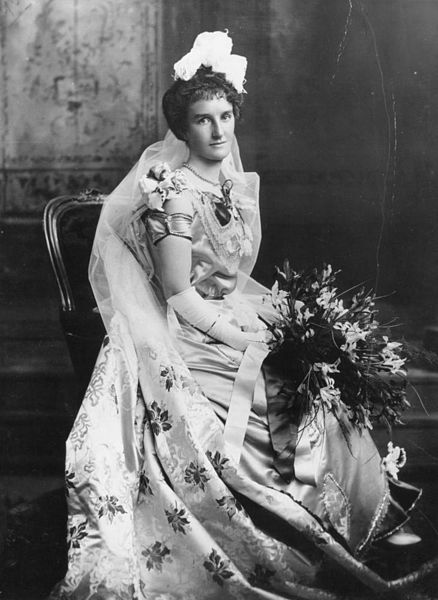
| Agnes Melanie Dickson as a debutante, 1890 |
Anyone who reads historicals, even 20th century historicals…or watches TV…knows what a debutante is. But as I started writing Colonial-set books, I was a bit surprised to learn the word wasn’t around in the 1700s. And a bit at a loss as to what to replace it with when talking about a young woman entering society.
But in its first appearance, debutante actually meant an actress making her stage debut. This word arrived in English round about 1801, coming (no surprise) from the French. It wasn’t applied to society ladies making their debut until 1817. So for me, that means no using it until my Civil War books.
Which I’m now going to hasten back to. 😉 If you haven’t seen the cover of said book, Circle of Spies, yet on Facebook, be sure to come back on Wednesday for a peek, and some fun behind-the-scenes I’ve learned about it since describing it to y’all last week!

by Roseanna White | Apr 11, 2013 | Uncategorized
Persuaded
by Julie Coleman
The supply of wine had been depleted.
Not one drop left. And the party was still going strong.
Mary shuddered at the embarrassment the
oversight would bring on the hosts. She instinctively turned to her
son to relate the news. He would know what to do. But Jesus seemed
impervious to the problem. “Woman, what does this have to do with
me?” he queried. “My hour has not yet come.”
Unfazed, Mary turned to the servants.
“Do whatever he says,” she simply told them. And Jesus turned the
water into wine.
This story has its puzzling moments.
But one big question towers over the rest: why would Jesus refuse to
help, even going so far as to state his reason for not helping, then
turn around and do the miracle anyway?
There were other times Jesus refused to
perform miracles. We are told in Mark 6 that in his
hometown of Nazareth, Jesus “could do no miracle there except that
he lay his hands on a few sick people and healed them.” Why? “He
wondered at their unbelief.” Several times, religious leaders and
then Pilate asked him to perform. Jesus flatly refused, for they were
merely “seeking a sign from heaven to test him” (Mark 8:12). They
had not asked in faith. The miracles were not meant to create faith;
they served merely to confirm it.
Faith is a necessary component to any
request we make of God. Jesus would not perform a miracle without it.
When two blind men asked for healing,
Jesus asked them, “Do you believe that I am able to do this?”
When they affirmed their trust, Jesus gave them their sight (Matthew
9:29). He asked a father to confirm his belief before ousting a demon
that controlled his son. Why? “All things are possible to him who
believes” (Mark 9:23). In these and many other cases, belief
in Jesus’ mercy and power was required before
Jesus would help them.
When faith is expressed, God responds.
Mary’s instructions to the servants
at the wedding of Cana were brim-full of faith. Whatever he
says, do it. She trusted Jesus would do the right thing. Jesus
responded by turning water into the finest of wines.
The Greek verb pisteuo, translated
as believe, trust, or to have faith often carries
the qualifying connotation of being persuaded or convinced. The Greek
lexicon defines it as “to cause to come to a particular point of
view or course of action.” Trust results from what one has found to
be true. Mary knew Jesus as only a mother can know her child. He
lived in unfailing obedience to his heavenly Father. What she had
observed of him in the past persuaded her to trust him now.
When God brought the Israelites out of
Egypt, he demonstrated his power and faithfulness to them over and
over, first with the plagues, then the crossing of the Red Sea,
provision of water and manna, and the dramatic giving of the Law. In
short, he was teaching them to trust him. But the months they spent
in the desert experiencing his faithfulness apparently weren’t
enough for the message to sink into this “stiff-necked” people.
They balked at entering the Promised Land, refusing to trust God for
his provision.
God ironically gave them what they
wanted. They would never go in. But their children would. So God
spent the next 40 years proving to the new generation just how
trust-worthy he was, teaching them the truth of his goodness and
power. And when it came time to go into the land, they were ready to
follow him anywhere. Truth is foundational to trust.
Trust doesn’t come
naturally to us. So God brings along hardship, times when we struggle
to perceive his presence or guidance, times when everything seems
hopeless or overwhelming. We hate those times and dread their
appearance into our lives. But he will use them to give us a deeper
understanding of just how faithful he is. We will emerge from the
darkness with a better capacity to trust him. And the conduit of
trust opens the way for his blessing and mercy.
“I thank God for the mountains,
and
I thank Him for the valleys,
I thank Him for the storms He brought
me through.
For if I’d never had a problem,
I wouldn’t know
God could solve them,
I’d never know what faith in God could
do.” –Andrae Crouch
Julie Coleman is an author and
speaker who focuses on Biblical study and women’s ministries. Julie’s
new book, Unexpected Love: God’s Heart Revealed in Jesus’
Conversations with Women, was recently released by Thomas
Nelson Publishers. You can learn more about Julie at
www.unexpectedgod.com.



 Roseanna M. White is a bestselling, Christy Award winning author who has long claimed that words are the air she breathes. Having successfully launched two homeschool grads, she now spends her time writing fiction, designing book covers, and pretending her house will clean itself. Roseanna is the author of a slew of historical novels that span several continents and thousands of years, as well as a fantasy series and contemporary mysteries and romances. Spies and war and mayhem always seem to find their way into her books…to offset her real life, which is blessedly ordinary.