
by Roseanna White | Oct 8, 2012 | Word of the Week
|
| Lesbia Weeping over a Sparrow by Sir Lawrence Alma-Tadema, 1866 |
Depression. Which is what I would be in right now after the failure of my primary coffee pot if I did not have a French press to serve as backup . . . 😉
Naw, seriously, this is another word I had to look up for my work-in-progress. See, I’ve learned to be careful about any word or phrase that is used in modern psychology, because many of them are either plain ol’ new or with new meaning since Freud and company came along, but so much in today’s common vernacular that we often don’t even pause to consider them… So I thought depression had better be investigated.
Apparently the first appearance of the word was in the 14th century, as a term in astronomy. I admit I had to look this one up, because I couldn’t fathom, on this Monday morning with belated coffee, why in the universe astronomy would employ this word. Until I saw the phrase “the sun at an angle of depression…” Ah. Angles. Right. Moving on.
Pretty much all connotations of depression stem from the literal “pressing down” of something, though that above sense pre-dates the literal meaning by 300 years. Go figure! For that matter, even the most familiar “dejection” is from the 15th century, so pre-dates the literal.
Of course, do keep in mind that when older texts (or historical fiction, LOL) refer to someone experiencing depression, this is merely a description of low spirits, not a clinical term. The clinical term didn’t come about until 1905.
But we also have a few more meanings that come from those in-between years. In 1826, depression was applied to “a reduction in economic activity.” And then in 1881 the meteorological meaning joined the team in reference to barometric pressure. Talk about a word with meanings in every sphere! The celestial one, the atmospheric one, through our wallets and all the way to our spirits.
Interesting indeed!
Hope everyone has a lovely October week full of no depression other than the atmospheric and celestial types. 😉
by Roseanna White | Oct 1, 2012 | Word of the Week
|
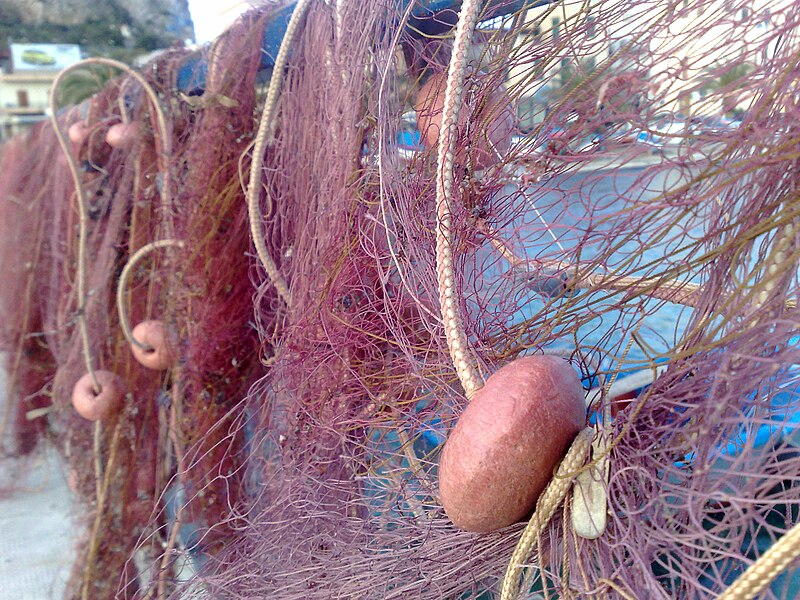
| Palermo: Fishing Net in Mondello by Dedda71 |
When one is writing a series about a secret espionage organization, one frequently finds oneself using modern words to describe this group. And then one must constantly check oneself and go, “Aw, man! That wasn’t around yet!”
One such word is network. Though historians will use the word network to describe the widespread Culper Ring, they certainly wouldn’t have used it themselves. It’s been a word since the 1500s, don’t get me wrong–a word that meant “net-like arrangement of thread or wires.” So you could have a network of string tangled around your feet. A network of rope with which to catch fish. And . . . yeah, that was pretty much it. 😉
By 1839, the word saw it’s first expansion and was applied to any inter-locking system. Like railways, canals, roads. From there the word traveled with us into the radio age and got applied to “a broadcasting system of multiple transmitters.” And then, finally, in 1947 that was taken a step further to a group of people who are connected.
Yeah, definitely not using that one in The Culper Series.
I hope everyone enjoys their first day of October! This signals the busiest month of my year . . . and of course, it’s the month I intend to finish
Whispers from the Shadows, which will require another 40-50,000 words written. So feel free to say a prayer for me as I balance writing time with family fun every weekend.

by Roseanna White | Sep 17, 2012 | Word of the Week
I was actually reading this weekend (oooo…ahhhh), and oh-so-enjoying losing myself in the pages of a fine historical. A fine historical that at one point made me pause when these 1866 characters used the word sketchy.
Insert Roseanna narrowing her eyes and scratching her head. And being word-nerd enough to pause and go, “Really? I trust this author and publisher, but…really?”
|
| Da Vinci, Head of a Woman sketch |
So naturally I had to look it up. =)
And indeed,
sketchy was a word by then. By, in fact, 1805. At which point it had a literal meaning of “sketch + y” says
www.etymonline.com. Which made me scratch my head again, because I’ve honestly never heard it used in a literal sense. So I hop over to
dictionary.com to see what
that is and discover it means (duh) “like a sketch, giving only outlines or essentials.” Which…yeah, okay. From which came the meaning of “imperfect or incomplete.” But
that sense didn’t emerge until 1878.
Not sure when the informal, slang meaning of “disreputable / shady” joined the family, but that one, I’m pretty sure is more modern. And how I usually hear it used. 😉
Hope everyone had a great weekend! I’m happy to report that I’ve finished going over my galleys for
Ring of Secrets and am ready to send the manuscript home to Harvest House today. =) Quite a relief, as now I can focus on preparing for conference. Woot!

by Roseanna White | Sep 10, 2012 | Word of the Week
I’m mixing things up today! Don’t worry, there’ll still be a wee bit of etymology here. But I also want YOUR thoughts.
So this past week there were two different times when I wanted an old-fashioned word for crazy. I found one I was looking for, which is:
 |
| by Giovanni Battista Piazzetta |
Crack. As in crack-brain fellow–this means, quite simply, crazy. Voila. To spice it up a bit more, you can even say something like cracked in the nob. (Nob being “head”…) This has been a meaning of crack since the 17th century, and the equivalent word was even used in Ancient Greek by Aristophanes! (Who, for the record, is not my favorite Greek playwright. He was a little, how shall we say, vulgar. Just so ya know…)
The thought there is pretty obvious–that your head/brain got cracked and all the sanity leaked out. (Oh, there are days…)
But I’d like to collect a few more. See, my heroine has been suffering severe sleep deprivation, which can result in some crack-brain symptoms like hallucinations and major mood swings. So twice I have someone wondering about her sanity. But I really shouldn’t use the same word both times, and “mad” and “crazy” and “insane” just get so boring, don’t they?
So who else can come up with a fun expression that would have been around in 1814? (I just found one other popular one that was, in fact from 1810. Let’s see if you can.) 😉
Ready…set…GO CRAZY!

by Roseanna White | Sep 3, 2012 | Word of the Week
 |
| Idle Hours by Henry Siddons Mowbray |
Today I’m going to examine the origin of a particular phrase rather than a particular word. 😉 Friday, as I was working on
Whispers from the Shadows, my hero was exclaiming something about how it was time to take action himself, since those who ought to be continued to…
Sit on their hands?
Twiddle their thumbs?
Do nothing, but that was far too boring an option for his current state of mind. So Roseanna headed to
www.etymonline.com. =)
I was somewhat surprised to find sit on one’s hands in the listing, because, well, I figured “sit” would have about a thousand idioms associated with it and didn’t know if that would make the cut. But in fact, it was one of the few they included.
And certainly not around in 1814, when Whispers takes place. No, to sit on one’s hands comes from the notion of doing so to withhold applause and originated in 1926. Not until the ’50s did it get extended to “do nothing; be idle.”
So Thad certainly couldn’t be accusing the politicians of sitting on their hands. What, then?
The next phrase to leap into mind was twiddling their thumbs. Here I got closer. Twiddle is from the 1540s, when it meant “to trifle.” But the notion of twiddling one’s thumbs, i.e., having nothing to do, didn’t emerge until the 1840s. Closer, closer. But not quite there.
But in the entry for twiddle was the earlier phrase that twiddle one’s thumbs replaced–to twirl one’s thumbs. Ah! Fun. Enough of a variation to sound old-fashioned to us, but still recognizable. And from . . . 1816.
At first sight, argh. Because that’s two years past my date. But then I remembered that etymonline uses the first written appearance (because what else could they possibly go on?) and in those days, a phrase usually appeared in writing several years after it had entered the common spoken vernacular. So I decided that was close enough, and my up-to-the-minute hero could well be using a newfangled, popular phrase that his father would be less likely to try out. 😉
And so a few key politicians in Washington City are twirling their thumbs. And Thad has decided it’s time to do himself what they refuse to…
Happy Labor Day, all! Enjoy some idle time today. Sit on your hands for a while, guilt free. Or better still, pick up a good book. 😉



 Roseanna M. White is a bestselling, Christy Award winning author who has long claimed that words are the air she breathes. When not writing fiction, she’s homeschooling her two kids, editing, designing book covers, and pretending her house will clean itself. Roseanna is the author of a slew of historical novels that span several continents and thousands of years. Spies and war and mayhem always seem to find their way into her books…to offset her real life, which is blessedly ordinary.