
by Roseanna White | May 20, 2013 | Word of the Week
I’m in a sprint toward the end of Circle of Spies (woo hoo!), and in my marathon writing these last few days have been looking up a lot of words’ etymology. This is the first time in a good while I’ve had a historical character prone to slang, and slang is so tricky! Good thing I enjoy learning this stuff. 😉

So from my bushel of new-found knowledge I have chosen
snap for today. =) Because Slade really, really wanted to tell Marietta to “snap out of it” during the scene I was writing last night. I mean,
really wanted to. But I
knew that wouldn’t work, so I had to prove it to myself.
Snap became a verb in the 1520s, meaning “to take a quick bite” and taken directly from the noun of the similar meaning, which dates from the 15th century. These two meanings were related to animals–a critter snapping its jaws around prey. The meaning of “to break suddenly” came along in the early 1600s (and I had no idea it was nearly a century after “bite”!) “To snap” mentally might be literally from that “break” meaning, but it came way late to the game–as in, 1970s.
Football move? 1887. Sound fingers make? 1670s. (See, I probably would have guessed that one came first. Shows what I know, LOL.) The turtle? 1740s. And then, aha! Snap out of it. My target phrase was a bit older than I thought but still of no help to my 1865 story, joining the party in 1907.
On an unrelated note, I discovered this weekend that
Fairchild’s Lady, the FREE novella sequel to
Ring of Secrets, is available for
pre-order on Amazon! I have a post set up dedicated to it on its release day, June 1, but thought I’d mention it today too. 😉
And just for the fun of sharing, today begins our last week of our school year! Woot!!! =)
by Roseanna White | May 13, 2013 | Word of the Week
|
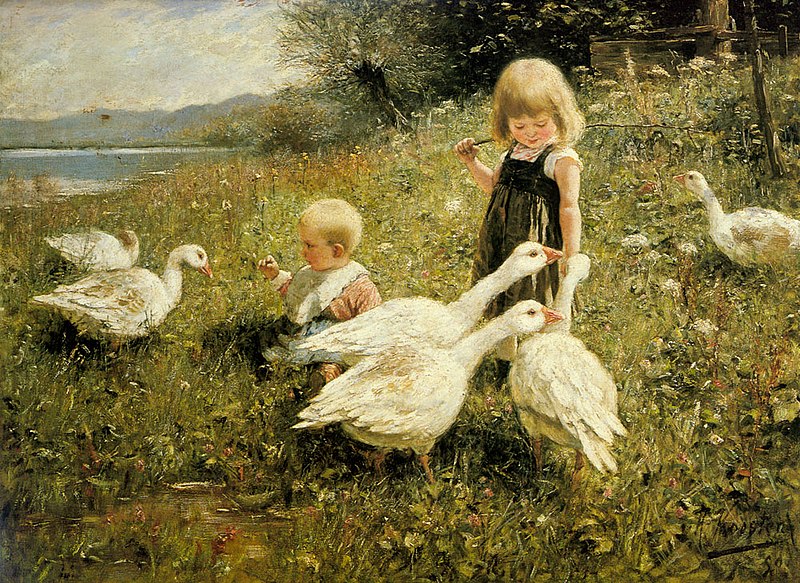
| Gänsefütterung by Alexander Koester, 1890 |
On the road last week, silly conversation led us to the word gander. And I started to wonder whether the two meanings I knew of–a male goose and to look around–were from the same root, or if it were one of those cases where they had nothing to do with one another.
So off I went to etymonline.com the next day to find the answer. =)
Gander has meant “male goose” since the days of Old English. Apparently for a while in the 19th century it was used to mean single men (like “stag”) too–which I didn’t realize! Fun!
In 1680 gander became a verb meaning “to walk aimlessly.” Kinda akin to a wild goose chase in that. Then in 1886, the verb arose that we’re more familiar with, “to take a long look,” from how a goose cranes its head around. So yep, definitely connected! In 1912, that verb became a noun–the look itself.
Always love discovering these things. =)

by Roseanna White | Apr 29, 2013 | Word of the Week
I think we all know what a scandal is, and it’s been in the English language pretty much forever. But there’s a subtly to it I had never picked up on, and which one of our friends was talking about this weekend.
When one goes back to the original Greek skandalizein, the meaning isn’t just “bad behavior, cause for offense,” it’s “to make one stumble.” So a scandal isn’t when one person goes astray…it’s when a person leads someone else astray. Though right there in the definition, I’ve never paused to realize that before. But it makes total sense, doesn’t it? Private sin can be terrible–but how much worse it gets when it becomes a public sin that leads others into it!
Hope everyone has a wonderful week! =)

by Roseanna White | Apr 22, 2013 | Word of the Week
In Circle of Spies, my villain is a railroad tycoon. Slightly tricky because I don’t want to imply that any of the actual railroad men were anything like him, LOL, but I digress. As I was blasting through the scenes last week, I very nearly had my hero contrasting himself with good ol’ Dev and calling the man a tycoon. Then I thought I’d better, you know, actually look it up…
And I’m glad I did. Because though I would swear I’ve watched documentaries that use the word for men of that era, it’s anachronistic to do so. The word originated in 1857, very specifically–it was used by foreigners to the shogun of Japan. Directly from the Japanese word taikun, “great lord or prince,” it was used by the shogun’s supporters to indicate that he was more important than the emperor.
In 1861 the word crossed to America and was used, again specifically, in reference to Abraham Lincoln. But it wasn’t applied to successful business in general until after World War I!
So while I couldn’t use it to speak of Devereaux Hughes, I did find the history intriguing. =) From the shogun to the president, and then nearly fifty years before it gained it modern meaning.
by Roseanna White | Apr 15, 2013 | Word of the Week
|
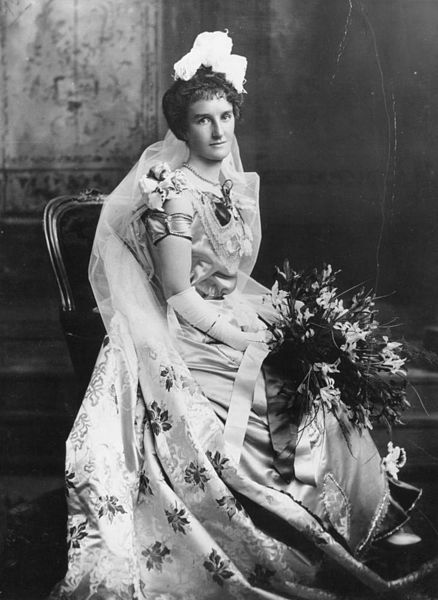
| Agnes Melanie Dickson as a debutante, 1890 |
Anyone who reads historicals, even 20th century historicals…or watches TV…knows what a debutante is. But as I started writing Colonial-set books, I was a bit surprised to learn the word wasn’t around in the 1700s. And a bit at a loss as to what to replace it with when talking about a young woman entering society.
But in its first appearance, debutante actually meant an actress making her stage debut. This word arrived in English round about 1801, coming (no surprise) from the French. It wasn’t applied to society ladies making their debut until 1817. So for me, that means no using it until my Civil War books.
Which I’m now going to hasten back to. 😉 If you haven’t seen the cover of said book, Circle of Spies, yet on Facebook, be sure to come back on Wednesday for a peek, and some fun behind-the-scenes I’ve learned about it since describing it to y’all last week!

 So from my bushel of new-found knowledge I have chosen snap for today. =) Because Slade really, really wanted to tell Marietta to “snap out of it” during the scene I was writing last night. I mean, really wanted to. But I knew that wouldn’t work, so I had to prove it to myself.


 Roseanna M. White is a bestselling, Christy Award winning author who has long claimed that words are the air she breathes. When not writing fiction, she’s homeschooling her two kids, editing, designing book covers, and pretending her house will clean itself. Roseanna is the author of a slew of historical novels that span several continents and thousands of years. Spies and war and mayhem always seem to find their way into her books…to offset her real life, which is blessedly ordinary.