
by Roseanna White | Jan 6, 2014 | Word of the Week
 |
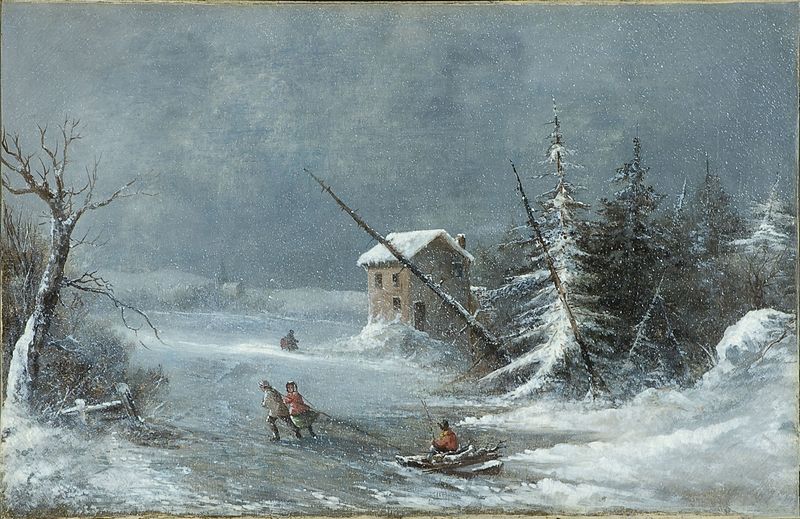
| The Blizzard by Cornelius Krieghoff, 1860 |
Given the awful winter weather striking so much of the country this year, this seemed like an appropriate word for the day. =) Though one I can’t take credit for coming up with–one of my fellow Colonial Writers, the amazingly-talented Lori Benton, posted to our group about this one. I otherwise wouldn’t have thought to question it!
But apparently blizzard is a pretty new word. Though occasionally used for a “a hail of gunfire” as early as 1829, it didn’t take on the snowstorm meaning until–get this–1859. It most likely came from blizz, a word for a violent rainstorm that dates to 1770. Etymologists suspect that its origin is America’s Upper Midwest, where locals probably took the word used for the rainstorm and applied it to the snowstorm just to be cheeky. 😉 (Okay, so they technically say “in a colloquialism.” But we all know what they mean.)
So what in the world did they call blizzards before blizzard was a word?? That’s the question Lori asked, and I’m not sure we really found the best answer. “Violent blow” seems to be the closest, but it doesn’t feel sufficient to me. Guess that’s why those Upper Midwesterners found a better word for it. =)
Hope everybody stays warm this week! And if you’re stuck inside, be sure to swing by again tomorrow. I’m hosting a good friend of mine (from Michigan’s Upper Peninsula, so a girl who knows all about the cold and blizzards, LOL) in an interview and giveaway of her just-released historical romance, The Wyoming Heir. And on Wednesday, I’m taking everyone on a step-by-step journey through the last book cover I designed for WhiteFire. That should be fun too. =) See you tomorrow!

by Roseanna White | Dec 30, 2013 | Word of the Week
First of all, I’d like too announce that next Monday will mark a pretty cool milestone around here–1,000 posts! Woot! I’ll have to think up some fun way to celebrate. Ideas welcome. 😉
And now, a word of the week. =)
I was designing a book cover with a bustle on it, which inspired me to look up the word. Not surprisingly the verb bustle dates back pretty far–all the way to 1570. It meant “be active,” and actually came from bustling, which is from the century before as an adjective. The adjective meant “noisy activity.”
The noun form followed by 1630 with the expected meaning of “activity, stir, fuss, commotion.”
So then, how about the padding in a skirt? Well, that arrived on the scene in the 1780s, though from where and how no one’s quite sure. Speculation is that its rustling sound inspired the name bustle, but it’s also possible that it came from the German buschel, which means “bunch or pad.” Either way, it was a key part of women’s fashion for well over a hundred years.
by Roseanna White | Dec 23, 2013 | Uncategorized
|
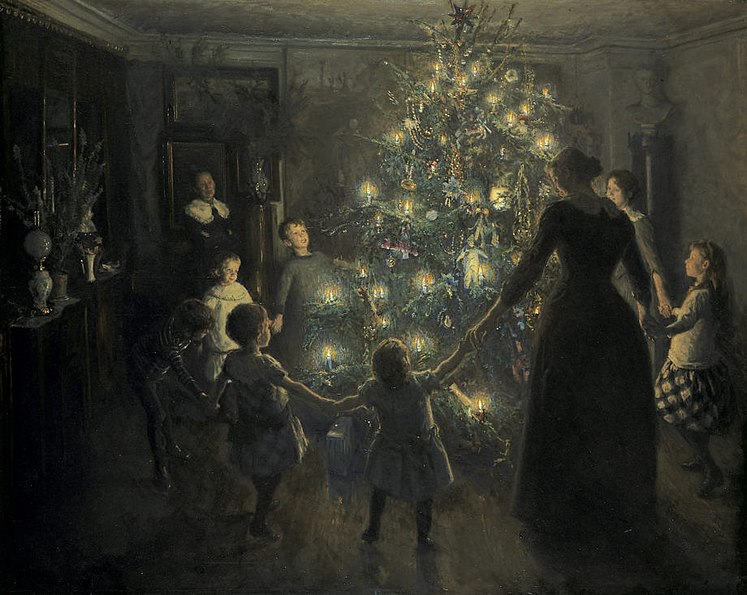
| Happy Christmas by Johansen Viggo, 1891 |
I thought today I’d put together a little of everything for the week and leave it at that. 😉 I daresay many will be so busy with holiday prep that blog-reading will fall by the wayside. So today, a one-stop shop for some Christmasy history and fun.
So let’s take a look at Christmas carols. I confess that I love Christmas music! I have a Pandora channel on my Roku (hooked up to TV to let me access online stuff like Netflix) and have had the classical Christmas channel playing in the evenings. Lovely. But have you ever wondered when the songs came around? Here are just a few with their dates.
“Angels We Have Heard on High”
Lyrics translated to English in 1862
“Deck the Hall”
Lyrics, 1862. Music is a 16th century Welsh melody. (The ‘s’ got added to the title in 1877)
“God Rest Ye, Merry Gentlemen”
Dates from the mid 1700s (exact date unknown)
Lyrics by Isaac Watts, 1719–intended not as a Christmas song,
but as one to celebrate the second coming.
The tune we know was written in 1839 by Lowell Mason.
Earlier tune was taken from Handel’s Messiah.
“Silent Night” (my favorite)
Lyrics were written in 1816 and music in 1818 by a friend of the writer;
it was performed that Christmas Eve in a small German town.
“The Twelve Days of Christmas”
Lyrics from 1780, but without a tune. The melody we know wasn’t written until 1909.
“We Wish You a Merry Christmas”
This one takes the prize as the oldest! Words and music date from the 16th century!
And I do indeed with you all a very Merry Christmas! If anyone has down time on Wednesday or Thursday, I have a post scheduled on Colonial Quills that talks a bit about the tradition of the Yule log.

by Roseanna White | Dec 16, 2013 | Holidays, Word of the Week
|
| Christmas throughout Christendom, 1873 |
I thought it would be fun to examine some Christmas traditions this week and next. So while this isn’t exactly etymology, it’s still looking at origins. 😉
The legend of mistletoe goes all the way back to Norse mythology. Baldr, grandson of Thor, had a troubling dream in which all living things were trying to kill him. His wife and mother saw how troubled he was by this and so went out to procure promises from all living things that they would not injure their beloved Baldr. They got these promises from everything from oak trees to cows…but not from the mistletoe. Some stories say they overlooked it, others that it seemed too young to give such promises. Whatever their reasoning, they failed to get its word–and then an arrow made of its stem pierced Baldr and killed him.
Mistletoe, therefore, became a reminder to remember and treasure what one loves, hence why couple kiss under it.
In Celtic traditions, mistletoe was considered a sacred plant, symbolic of fertility. The reasoning actually gets a bit explicit, but suffice it to say that this culture also held it as holy, and when Christianity spread, they integrated it into the Christmas tradition.
Kissing under mistletoe has been around for longer than we can accurately say, referenced in some European writings as early as the 17th century. The first English mention of it seems to be in the 1820s, though the mention implies it’s a longstanding tradition.
Whatever its origins, it’s always been a popular one, with young couples quite eager to lure a special someone under the berries and greens. And I daresay few care too much about why they’re doing it, LOL.
Hope everyone is enjoying the Christmas season!

by Roseanna White | Dec 9, 2013 | Word of the Week
I was looking through a website called “You Can’t Say That!” last week, which is dedicated entirely to words like I feature here. One of the entries that surprised me–and sent me scurrying to my latest manuscript to see if I used this when I shouldn’t have, was fix.
Fix has been around since the 14th century. But only in the meaning of “to set one’s eyes or mind on something.” It comes from the Latin fixus, meaning “fast, immovable, established, settled.” By about 1400, it added the meaning of “fasten, attach.” So early on, we could fix our eyes upon someone or fix a button to a coat. But not until 1737 could we fix something that was broken.
And according to the website above, that meaning was considered slang and not in use by any but the lowest classes until the late 1800s, and then only in America. Hence why I went flying to my galleys of Circle of Spies…where I was relieved to see that there was only one use of fix as “repair,” and it was used by my hero, who isn’t exactly from the highest echelon of society. 😉
Oh, and we mustn’t forget the meaning of “tamper with.” That joined the fray in 1790. Not, I daresay, that people did not fix fights or juries before then…
I hope everyone had a great weekend! We enjoyed seeing my daughter’s ballet studio perform The Nutcracker on Saturday night–and were supposed to enjoy it again yesterday, but it got snowed out. So we enjoyed our first winter storm instead. 😉



 Roseanna M. White is a bestselling, Christy Award winning author who has long claimed that words are the air she breathes. When not writing fiction, she’s homeschooling her two kids, editing, designing book covers, and pretending her house will clean itself. Roseanna is the author of a slew of historical novels that span several continents and thousands of years. Spies and war and mayhem always seem to find their way into her books…to offset her real life, which is blessedly ordinary.