
by Roseanna White | Aug 11, 2014 | Word of the Week
An always-hot topic in Christian writing circles is the use of foul language. Is it ever okay in Christian fiction? Some words? What about others? Why or why not?
I have my own opinions on such things–namely, I don’t use “bad language” but see no point in getting up in arms about those who do–but I find some of the distinctions very interesting.
What I definitely take issue with is profanity. Profane comes directly from the Latin profanus, which means “unholy.” Profanity obviously is taken from profane, and it speaks directly to abusing/misusing the name of the Lord. So your average expletive is not profanity. And in fact, the original English translations of the Bible include words that today’s Christians would probably raise a few eyebrows at, LOL.
Expletive just means exclamation…cuss is a variation on curse…
So then I jump to curse, thinking surely that this word will provide some good meaning. But curse has its roots, oddly enough, in, you know, a curse. As in “a prayer that evil will befall one.” That’s not exactly what modern cursing is either, is it? LOL
Looking at the etymology of these words themselves, it seems that our notion of bad language has just evolved over the centuries. “Rough” or “impolite” terms have slowly taken on the blight of being “bad.” From “bad” they have become “cursing and profanity”…though in reality, most of them I’ve ever heard have nothing to do with actual curses or profaning the name of the Lord.
I still don’t say them, because connotation means as much as denotation. But looking at it logically, I think the only things that strictly fall under these definitions are using the Lord’s name in vain and wishing somebody be damned. Which, oddly, are two of the more acceptable ones. Oh, the irony…

by Roseanna White | Aug 4, 2014 | Word of the Week
Hi is one of those greetings that feels new to me, and which I usually avoid entirely in my historicals…though I’ve seen it in a few others. And so, I look it up.
It isn’t quite as new as I’d thought–as a greeting like it’s used today, hi is from 1862 (though let it be noted it’s American English from then, not British). The first recorded reference is from the speech of a Kansas Indian.
It traces its roots further back, though. As a shout to gain attention (so not just a substitute for hello or good day), it’s from the 15th century, as a variation of hey.
On another note, today is the last day to enter the giveaway on the Harvest House blog to win Circle of Spies! Hop over to read my guest post about the Culper Ring and enter to win! Click Here
Cylist photo credit: -Jeffrey- via photopin
by Roseanna White | Jul 28, 2014 | Word of the Week
Don’t you hate it when plans backfire?
Ever stop to wonder how long they’ve been doing it–with that exact word, anyway? No? Well, pause to wonder. 😉
One of the first meanings of backfire to find its way into English was a literal fire–one lit on a prairie to stop the advance of a wildfire and deprive it of fuel. This backfire joined the language in 1839, as a noun, with the verb of this meaning following in the 1880s.
But that’s certainly not what we mean by it in casual conversation today, right?
The next familiar meaning is fro 1897, that of “premature ignition of an internal combustion engine.” So the car that backfires. Sure.
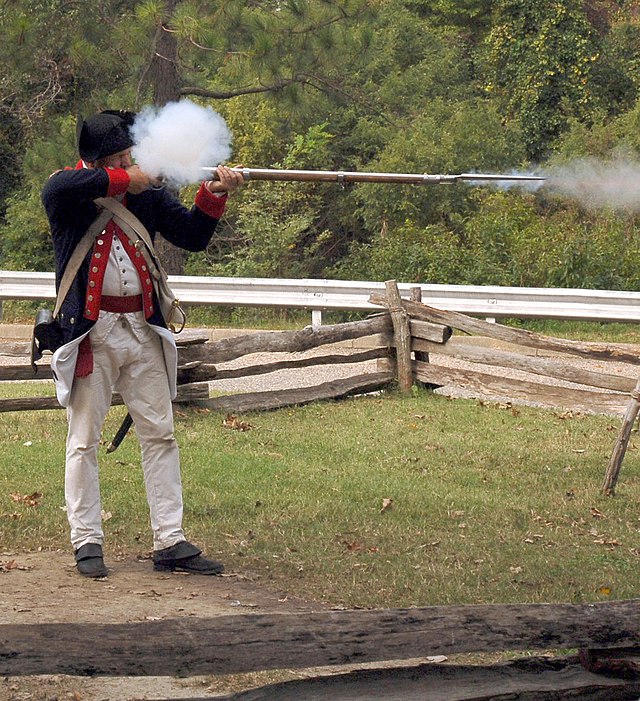
What I find interesting is that the figurative meaning of “to affect the initiator rather than the intended object,” from 1912, is the newest meaning…from the oldest one. This of course alludes to the back-firing of a fire arm, when there’s an explosion from the breech of a gun–which dates from 1775-1780 in America. Backfire is, then, it seems, a word from the American Revolution. Who knew? (And okay, so I’m extrapolating that from the dates, but it seems logical, LOL.)
(The photo above is a normally operating flintlock rifle, not a backfiring one. Just FYI)

by Roseanna White | Jul 22, 2014 | Word of the Week
I had no internet yesterday, so the Word of the Week is coming to us a day late. But I found a fun one, quite by accident. =)
Growing up in West Virginia, I’ve heard the term “hillbilly” plenty of times. And of course, there are the famous ones from Beverly Hills. 😉 But I really had no idea where the term came from. Turns out it’s pretty straight forward–“hill” (the southern Appalachians, to be precise) plus the proper name “Billy.” But the fun part comes from some of the earliest quotes using the term.
First is the original one, from 1892:
Then again, I do not think It will do so well. I would hate to see some
old railroad man come here and take my job, and then, I don t think It
is right to hire some Hill Billy and give him the same right as I just
because he was hired the same time I was. [“The Railroad Trainmen’s
Journal,” vol. IX, July 1892]
And this one from 1900 is even more interesting:
In short, a Hill-Billie is a free and untrammelled white citizen of
Alabama, who lives in the hills, has no means to speak of, dresses as he
can, talks as he pleases, drinks whiskey when he gets it, and fires of
his revolver as the fancy takes him. [“New York Journal,” April 23,
1900]
If that is, indeed, the definition, then I gotta say I don’t know a single hillbilly, LOL.
Hope everyone’s having a good week!

by Roseanna White | Jul 14, 2014 | Word of the Week
With all the World Cup stuff going on right now, this one seemed appropriate. And is why my kids asked, “Why do we call it soccer and everyone else call it football?”
So naturally, I looked it up. =)
As it turns out, soccer comes directly from football…sort of. It started as an abbreviation of Football Association. For reasons fairly obvious, rather than abbreviate with the first three letters of association, university kids would abbreviate it socc instead. Sometimes socca. In the 1890s, it was pretty common for university slang to apply an -er ending to just about anything. Rugby players were called ruggers, for example, so by 1891, soccer had joined the language. Probably first applied to the players, but it apparently stuck and became applied to the game itself.



 Roseanna M. White is a bestselling, Christy Award winning author who has long claimed that words are the air she breathes. When not writing fiction, she’s homeschooling her two kids, editing, designing book covers, and pretending her house will clean itself. Roseanna is the author of a slew of historical novels that span several continents and thousands of years. Spies and war and mayhem always seem to find their way into her books…to offset her real life, which is blessedly ordinary.