
by Roseanna White | Dec 7, 2015 | Word of the Week
Since it’s getting rather frosty outside here in the Appalachians, I thought today we’d take a look at ice…or rather, at when some of its idioms came into use. =)
Ice itself is from Old English, from Proto-Germanic is. There are cognates for it in quite a few other languages that also derive from that old-old-old German tongue. Our modern spelling began to appear in the 1400s.
Having been part of our language for so long, it’s no surprise that eventually it began to be used in idioms. The oldest of these is to break the ice. It has been meaning “to make the first attempt” since 1580! I had no idea it was so old. But it comes about as a metaphorical allusion to boats breaking up the ice in a river.
The 1800s brought us quite a few uses. The term ice age was coined in 1832. Ice fishing began to be spoken about in 1869 (which makes me wonder…was the activity itself first practiced then or did people use to call it something different?). Thin ice, in the figurative sense, first appeared in writing in 1884. On ice–as in, kept out of the way until needed–is from 1890.
And finally, the use you may have spotted in The Lost Heiress. Ice as a slang for diamonds is from 1906. (I totally would have thought it a product of the 1920s before I looked it up for use in my book. Shows what I know, LOL.)
Stay warm, everybody!

by Roseanna White | Nov 30, 2015 | Word of the Week
I was surprised to realize this weekend past that the Advent season is officially begun–I thought it would start next weekend, but my calendar is obviously off. 😉
As a child, I knew that advent marked the season leading up to Christmas…but it wasn’t until later that I realized advent actually meant “the approach, arrival, or coming.” But once I learned that bit of information, I naturally assumed that the word had always meant “the approach, arrival, or coming,” and hence was applied to the Christmas season as it counted down to the arrival on earth of our Savior.
As it happens…not exactly.
It wasn’t until 1757 that advent took on that general meaning–then that people may have begun saying things like “the advent of summer” or the like. Until then, the word meant only the Christmas season.
Advent was present in Old English as such, taken from the Latin adventus (which does indeed mean “coming, arrival” etc.), but in Church Latin (what would have been used in English-speaking realms at the time) it was used only for the season leading up to Christmas.
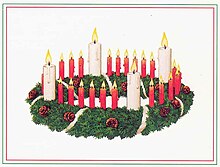
As for the Advent wreath many churches and families keep today–the tradition was begun by a German pastor and missionary, Johann Hinrich Wichern, in 1839 (though there were a few earlier versions that didn’t catch on dating back to the Lutherans of the 16th century). The original version counted down the whole month for the children of the mission school where he served, with 20 red candles and 4 large white ones.
The purple and rose candles most churches use today were made to match the liturgical colors in the Catholic church for those Sundays in December.

by Roseanna White | Nov 16, 2015 | Word of the Week
This one is quick–but interesting!
Anyway dates from 1560, though it was traditionally two words until the 1830s. And up until modern history, it was quite literally “any way.” As in, Is there any way I can help you? I’ll get there any way I can. It quite literally meant “in any manner.”
It wasn’t until 1859 that it took on the sense of “regardless” that it now often has. So, historically, no “I’m going anyway!” unless you mean “by any path.”
Yeah, pretty sure I may have used that one incorrectly at some point or another, LOL. But now we know!

by Roseanna White | Oct 26, 2015 | Word of the Week
About a month ago, a lady at our church volunteered to teach knitting classes. Having been crocheting since she was 9 and then knitting as well when she moved to our area and began working in a yarn store, Ms. Judith knows her stuff!
I joined mostly because Xoe has taken a few classes and needed a few more, LOL. And I figured, this way I could help her. I wasn’t expecting to fall in love with it, but boy have I!
So today, our word of the week is knit.
The word has been around since Old English, meaning “to tie with a knot, bind, fasten.” And while the art of knitting has been around so long no one knows exactly when it started, the word has been in English with the particular meaning of “to do knitting” only since the 15th century. (Only . . . LOL)
Interestingly, referring to a piece of knitted work as “knitting” is quite new! That only joined the English language in 1848. (Wondering now what they called it before…)
(Those are my knitting projects thus far in the photo – starting at the left, we have a stitch I just wanted to try so did something that ended up the size of a pot holder, LOL. Didn’t like the yarns though so stopped. Then I decided I’d do a cable knit scarf. I still had lots of the yarn, so I made a cable-knit hat to match [it’s finished, but I didn’t take a finished photo yet]. Those are the same yarn in the two middle pictures, just different lighting, LOL. And finally, I’m trying some toy patterns, so I did a star fish. Just finished that this weekend, and am currently working on a bat!)

by Roseanna White | Oct 15, 2015 | Thoughtful Thursdays, Uncategorized
Freedom.
It’s a subject being discussed quite a bit these days in hot-topic conversations . . . though sometimes I don’t think people realize that is at the heart of what they’re talking about.
Freedom.
It’s the heart of the Christian faith, something Americans certainly make a show of valuing . . . but often atheists’ main objection to Christianity is–though they rarely realize it–our freedom.
Freedom.
Something we want so desperately, but understand so poorly.
Last week, a friend of mine had changed her social media profile picture to be a little thing that said “I Am a Christian.” For some bizarre reason, this triggered attacks on her by total strangers on Twitter, who took it upon themselves to insult her in some rather colorful language and accuse her of “liking to be a victim then.”
I was so very impressed with how my friend handled herself. Not at all confrontational, she just asked the person to explain what they meant. The root of their argument? That there had better not be a God, because if there were, He was doing a lousy job of protecting people. Just look at all the violence and crime!
My friend’s response: “So you want a God who controls you completely?”
The confrontational person certainly didn’t take kindly to that. But it sure got me thinking.
That is, in essence, what people are asking for when they say, “Why doesn’t God stop these bad things from happening? Why didn’t He stop that shooter? That bomber? ISIS?”
When those are the questions churning through our mind, we see only one side of the equation, and it looks grossly unfair. God should put a halt to these terrible thing! Right?!
Wrong. So very, very wrong.
Because if God put a halt to those terrible, terrible things–things people choose to do to each other–then He, being perfectly just, would also have to put a halt to everything you do that isn’t perfectly pleasing to Him.
Is that how you would want to live? With God controlling your every word? Your every action? Your every thought? Do you want to live as nothing but a puppet?
I daresay no one, even those of us who strive to be better and live according to God’s will, want that. We, by nature, value freedom. Free will. We, by nature, want to choose whether we love God, whether we serve Him. He doesn’t demand compulsory service–He softly requests our hearts.
But if we grant that He should give us free will, we have to extend it to all humanity–including those who abuse it.
And there will always be people who abuse it. There will always be people who heed the whispers of the enemy rather than those of God, who take perverse delight in hurting, killing, abusing, misusing other people. Could God stop them? Of course He could. But except for a few occasions where His people are praying and His glory needs to be demonstrated, He doesn’t. Because He already let us choose–He granted us that most basic freedom. We don’t really want Him to take that away.
Not from us, anyway. But we still wish He would take it away from them, don’t we?
At least until we realize that God loves them just as much as He loves us. And because He loves them, He wants them to have that freedom to choose Him too. He wants to reach their hearts, not to bind their hands.
But freedom, as much as we treasure it, terrifies us when it’s extended to those whose views are different from ours. Because what if they abuse it? How do we stop them?
Well, as I know I’ve said before, we don’t accomplish it by tying their hands, since God won’t. We don’t do it by taking away guns. We don’t do it by limiting everyone’s freedoms.
We do it by praying a revival into the world. By turning hearts to Him. By reinstating the morality that God, in fact, gave us to try to guide us away from these abuses we find so heinous . . . but which also include Him guiding us away from abuses we find pretty nice. You know, like sex with whomever we want, whenever we want, married or not. Like getting rid of whatever child (oh, I’m sorry, fetus [which, now that you mention it, means “child” in Latin, no differentiation between born or unborn]) we find inconvenient. Like putting anything and everything before Him in our priorities and loyalties.
We call those things freedoms, proving how little we understand the concept. Free choice. Free love. Free time.
Those things aren’t free–they come with a cost. One America and the world are paying every day when we create a generation, a people, who value life so little that they see no reason not to end the lives of those they disagree with. We, as a culture, have taught them to do that, then we wonder why God didn’t stop them?
Freedom.
It’s a crazy thing, isn’t it? Something we want so fiercely . . . understand so little . . . and don’t know what to do with once we’ve got it. Something we go to war to protect . . . and then give away in terror. Something we say is a basic human right . . . even if that requires changing the definition of “human” so it doesn’t have to apply to those to whom we don’t wish to grant it.
Freedom.
It’s one of God’s sweetest gifts to humanity. And one of the things that make people doubt His very existence.
Freedom.
A gift we can’t accept without extending it to others too.





 Roseanna M. White is a bestselling, Christy Award winning author who has long claimed that words are the air she breathes. When not writing fiction, she’s homeschooling her two kids, editing, designing book covers, and pretending her house will clean itself. Roseanna is the author of a slew of historical novels that span several continents and thousands of years. Spies and war and mayhem always seem to find their way into her books…to offset her real life, which is blessedly ordinary.