by Roseanna White | Jun 6, 2012 | Remember When Wednesdays, Uncategorized
I’m back to work on my Victorian-turned-Edwardian historical romance–I thought I’d be working on my second Culper Book this week instead, but alas. When an editor asks to see more, I must be flexible. 😉
In order to achieve the right balance in this one, I have to have a solid understanding of servants of the day (one of my POV characters is a head maid, soon to be promoted to lady’s maid). So much of my day yesterday was spent in research. Naturally, I thought you’d enjoy a look at some of it. 😉
First, I’d like to recommend you to the
Jane Austen World blog, if you don’t frequent it already. She has some truly beautiful and insightful posts put together, using
Downton Abbey as her example.
But I’m going to post here some Servant Rules, provided by PBS’s
Manor House site.
- Never let your voice be heard by the ladies and gentlemen of the house, except when necessary, and then as little as possible.
- Always “give room” if you meet one of your employers or betters on the stairs.
- Always stand still and keep your hands quiet when speaking to a lady or being spoken to and look at the person speaking to you.
- Never begin to talk to ladies and gentlemen unless it be to deliver a message or ask a necessary question.
- Servants should never offer any opinion to their employers, nor even
to say good night or good morning except in reply to salutation.
- Never talk to another servant, or a person of your own rank, or to a
child in the presence of your mistress, unless for necessity then do it
as shortly as possible, and in a low voice.
- Never call from one room to another.
- Always answer when you have received an order or reproof.
- Outer doors are to be kept constantly fastened, and their bells to
be answered by the Butler only, except when he is otherwise
indispensably engaged, when the assistant by his authority will take his
place.
- Every servant is expected to be punctually in his/her place at meal times.
- No servant is to take any knives or forks or other article, nor on
any account to remove any provisions, nor ale or beer out of the Hall.
- No Gambling of any description, or Oaths, or abusive language are on any account to be allowed.
- The female staff are forbidden from smoking.
- No servant is to receive any Visitor, Friend or Relative into the
house; or to introduce any person into the Servants’ hall without the
consent of the Butler or Housekeeper.
- Followers are strictly forbidden, and any maid found fraternising
with a member of the opposite sex will be dismissed without a hearing.
- No tradesmen, nor any other persons having business in the house are
to be admitted except between the hours of 9am and 3pm and in all cases
the Butler or Chef must be satisfied that the persons he admits have
business there.
- The Hall door is to be finally closed at half-past ten o’clock
every night, after which time no person will be admitted into the houses
except those on special leave.
- The servants’ hall is to be cleared and closed, except when visitors
with their Servants are staying in the house, at half-past ten o’clock.
- No credit upon any consideration to be given to any person residing in the house or otherwise for Stamps, Postal Orders etc.
- Any breakages or damage to the house will be deducted from wages.
Now, let it be noted that there are plenty of responsibilities for the “betters” in master/servant relations too! Maybe we’ll take a more detailed look later on, but the one that struck me most was they were strictly instructed in ignoring the servants if they came upon them (in one of those instances when the servants “gave way”), lest they embarrass them by calling attention to them when they were trying to be invisible.
So now that I have my guide, time to get writing!
by Roseanna White | Jun 4, 2012 | Word of the Week
This weekend we had a great time with our out-of-town visitors, my friend (and fellow WhiteFire author and editor, and critique partner) Dina Sleiman and her husband. So in the spirit of enjoyable company, I thought I’d look at the word. 😉
Sine the mid-12th century, company has meant “a large group of people.” A meaning still in use, but it sounds a little old-fashioned to talk about “being in a company of people.” It’s from the Old French compagnie, which means “society, friendship; body of soldier.” Note that the French carries a military meaning, but that didn’t get applied to the English word until 1580.
Company meaning “companionship,” (i.e. “I’d like some company while I do this”) is from the late 13th century. It adopted the sense of a business association since the 1550s but apparently been used for trade guilds since the 1300s.
So as you can see, it’s an old, well-established word in pretty much all its current meanings. Even the abbreviation “co.” is old, dating from the 1670s.
And so I thank you for your virtual company and hope you all enjoy your week! It’s our first full week of summer break here. School wrapped up on Wednesday, but Wednesday, Thursday, Saturday, and Sunday we had ballet–that’s now over too, so we’re free! Woot!

by Roseanna White | May 31, 2012 | Thoughtful Thursdays, Uncategorized
As summer approaches and is in effect here for many of us in terms of school and whatnot, I’ve noticed something. Most writers with kids assume they’ll get less done during the summer, with their bundles of energy underfoot. And I can see where this would be the case.
But I home school–so for me, summer is a break from the grind just like it is for the kids. And man, am I hoping to get MORE done!
Since the school year began, I’ve wrapped up one novel that was 75% done when the year started. I’ve written another novel. I’ve edited that first one. I’ve written a novella. I’ve put together something like four different proposals. And I’ve also done quite a bit of editing for WhiteFire titles.
But oh, the work I have piled up that I’d like to tackle this summer! I’ve gotten sidetracked by an unexpected but promising project that’s allowing me to rewrite (again, LOL) my first-ever novel. I worked on that proposal a month ago and now need to work a bit more on it. But I also need to dive into my second Culper Ring book for Harvest House; it’s not due until January, but I want it mostly done by the time the school year rolls back around again.
I’ll also have to edit my Civil War-era book at some point, and that might have to be this summer too. Plus editing for WhiteFire, of course–got some fun projects there. =)
When am I going to do all this? Yeah, um…I don’t know, LOL. And have I mentioned I’m probably moving at the end of summer? Not far, just back to the WV side of the river, but I’m sure that’s going to throw a wrench into my schedule at some point too.
But for today, I have a few hours of quiet, and all I have to do (ahem) is three loads of laundry, clean my house top to bottom, and write. Piece of cake, right? 😉 Seriously, we just finished up our school year yesterday, so this feels like complete freedom. And tomorrow, my fellow-WhiteFire editor and author, critique partner and friend Dina Sleiman is coming up for a visit, so I’m really excited to get to hang out with her. =) (Although that is why I have to clean my house…) And tonight is dress rehearsal for my daughter’s first ballet, which will be performed Saturday and Sunday.
Yeah, busy weekend. And sure to be a busy summer. What big goals do you have?

by Roseanna White | May 30, 2012 | Remember When Wednesdays, Uncategorized
Real quick–today I’ve posted on Go Teen Writers about what an editor at a publishing house really does. Check it out if you’re curious!
https://www.roseannamwhite.com/2012/05/what-does-editor-do-anyhow.html
~*~
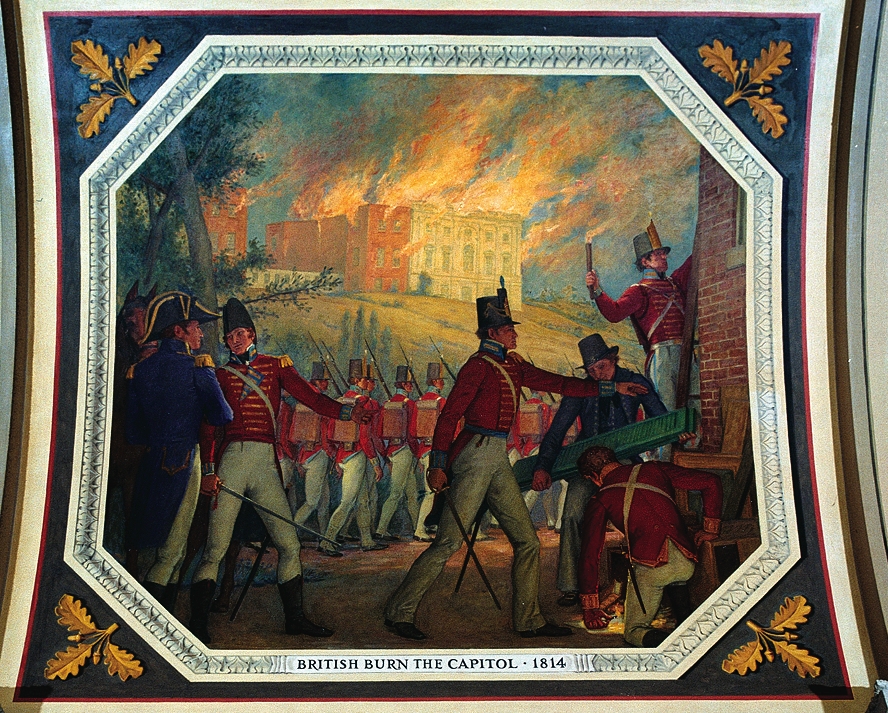
I’m nearing the end of my War of 1812 research, and several times I’ve been amazed at how the British commanders totally misunderstood the American spirit. They thought from the start that if they could just convince the Americans to turn on each other, if they could discourage us, then we would turn on our own cause and join theirs instead.
Boy, were they wrong.
I got my first chuckle when I saw how a good ol’ Maryland summer wreaked its havoc on the out-of-condition British troops, who had spent far too long on board their ships and hadn’t made an attempt to get back in shape upon landing, thinking it not worth the effort, more or less. The march toward Washington, made in 95 degree August heat–which means humidity that would have made it well over a hundred–felled more men than our troops did. Seasoned British veterans later said this march was the single worst time in their careers. (Oh yeah–go Maryland summers!)
We all know, of course, that they made it to Washington. To be sure, the British were a little baffled as to why it was left all but defenseless. But for our part, we couldn’t understand why they would make the effort to take a city of absolutely no strategic importance.
The answer? The British command wanted to hit us where it hurt. Burning Washington was meant to be a sucker-punch, meant to break our fighting spirit. But even their own people back home shook their heads when they got the news of the attack, one member of Parliament saying Britain “had done what the Goths refused to do at Rome.” He was echoing a London paper that had written, “Even the Cossacks spared Paris, but Englishmen spared not the capital of America.”
The British commander–hating America because his father had died at Yorktown in the Revolution–had crossed a line. And rather than break us, it made every individual American realize this war wasn’t against a nebulous idea of country–it was against them. For the first time, many citizens understood that our government couldn’t succeed without their support.
The burning of Washington achieved what no amount of pleas from our military commanders had been able to–it made the war hit home, and made it personal. In the week following, men volunteered by the thousand, and people finally determined that they would not suffer the British actions.
The British were in for another lesson too–that our government doesn’t rely on one location. Within two days of Washington’s burning, Congress and the Cabinet were back together and in action.
And boy, were we ready for action! =)
~*~
On a totally unrelated note, my watermelon cake. It was in some respects a total fail–the back completely fell apart as I iced it. But I hid the damage in a clever display (somewhat anyway) and got a couple decent pictures. And my grandmother, whose birthday we were celebrating on Memorial Day, got a kick out of it. (My grandparents own a produce farm, so…)
by Roseanna White | May 28, 2012 | Word of the Week
Since it’s Memorial Day, I thought I’d take a look at some appropriate words. =) I know I did “memorial” last year, though, so today we’re going with “veteran.”
I was a bit surprised by how old this one was for some reason. Since 1500 it has carried the meaning “old experienced soldier.” It’s taken from the French vétéran, which is in turn from the Latin “veteranus,” which means, simply, old. (Sorry, all you vets out there! LOL) Of course, “veteranus” is from “vetus” which also means old, derived from a bunch of really ancient languages in which similar words mean “year.”
That kind of surprised me, since its only history is attached to age and not to service. But there you have it. By the 1590s it had taken on the meaning of anyone experienced with any position, moving from noun to adjective by 1610.
But no matter where the word comes from, I certainly want to take today to thank all those men and women who have served our country, who have fought for our freedom. All those who have given of themselves for a noble cause.
And now, go enjoy your holiday. 😉 I’m off to bake a watermelon-shaped cake…



 Roseanna M. White is a bestselling, Christy Award winning author who has long claimed that words are the air she breathes. Having successfully launched two homeschool grads, she now spends her time writing fiction, designing book covers, and pretending her house will clean itself. Roseanna is the author of a slew of historical novels that span several continents and thousands of years, as well as a fantasy series and contemporary mysteries and romances. Spies and war and mayhem always seem to find their way into her books…to offset her real life, which is blessedly ordinary.
