by Roseanna White | Apr 15, 2013 | Word of the Week
|
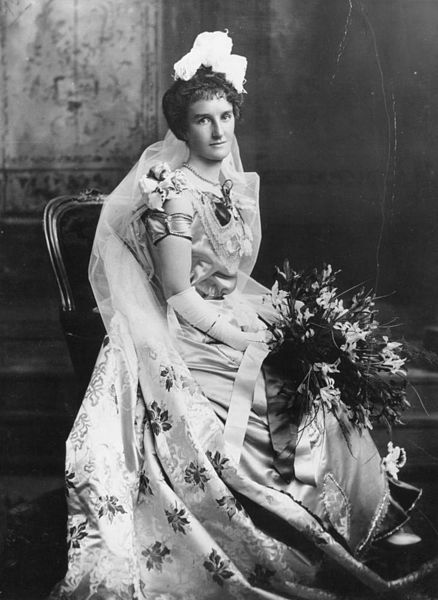
| Agnes Melanie Dickson as a debutante, 1890 |
Anyone who reads historicals, even 20th century historicals…or watches TV…knows what a debutante is. But as I started writing Colonial-set books, I was a bit surprised to learn the word wasn’t around in the 1700s. And a bit at a loss as to what to replace it with when talking about a young woman entering society.
But in its first appearance, debutante actually meant an actress making her stage debut. This word arrived in English round about 1801, coming (no surprise) from the French. It wasn’t applied to society ladies making their debut until 1817. So for me, that means no using it until my Civil War books.
Which I’m now going to hasten back to. 😉 If you haven’t seen the cover of said book, Circle of Spies, yet on Facebook, be sure to come back on Wednesday for a peek, and some fun behind-the-scenes I’ve learned about it since describing it to y’all last week!

by Roseanna White | Apr 11, 2013 | Uncategorized
Persuaded
by Julie Coleman
The supply of wine had been depleted.
Not one drop left. And the party was still going strong.
Mary shuddered at the embarrassment the
oversight would bring on the hosts. She instinctively turned to her
son to relate the news. He would know what to do. But Jesus seemed
impervious to the problem. “Woman, what does this have to do with
me?” he queried. “My hour has not yet come.”
Unfazed, Mary turned to the servants.
“Do whatever he says,” she simply told them. And Jesus turned the
water into wine.
This story has its puzzling moments.
But one big question towers over the rest: why would Jesus refuse to
help, even going so far as to state his reason for not helping, then
turn around and do the miracle anyway?
There were other times Jesus refused to
perform miracles. We are told in Mark 6 that in his
hometown of Nazareth, Jesus “could do no miracle there except that
he lay his hands on a few sick people and healed them.” Why? “He
wondered at their unbelief.” Several times, religious leaders and
then Pilate asked him to perform. Jesus flatly refused, for they were
merely “seeking a sign from heaven to test him” (Mark 8:12). They
had not asked in faith. The miracles were not meant to create faith;
they served merely to confirm it.
Faith is a necessary component to any
request we make of God. Jesus would not perform a miracle without it.
When two blind men asked for healing,
Jesus asked them, “Do you believe that I am able to do this?”
When they affirmed their trust, Jesus gave them their sight (Matthew
9:29). He asked a father to confirm his belief before ousting a demon
that controlled his son. Why? “All things are possible to him who
believes” (Mark 9:23). In these and many other cases, belief
in Jesus’ mercy and power was required before
Jesus would help them.
When faith is expressed, God responds.
Mary’s instructions to the servants
at the wedding of Cana were brim-full of faith. Whatever he
says, do it. She trusted Jesus would do the right thing. Jesus
responded by turning water into the finest of wines.
The Greek verb pisteuo, translated
as believe, trust, or to have faith often carries
the qualifying connotation of being persuaded or convinced. The Greek
lexicon defines it as “to cause to come to a particular point of
view or course of action.” Trust results from what one has found to
be true. Mary knew Jesus as only a mother can know her child. He
lived in unfailing obedience to his heavenly Father. What she had
observed of him in the past persuaded her to trust him now.
When God brought the Israelites out of
Egypt, he demonstrated his power and faithfulness to them over and
over, first with the plagues, then the crossing of the Red Sea,
provision of water and manna, and the dramatic giving of the Law. In
short, he was teaching them to trust him. But the months they spent
in the desert experiencing his faithfulness apparently weren’t
enough for the message to sink into this “stiff-necked” people.
They balked at entering the Promised Land, refusing to trust God for
his provision.
God ironically gave them what they
wanted. They would never go in. But their children would. So God
spent the next 40 years proving to the new generation just how
trust-worthy he was, teaching them the truth of his goodness and
power. And when it came time to go into the land, they were ready to
follow him anywhere. Truth is foundational to trust.
Trust doesn’t come
naturally to us. So God brings along hardship, times when we struggle
to perceive his presence or guidance, times when everything seems
hopeless or overwhelming. We hate those times and dread their
appearance into our lives. But he will use them to give us a deeper
understanding of just how faithful he is. We will emerge from the
darkness with a better capacity to trust him. And the conduit of
trust opens the way for his blessing and mercy.
“I thank God for the mountains,
and
I thank Him for the valleys,
I thank Him for the storms He brought
me through.
For if I’d never had a problem,
I wouldn’t know
God could solve them,
I’d never know what faith in God could
do.” –Andrae Crouch
Julie Coleman is an author and
speaker who focuses on Biblical study and women’s ministries. Julie’s
new book, Unexpected Love: God’s Heart Revealed in Jesus’
Conversations with Women, was recently released by Thomas
Nelson Publishers. You can learn more about Julie at
www.unexpectedgod.com.

by Roseanna White | Apr 10, 2013 | 17th-19th Centuries, Remember When Wednesdays
Okay, I’m too excited not to mention it, though I’m not sure if I can share the image yet–I was surprised by my cover for Circle of Spies yesterday afternoon! I wasn’t expecting this for another few months, so it was pretty cool to get it early, while I’m still writing it. I’ll share the image when I get the go-ahead, but for now, I’ll just talk a bit about why I absolutely love it. =)
First, the model is 100% perfect. Closest match to Emma Stone as a redhead that I’ve seen, LOL. The costuming is excellent–they put her in half-mourning as I requested, an elegant gray day dress with black piping. Love it! My critique partner declared the gloves she’s wearing totally awesome. =) The colors are muted, which the designer got spot-on without any input from me. All through the book I’m describing the world as gray and colorless, the vibrancy having been leached out by the war. He didn’t know that, but he sure got it right! (Which draws the eye straight to her beautiful red hair. Just like happened with my hero, LOL. PERFECT!!)
And in the background is Ford’s Theater!
|
| Ford’s Theater |
This is pretty exciting in and of itself, because the next scene I’m writing with Marietta will be at the theater. =) I listed it as a possible background image months ago, but at the time wasn’t sure how I would get her there. Then when I had the epiphany of how, when, and why she was at Ford’s Theater, I had no clue if they’d want to go that way for the cover. So this is just amazingly fun!
 |
Actress Laura Keene,
star of Our American Cousin |
She won’t be there the night Lincoln is assassinated–she’s in some hot water of her own then–but she goes a month before, when the same play is being performed. Which, for those of you like me who don’t have all this history memorized randomly, was Our American Cousin. It was a comedy about a British dowager who thought a visiting bumpkin was an American millionaire. The star of the performance was Laura Keene. On that fateful night in April, Booth chose the laughter following one of her most famous lines in the play to cover the sound of his gunshot.
So yep, this cover came at a perfect time for me and will be up on my screen providing inspiration as I write the scene–hopefully today, but maybe tomorrow, as I have two scenes to get through before she gets there. =) This will be Marietta’s first social appearance since emerging from second-mourning, and it’s a big one for her, because she makes it without a certain someone by her side…and I daresay he’ll be none too pleased about that when he gets back from his conspiratorial trip to Cumberland. 😉
Ah, I love this stuff. Happy Wednesday, everyone!

by Roseanna White | Apr 8, 2013 | Word of the Week
Another one I looked up in the course of writing. =) I knew that charades was a pretty old game, but I was interested in the metaphorical sense. And learned some fun things.
Charade entered the English language round about 1776, obviously from French. The interesting bit is that it’s from a word that means chatter, talk. Interesting because of where our version of the game has ended up–silent. LOL. The original version of the game relied on enigmatic descriptions to try to get the players to guess the word.
The silent form variation was originally referred to as dumb charades. This is what led to “acting charades,” which is what our metaphorical (i.e. Could she keep up this charade forever?) sense is taken from.
I hope everyone has a lovely Monday! I’ll be enjoying the National Aquarium with my kiddos and a group of other homeschoolers. =)
Oh! And one of WhiteFire’s titles is on super-sale! Check out this biblical novella for only $.99! Trapped: The Adulterous Woman by Golden Keyes Parsons.

by Roseanna White | Apr 4, 2013 | Thoughtful Thursdays, Uncategorized
My parents always read to me as a kid. I started writing when I was, oh, six or seven. It took another year or two for me to love reading (myself) other stories as much as I loved creating my own, but I definitely came down with that bug something fierce. And after college, I decided I should take up writing reviews. At the time there was a lack of reviews from the Christian perspective, and I wanted to fill the gap.
It wasn’t long until I was a member of ACFW and reviewing the books of a lot of other authors from the organization. And because of that, I had faces to put to the names and titles. I knew there were people behind the books, I knew the people, sometimes (a little). And I knew too that I was a writer, and that was always in the back of the my mind. I wanted my reviews to be honest, but I also wanted them to be fair and Godly. I wanted to never, ever write a review that was not one I would be hurt to receive.
When I first had books out there in the world to be reviewed, I was pretty blessed. All my first reviews were positive. And often not just positive but glowing. Left and right I had folks saying how my biblicals changed their lives, their understanding, I heard “best book” or “favorite book” a few times. Which gave me the confidence to say that I was actually looking forward to my first negative review, because it would make me more a “real” writer.
Yeah. Silly me, LOL.
In the years since then, I’ve gotten my fair share of bad reviews. I’ve let them bog me down sometimes, and other times I’ve shaken them off. When they’re really well thought-out negative reviews, I learn and grow from them. I thought I’d gotten pretty good at dealing with the negative, focusing on the positive. But recently, I’ve come to a decision that, for me, is pretty big.

I’m done reading reviews of my books. Finished.
Ciao, bye-bye. Other writers I love and respect have arrived at this place long before me, and I never quite got it. But with the release of
Ring of Secrets, I do. All of a sudden, reviews are depressing me, even the good ones. I can’t really explain the reason, just the result. I want readers to find and read and love my book, I want to be approachable, I welcome and love notes from them. But I’m to the point where I’m leaving that up to them. If they want me to know their thoughts, they can email or find me on Facebook–and I LOVE THAT!–but leaving a review on Amazon is for the other readers. Not for me anymore. If someone sends me their review, I’ll read it, because they want to share. If my editor forwards me one, awesome. I’ll assume it’s something she wants me to read. But I’m done with seeking them out.
For me, this is a matter of putting aside pride and refocusing. After years and years of reading my reviews, this is a new decision, one I’m still thinking through. I don’t want to be hung up, anymore, on what people are saying about me. I don’t want to be writing just for praise. I’m writing to praise. I’m writing to share the stories the Lord has put on my heart. I’m writing to minister.
I’m certainly not saying authors who read their reviews are not doing this–not at all!! Just speaking for my own tendencies. As my heart and mind continue this journey of publication, it’s easy to for me to get too competitive, too glory-hungry, too focused on me. It’s easy to take offense. And I need to guard my heart against that. I need to stay focused on God, on the readers, on the stories. Not on the praise or the criticism.
Where do you come down on reviews? As readers? As writers? What do you think their purpose is, and how do they effect you personally?



 Roseanna M. White is a bestselling, Christy Award winning author who has long claimed that words are the air she breathes. When not writing fiction, she’s homeschooling her two kids, editing, designing book covers, and pretending her house will clean itself. Roseanna is the author of a slew of historical novels that span several continents and thousands of years. Spies and war and mayhem always seem to find their way into her books…to offset her real life, which is blessedly ordinary.