
by Roseanna White | Oct 24, 2012 | 17th-19th Centuries, Remember When Wednesdays
Today a good friend of mine, Dina Sleiman, is celebrating the release of her latest novel, the debut title for Zondervan’s new Zondervan First digital line. She wrote this fabulous guest post for us over at the Colonial Quill, and I thought it would be a treat for you guys too. =) As one may be able to tell from the title, Love in Three-Quarter Time, a certain dance is featured in Dina’s novel. And she’s here to tell us a little bit about it. I’ll tease you here (mwa ha ha ha) and then direct you to the CQ for the rest of it. Take it away, Dina!
~*~
The Forbidden Dance
No, I’m not talking
about the tango. In the late 1700s and early 1800s the waltz was
considered quite a scandalous dance. It gained popularity on the
European continent by around 1780, but was still scorned in
respectable circles in England and the United States. It wasn’t
until the Prince Regent introduced the waltz at a ball in 1816 that
it was accepted in England. As for the newly formed US, all we can
say for certain is that it was a standard dance by 1830.
For my new novel, Love
in Three-Quarter Time, I assumed that as in
all things fashionable, Americans would have followed close on the
heels of their British cousins. I showed the waltz being introduced
to Charlottesville, Virginia, by a trend-setting plantation matron in
1817. But the waltz of the Regency (or in this case late Federalist)
era was quite different than the waltz we know today. It was closely
related to the cotillion, and it incorporated a variety of handholds
that could, in fact, turn a bit risqué in the wrong company.
Here are just a few lines
from a very lengthy poem called “The Waltz,” written by Lord
Byron in 1813.
Endearing
Waltz! — to thy more melting tune
Bow
Irish jig and ancient rigadoon.
Scotch
reels, avaunt! and country-dance, forego
Your
future claims to each fantastic toe!
Waltz
— Waltz alone — both legs and arms demands,
Liberal
of feet, and lavish of her hands;
Hands
which may freely range in public sight
Where
ne’er before — but — pray “put out the light.”
Methinks
the glare of yonder chandelier
Shines
much too far — or I am much too near;
And
true, though strange — Waltz whispers this remark,
“My
slippery steps are safest in the dark!”
To read the rest,
go to Colonial Quills!
~*~
In the style of Deeanne Gist, Dina
Sleiman explores the world of 1817 Virginia in her novel Love in
Three-Quarter Time. When the belle of the ball falls into genteel
poverty, the fiery Constance Cavendish must teach the dances she once
loved in order to help her family survive. The opportunity of a
lifetime might await her in the frontier town of Charlottesville, but
the position will require her to instruct the sisters of the
plantation owner who jilted her when she needed him most. As Robert
Montgomery and Constance make discoveries about one another, will
their renewed faith in God help them to face their past and the guilt
that threatens to destroy them in time to waltz to a fresh start?
http://dinasleiman.com
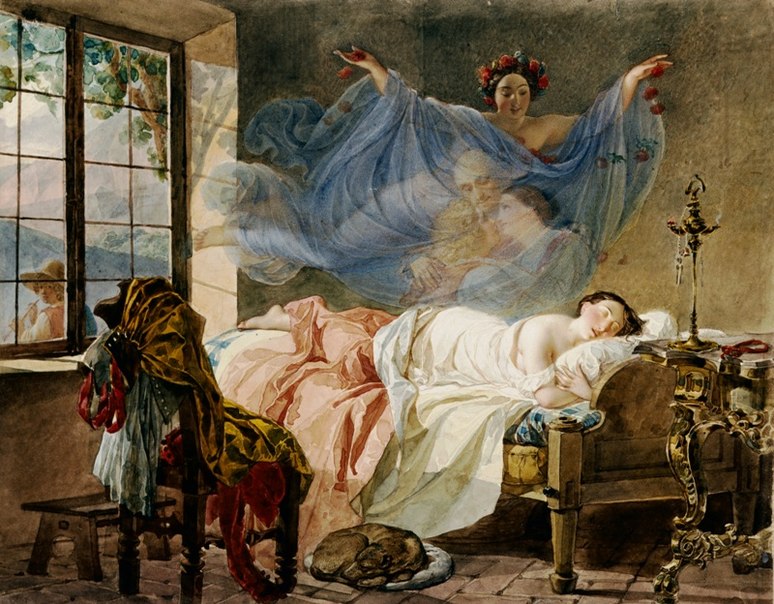
by Roseanna White | Oct 22, 2012 | Word of the Week
|
| A Dream of a Girl Before Sunrise by Karl Briullov, 1830 |
|
|
|
|
|
|
This is a word that I had no idea had anything interesting to it so was very shocked to find such a long entry! And at this point, can’t even remember why I bothered looking it up, LOL.
Dream in the literal sense–a sleeping vision–dates from the 13th century and is related to a number of similar words in other Germanic languages, including a few with a meaning of “merriment or noise,” “illusion, deception, or phantasm,” and from there “ghost, apparition.” Our
dream though, the Old English word carried only the literal meaning and those of
Joy, mirth, and (for some reason…) music.
There were, however, two identically spelled Old English words. The one that meant a literal dream and the one that meant “revelry.” Folks have tried to prove that the modern
dream came from the revelry one instead of the expected one, but to no avail. As it turns out, Old English literature often avoided using the word for the primary purpose to avoid confusion and would use
swefn (sleep) in its place.
Who knew?
But here’s the thing that really surprised me. It wasn’t until 1931 (1931!?) that dream gained the meaning of “ideal of aspiration.” Can you believe that?? I had no clue it was so new. And now so need to rewrite a line of my manuscript…and wonder how many times I’ve used it wrong in other books. Argh! Seriously. Never thought to look this one up. But apparently this modern meaning came from an 1888 sense of “something of dream-like beauty of charm.”
Yeah, definitely one of those words I never thought to question and now will never look at the same again. 😉

by Roseanna White | Oct 18, 2012 | Thoughtful Thursdays, Uncategorized
|
| Par-tay! (Also known as Luncheon of the Boating Party by Renoir, of course) |
Last week in church, in the course of our conversation in class time, one fella said something that struck me as so very true: God doesn’t want to bless us a little–He wants to bless us completely. He doesn’t want to give us some–He wants to give us everything. But we so often can’t accept it. Won’t accept it. Then sit around wondering why we always seem to lack.
Today is my mother-in-law’s birthday, Sunday is my Xoe’s 7th birthday party, Tuesday her actual day. And as I prepare myself for dinners and cake and fondant and present-wrapping, I have to pause and consider the blessing they are to me.
And as one part of my mind considers those dinners and cakes and fondants and presents, there’s that other part of my mind looking at the outline for my work-in-progress and realizing I’m so, so close to the climax. That if I just had a few solid hours, I could get there. Get ‘er done. Wrap it up.
Some days (many days, LOL), those two sides have some friction. They rub against each other, they cause conflict. Some days (most days), I wish I had nice, neat compartments for them. That Family Time would be an uninterrupted chunk, and that Writing Time would have its own. I find myself wishing for something different, and usually when we wish for something different, it takes the tone of wanting more.
But you know what just hit me? This is the more.
When I was a girl, there were two things I wanted above all: to fall head over heels in love with my Prince Charming and have a family with him, and to write novels. I had no intentions of settling for anything else, and in the clarity of a child’s mind, I never even considered that I may have to do so. And I didn’t. I wrote my books, and I found my love. (Not that I can take credit for that part, mind you. That was all God, bringing me and David together so early in life!)
God has given me my heart’s desires. God, in His love for us, always does. But we have to take them. Accept them. Cherish them. Take care of them. We have to work for them.
Here I sit with my awesome, adorable, crazy-wonderful family—but how easy would it be to lose my focus on what a gift they are and instead complain about how much work they bring me? Here I sit with a growing career, a fabulous agent, an amazing editor, a ton of prospects, and an awesome editing calling with WhiteFire too–but how easy would it be to take a prideful misstep and end up back at square one?
Here I sit with it all–but how often do I complain about being overwhelmed? Short on time, short on energy, short on focus? How many times do we have it all and think we need more–yet neglect or misuse or even just plain not-appreciate what we have?
God wants to give us that crazy-big, over-the-top, filled-to-overflowing blessing. He does. He wants us to be complete, to want for nothing, to be blissfully happy. But He wants us to be all that
in Him. He wants us to take
Joy from the things He gives, not complain when He sends manna that He didn’t also send meat.
We often chant about how God won’t give us more (in terms of challenges or burdens) than we can handle. But you know, that goes for blessings too. He won’t give us more than we can appreciate. He won’t give us more than we can accept from His hands with the right attitude.
So as I go through these last couple weeks of my Busy Month and tackle countless projects, as I dash about, miss some sleep, and occasionally whimper that I need a clone, I’m going to have a new motto.
I have Nothing Less.
Nothing Less than what I need. Nothing Less that what I’ve earned. Nothing Less than what I can handle. Nothing Less than what God has given.
I have Nothing Less than everything. I have Nothing Less than the More I always wanted. I have Nothing Less than a reason to smile, laugh, shout, and be over-the-top, crazy-big, filled-to-overflowing happy.
I have Nothing Less than Him.

by Roseanna White | Oct 16, 2012 | Uncategorized
I am pleased as can be to announce that
Jewel of Persia is the pick for an online book club for the month of November! It’s at
Reading to Know, and everyone is welcome to check it out and join in. =)
So to celebrate, my friend Annette (who is responsible for JoP being the November pick–thanks, Annette!) and I decided to offer a joint giveaway and chat about the book. So
here on my blog, I am giving away TWO (2) digital copies of Jewel of Persia. To be entered, just leave a comment below.
To be entered for the one (1) print version being given away, enter on Annette’s blog, This Simple Home.
Got that? Commenting here = entries ONLY for the digitals, and commenting there gets an entry ONLY for the print. You’re welcome to enter for both, but cannot win both, LOL. We will have a total of 3 separate winners; international entries are eligible only for the digitals. All winners will be drawn on Tuesday, October 23. (My little girl’s birthday, as it happens *grins*.)
Okay, technical stuff is complete. =) Now onto the fun!
As my loyal readers undoubtedly know already (all five of you, LOL), I wrote
Jewel of Persia for a few reasons. First, my agent at the time recommended I follow up my first biblical,
A Stray Drop of Blood, with another of the same genre. So as I was contemplating biblical stories I love, I kept coming back to Esther. Esther has always been my absolute favorite Bible story. But let’s face it–it’s been done. And done again. And done some more. And…
I knew that if I was going to write a novel based on Esther, it would have to be different. Very different from what was already out there. So I got to thinking about my way of writing historicals–namely, to have my heroine be fictional, but interacting with historical figures. Why not do the same here? But who else could it be about?
I was in the shower pondering this, thinking back on the Esther story, when a line from a Vacation Bible School skit about Esther that I’d written sprang to mind–about how if she hadn’t gained the favor of the king after her first night with him, she would have gone to the harem as just another wife.
Just . . . another . . . wife. Hmm. That was it! One of the other wives! And so Kasia was born, and her story as Esther’s best friend and Xerxes’ favorite before Esther joined the harem churned its way to life in my brain. Then in a whirlwind two days, I pounded out the first five chapters. And I knew I was in love–but needed to refresh myself on some research.
One of my favorite things about
Jewel of Persia is that it allowed me to join together two awesome things–the book of Esther from the Bible, and one of the Greek histories that I had to read in college but never dreamed I’d put to use afterward,
Histories by Herodotus. Herodotus details the Greco-Persian war as waged by Xerxes, who most scholars agree is same king known as Ahaseurus in the Bible. I wasn’t entirely convinced they were one and the same going in, but as I did my research, it really started to make sense. The timelines clicked together perfectly, and so did the personalities described in both Esther and
Histories. Both kings even had this habit of offering cities to those who pleased him, “up to half my kingdom.” Perfect!
Jewel of Persia is by no means a simple story, nor is it the Esther story you think you know. For any who haven’t read it yet, I’ll warn you of that up front–Esther is an important character, she is a lovable character, she is an upright and inspiring character. But she is not the
main character, and most of the negative reviews I’ve gotten have been from people who didn’t want an Esther story where Esther wasn’t in the spotlight. Which I can respect. But that’s just not what this book is. So be forewarned. 😉
And because JoP has
so much history woven in, I have put together a
Companion Guide to detail where fact ends and fiction begins, delve more into the cultural tidbits, the histories of the factual characters, and as an excuse to post more of the awesome pictures of the cover model in costume. 😉
I was going to list the blog entries where I talk about this stuff too, but it occurs to me that they’re almost identical to the Companion Guide, so I’ll save us all some time. 😉 And instead, share some of the reader feedback that has made many a day for me.
Thank you so much for writing “Jewel of
Persia”! My women’s Bible study group just finished Beth Moore’s study
on Esther and I found your book such a wonderful companion read. The
ties to historical events added even more depth to the Biblical account,
especially as to how events may have lead to Esther’s rise to the
palace – in such a time as this. The ending was true to what we learned
during our in-depth study and I am finding it hard to concentrate on
real life around me now!
Hi Roseanna,
I just wanted to tell you how much your books have blessed me. I
just discovered you as an author and I think these are among the best
books I have ever read! (and I read a lot) I just wish there were more
of them. I read A Stray Drop of Blood and the Jewel of Persia, and now I
am telling all of my friends and family about these books and you as an
author. I cannot wait to go buy your newest book. Thank you so much
for listening to the voice of the Lord as He obviously inspires your
writing. You are a blessing, thank you!!
Greetings Roseanna!! I just finished
reading A Stray Drop of Blood and I have to tell you that I loved it so
much that I was sad when it was over! I so enjoyed being transported
back in time for that wonderful story. It almost felt as if the
characters were a part of my life for the 3 days it took me to read it! I
am now halfway through Jewel of Persia and completely loving it as
well!! Blessings to you and your God-given talent for writing. I told
all of my friends about your extraordinary fiction! PLEASE WRITE MORE
BOOKS!!!
So remember, leave a comment HERE to be entered to win a digital, at
This Simple Home to be entered to win a print, and check out
Reading to Know in November to join in the discussion!
Void where prohibited. Entry into the contest is considered
verification of eligibility based on your local laws. Chance of winning
depends on number of entries. Contest ends 10/23/12. Winner will have one
week to claim prize.
_-_Worcester_Art_Museum_-_IMG_7700.JPG/800px-Christ_Healing_the_Sick,_1813,_by_Washington_Allston_(1779-1843)_-_Worcester_Art_Museum_-_IMG_7700.JPG)
by Roseanna White | Oct 15, 2012 | Word of the Week
|
| Christ Healing the Sick by Washington Allston, 1813 |
Oh yeah, going for controversy this week. 😉
So here’s the deal. I’ve heard from quite a few sources that we moderns are misusing the word nauseous. That it ought not mean “to feel sick or queasy” but that it rather means “to cause a feeling of nausea.”
Now, I’ve heard this from sources I trust, but they never quote their sources, and I’m now on a quest to figure out why in the world this is touted as grammatical fact and, more, as a “modern mistake” when every dictionary I look it up in says that nauseous has carried both means (“to feel sick” and “to make sick”) since 1600-1610.
One dictionary I found says “careful writers will use nauseated for the feeling of queasiness and reserve nauseous for “sickening to contemplate.” I’m okay with being careful, really I am, but I’m still unsure why grammarians are saying that using its original meaning is “a mistake of the moderns.” It is, in fact, the first definition of the word in the OED.
So. Calling all grammarians! 😉 If you learned it this way and could point me to a source (not just an expert like the wonderful Grammar Girl, mind you) that states this as fact (maybe CMS has settled the question at some point??), I would be very grateful. I don’t mind changing my ways to be a “careful” writer–but I’m a Johnnie. I don’t ever accept an expert’s opinion without checking out their sources. 😉



_-_Worcester_Art_Museum_-_IMG_7700.JPG/800px-Christ_Healing_the_Sick,_1813,_by_Washington_Allston_(1779-1843)_-_Worcester_Art_Museum_-_IMG_7700.JPG)
 Roseanna M. White is a bestselling, Christy Award winning author who has long claimed that words are the air she breathes. When not writing fiction, she’s homeschooling her two kids, editing, designing book covers, and pretending her house will clean itself. Roseanna is the author of a slew of historical novels that span several continents and thousands of years. Spies and war and mayhem always seem to find their way into her books…to offset her real life, which is blessedly ordinary.
verification of eligibility based on your local laws. Chance of winning
depends on number of entries. Contest ends 10/23/12. Winner will have one
week to claim prize.