by Roseanna White | Nov 15, 2012 | Thoughtful Thursdays, Uncategorized
|
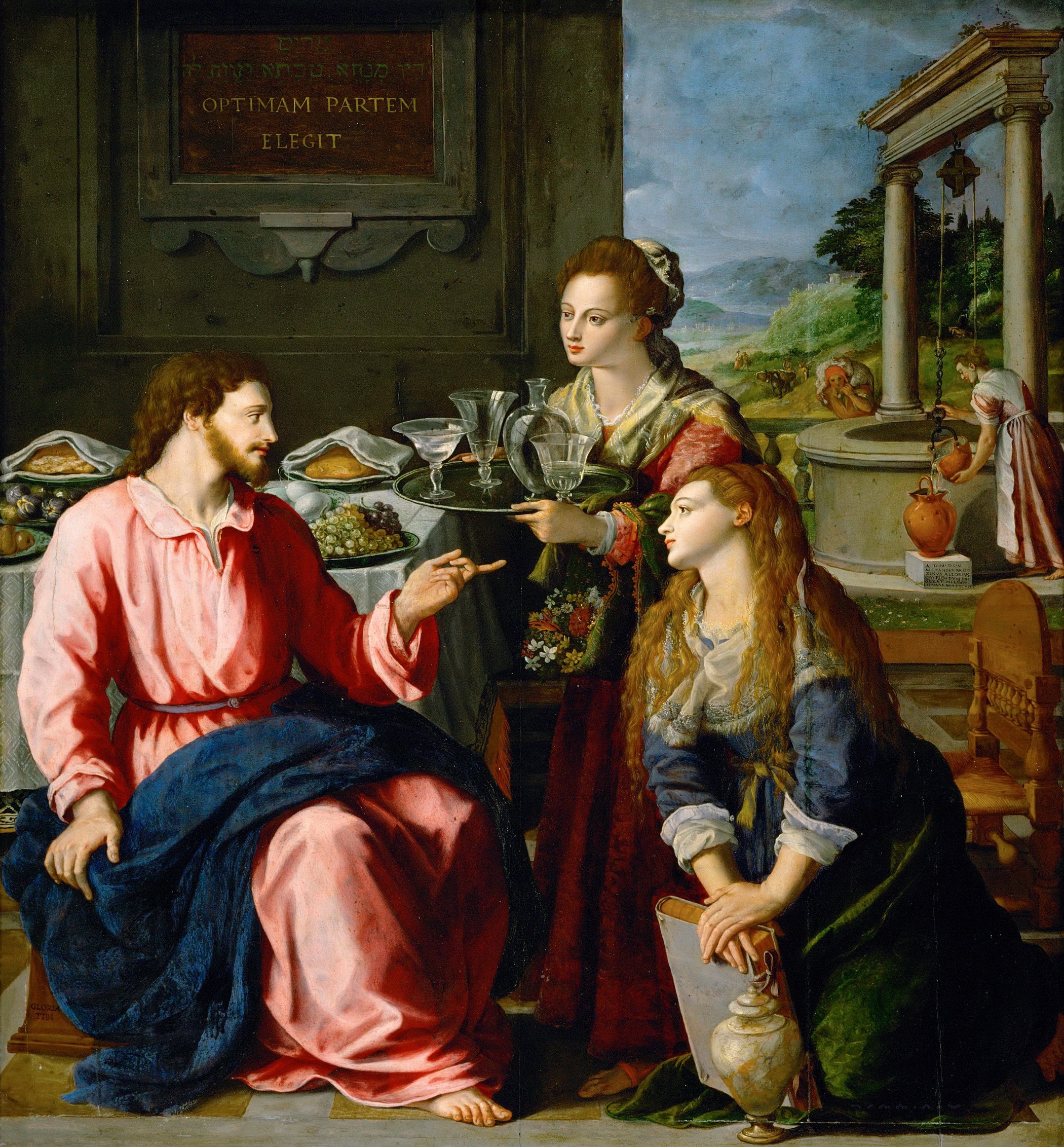
| Christus bei Maria und Martha by Allessandro Allori, 1605 |
What’s your calling?
A few simple words, but a whole world of meaning, isn’t it? To what has the Lord called you? It doesn’t have to be something grand. He could have called you to accounting. To farming. He could have called you to raising kids. Maybe He called you clean your church once a week. It doesn’t have to some awesome-sounding ministry, but I feel strongly that we all have something the Lord has called us to.
Mine’s easy–I’ve known I was called to write pretty much all my life. So . . . then what? What do I do with that knowledge? Well, I write. In my case, I write books and I blog. But what kind of books? What kind of blogs?
My husband and I were talking about callings last night, and in the course of our discussion it occurred to me that having a calling you recognize doesn’t mean you do it as you should. I could be writing books that are simple and easy. I could be churning out stories that fit what I was told years ago were marketable. I could be writing stories that make no attempt to glorify the Lord. I could be writing only what I want instead of what I should be.
In a few months, I’m going to doing a blog series that ties in with
Ring of Secrets on ordinary heroes. See, that was what set the Culper Ring apart–they were just everyday people serving where they had been called. In their store, on their farm, in the military. But they were serving there with a heart open to what the Lord might ask of them. And so these folks ended up taking risks that could have gotten them lynched–not by dropping everything and running off to some big task, but by serving where they’d been placed.
So how do we translate that to today? How do we, now, serve where we’ve been placed in a way that can make a difference? Not a rhetorical question here–it’s one I’m going to be thinking a lot about over the next few months.
And I want to start with gathering some answers to that first question. What’s your calling? In its most simple form, what has the Lord asked you to do? Please share!

by Roseanna White | Nov 14, 2012 | Ancient World, Remember When Wednesdays
I’ve always been intrigued by Egyptology, so including Egypt in my new biblical idea I’m toying with is a lot of fun. Of course, trying to pinpoint an exact year to set this thing in is more complicated than it sounds. I want my characters to interact with Abram and Sarai, but scholars can’t agree on when, exactly they lived. There’s quite a range of possible years given, as much as a thousand years apart depending on which school you belong to.
Picking one randomly didn’t seem fun, so I instead decided to pick my date based on the history of the pharaohs. And when I was reminded of the missing pharaoh, I decided that would be oh-so-much-fun to explore!
 |
| Mentuhotep III, father of the missing pharaoh |
See, in the Middle Kingdom, there’s this seven year stretch when records of the pharaoh have been obliterated, giving rise to the idea that he was assassinated, overthrown, and his predecessor had his records removed to make himself more legitimate. Archaeologists did eventually find mention of a Mentuhotep IV that seems to fit in that seven-year period…especially when they realized that his vizier (second in command) had a name only one vowel off from the next pharaoh. Obviously, the theory is that the vizier overthrew his pharaoh, seized the crown, and so began the twelfth dynasty.
I love this! Not just because of the intrigue, but because that lack of record gives me freedom to create this pharaoh however I please. =) The other theory (about the change of dynasty) is that Mentuhotep just died without heirs, but I don’t know why he would have been erased from the records in that case…so I decided he has daughters. That’ll work. And a sister. A sister named Aziza…
And working from this theory also gives me a great character in the vizier, Amenemhet. (I’m calling him Nem. I can only go so far with this unpronouncable-to-English-speaker names, LOL.) What kind of guy would be a king’s dedicated right hand, only to kill him and take his crown after seven years? The same kind I need for my story, mwa ha ha ha. And of course, I always explain the motivation through my totally-fictional characters.
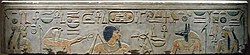 |
| Relief of Amenemhet from his mortuary temple |
This is going to be fun! Disappearing kings, usurping viziers, undiscovered history…oh yeah. Just my speed.
by Roseanna White | Nov 12, 2012 | Word of the Week
|
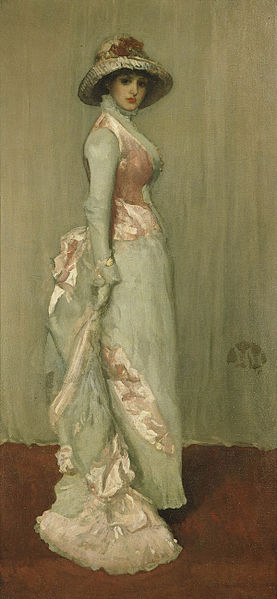
Whistler’s Harmony of Pink and Gray – 1881
Yes, I chose it because of the year and its prettiness,
not because of any other relevance. 😉 |
|
I know, right? You’re thinking “Her word of the week is what? Seriously? This chick is losing it…” 😉 But hopefully you’ll read on to see what in the world inspired me to write about what, LOL.
Last week as I was editing an upcoming WhiteFire title, I read a line where one of the characters says “What’s up?” The year is 1921, the phrase sounds modern to me, so I thought I had better look it up (even though I trust this author implicitly, things slip by us all, right?) So I tapped what into the etymology dictionary and found quite a few idioms that were older than I’d thought!
The word as a question, as a “What did you say?” dates all the way back to 1300. That doesn’t really surprise me. But I was quite surprised to see that “what’s-his-name” dates from 1690! I would have thought that a more modern phrase, personally. (The variant “what’s-his-face,” though, is from the 1960s, LOL.)
The phrase “what for,” as in “give him the what-for” is from 1873, which apparently, interestingly, came about as a smart reply to people asking the question “What for?”
And finally, the one I was looking up. “What’s up?” made its debut right around 1881. Which did surprise me a bit, I confess. It didn’t give me any idea where it came from (like that handy explanation of the what-for…) but it’s always so much fun to discover a use is older than I anticipated!
I hope everyone has a lovely week!

by Roseanna White | Nov 8, 2012 | Thoughtful Thursdays, Uncategorized
|
| Ironing Women by Ivana Kobilca |
It’s so easy to point fingers, isn’t it? From something as small as “Look what you made me do!” to the bigger “Don’t blame me–I voted for the other guy.”
This is a problem I’ve recognized in myself for years–not so much in politics, LOL, but in little things. It’s not my fault for neglecting things, it’s the fault of whoever distracted me. It’s not my fault we didn’t have that conversation, I tried but you put me off. It’s not my fault this venture isn’t growing; I’m doing my part, now you need to pick up the slack.
It’s so, so easy to fall into this trap. And something I’ve been thinking about again after reading a really aggravating kids book. I picked it up at the Library expecting it to be whimsical and fun, since it had a cute little picture of dragons on the cover. But it wasn’t–it was an environmentalist sermon that basically told kids, “Do you know any dragons who are destroying our world by not recycling? Sic ’em!”
Yeah, um–not what I’m trying to teach my little ones, thank you very much. I want to teach them to be responsible, but not to play the blame game. Not to point fingers. I have a hard enough time convincing them not to blame each other for every little thing, I don’t need picture books telling them it’s okay to do that so long as you slap a cute picture on it first.
And of course, elections bring it up too. It seems like so often the two sides of the aisle do nothing but blame the other for what they see as the woes we’re facing. They get angry, they get upset, and they can’t (or perhaps don’t try?) to understand that opposite point of view. The result? A nation divided.
It makes me so sad. I hate when I see this tendency in myself, I try so very hard to teach my kids not to fall into that same destructive way of thinking, because let’s face it–all that ever does is destroy relationships and keep your focus, always, on yourself. As long as it’s someone else’s fault, then I don’t have to fix anything.
But that approach doesn’t work. It doesn’t work in our nation, in our states, in our communities, in our churches, in our families, or in our marriages. It does–not–work. We cannot ever think “If only I could change him/her/them…” No. We can only change ourselves. And until everyone sees that they need to change themselves, until we all take responsibility for our own actions and lack of actions, then this disease is going to keep on spreading.
We have to stop thinking “If only they would…” and start praying “Lord, help me to…” We have to stand up. We have to then fall to our knees. And we have to start changing from the inside (ourselves) out.

by Roseanna White | Nov 7, 2012 | Remember When Wednesdays, Uncategorized
I’ve got a little cushion of time before I need to start work in earnest on my third Culper Ring book–and need to take another week or so before diving into edits on Whispers from the Shadows–so I thought I’d enjoy using my writing time to revisit the biblical world. =)
Though neither Jewel of Persia nor A Stray Drop of Blood are exactly new anymore, I still get a lot of reader feedback about them, and I’ve heard quite a few times that my readers are waiting for another biblical fiction from me. Well, I’ve got some ideas!
Of the four or five jotted down in my Ideas folder, I decided to dedicate some time to the one most fully developed in my little ol’ brain. Want a sneak peek? Eh? What was that? Well, okay then. A quick look at what I’m playing with. 😉
The idea started, as my bib-fic ideas often do, with a sermon my dad preached. Actually, in this case, with two. He did a sermon on Melchizedek which I found oh-so-interesting, but it didn’t make any ideas really pop in terms of story. But then a couple weeks later he preached on one of Jesus’s parables. And that got the juices rolling. What if, I thought, the story were true? What if it were set in Old Testament days? What if (a light goes off) it were in the times of Melchizedek? Oo! Oo! Oo!
And LOL–I’ve never written anything that takes place quite that early in the Old Testament, and let me just tell you, I’m already learning, only 10 pages in, that it’s a whole different world than Persia or Jerusalem of Jesus’s day. Oh, the research I have to do! But I’m having fun. And my hubby is rubbing his hands together at the thought of another biblical for WhiteFire someday. 😉
I’m still debating titles and would love some feedback! My heroine, Aziza, is Egyptian, from the house of Pharaoh. My hero is the son of Melchizedek, who most OT scholars believe to be Shem, son of Noah (which is so interesting in and of itself!). And thus far (again, only 10 pages in here), I can tell you that a song is very important to the story–it seems Aziza hears a mysterious melody half the time, calling her away from Egypt. Symbolic, of course, of the Lord calling her. So. My title ideas thus far.
Leading the votes…
The Song of Midnight
Midnight Song
I really like these, but WhiteFire will have Veiled at Midnight by Christine Lindsay in the next year or so, so I want to have some other options in case they end up sounding too similar. So…

The Princess of Salem (bleh)
The Pharaoh’s Sister
Daughter of Egypt
Egypt’s Daughter
Song of the Night
Song of the Sands
Song of the Stars
Any other brilliance? Well, to inspire you, I’ll share the cover I created to inspire me. 😉 Whenever I finish this baby, she shall look like so. Well, the title will obviously read whatever I decide. But you know. The design will be this, LOL. Isn’t it fun? I had a blast going all Ancient Egypt on it. 😉



 Roseanna M. White is a bestselling, Christy Award winning author who has long claimed that words are the air she breathes. When not writing fiction, she’s homeschooling her two kids, editing, designing book covers, and pretending her house will clean itself. Roseanna is the author of a slew of historical novels that span several continents and thousands of years. Spies and war and mayhem always seem to find their way into her books…to offset her real life, which is blessedly ordinary.